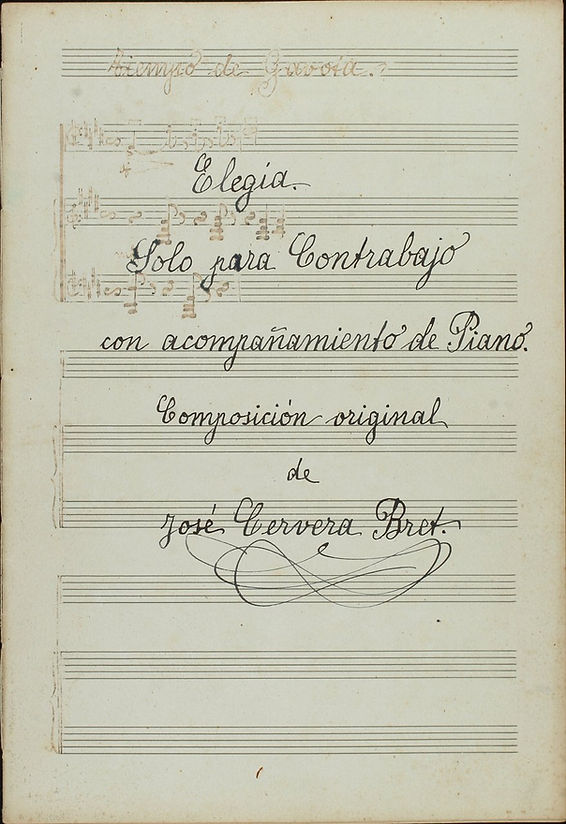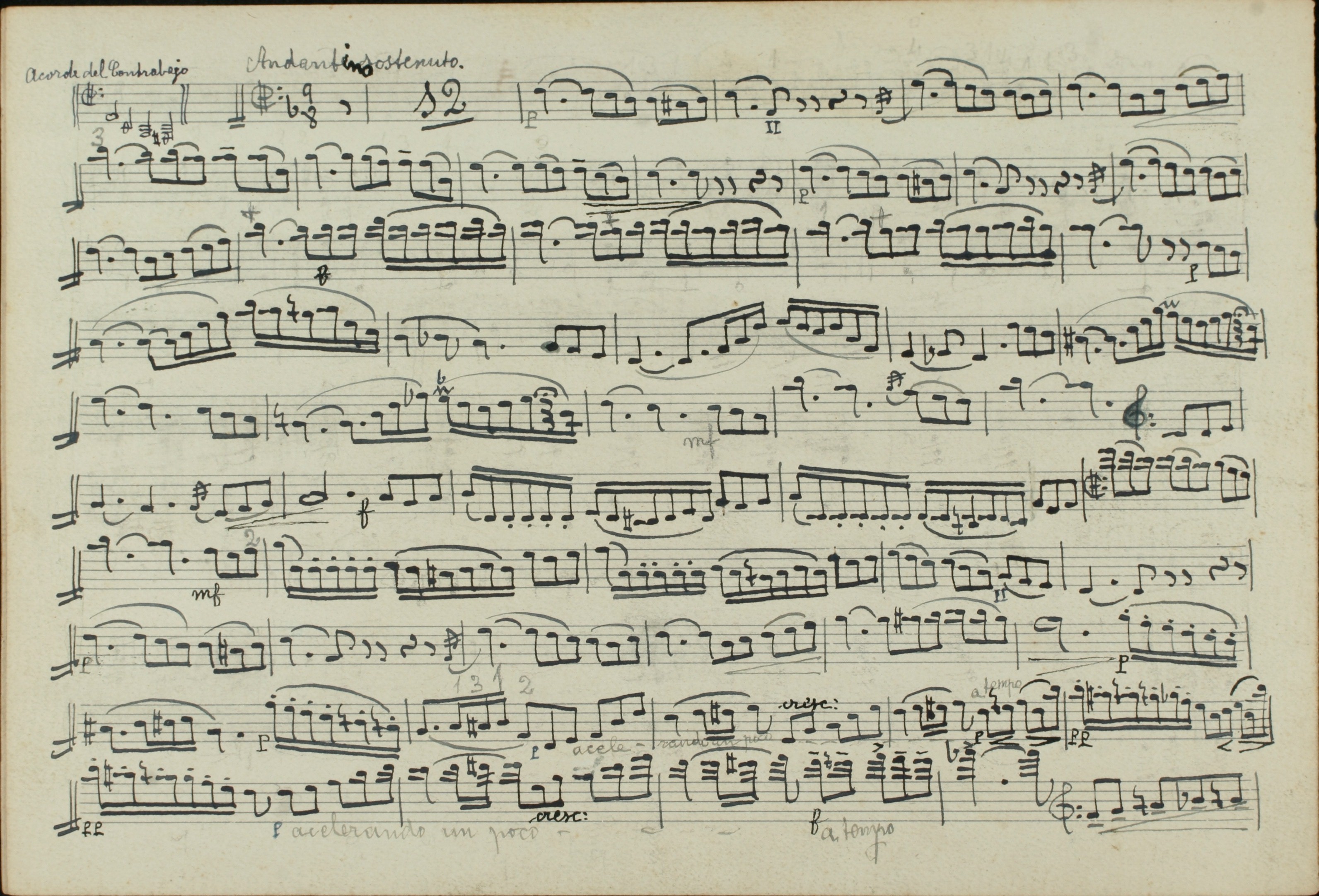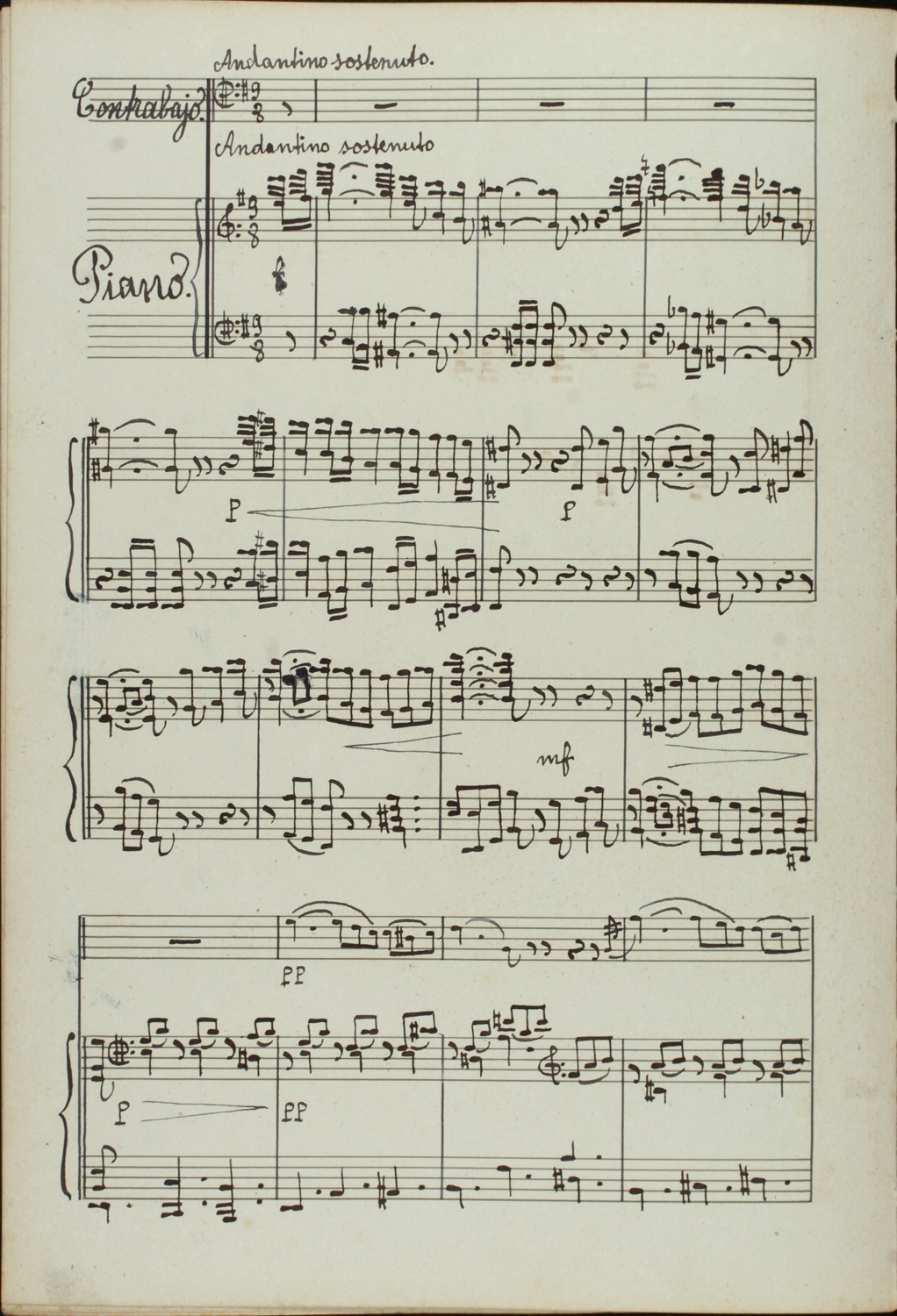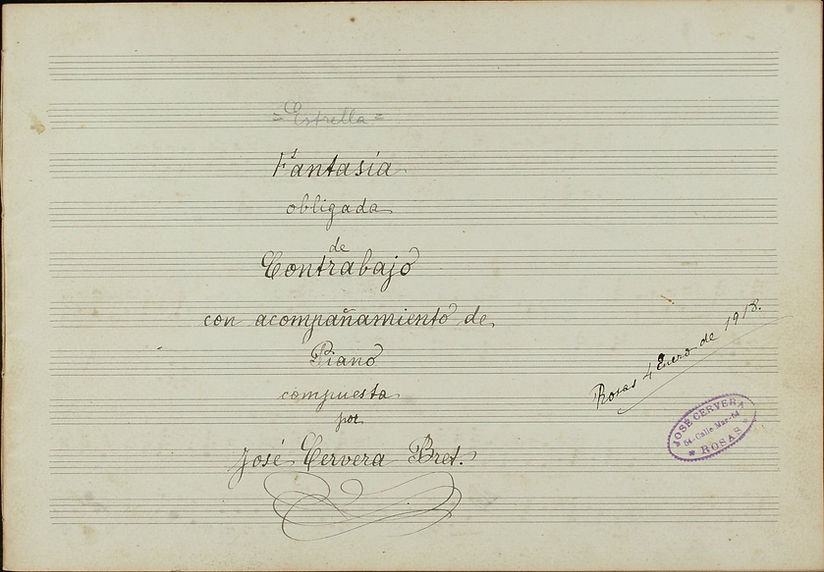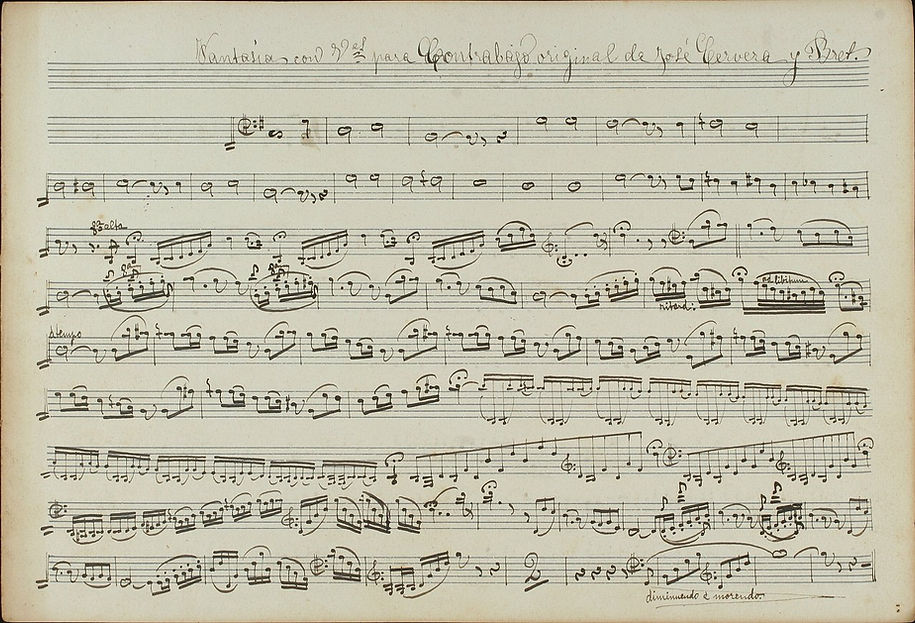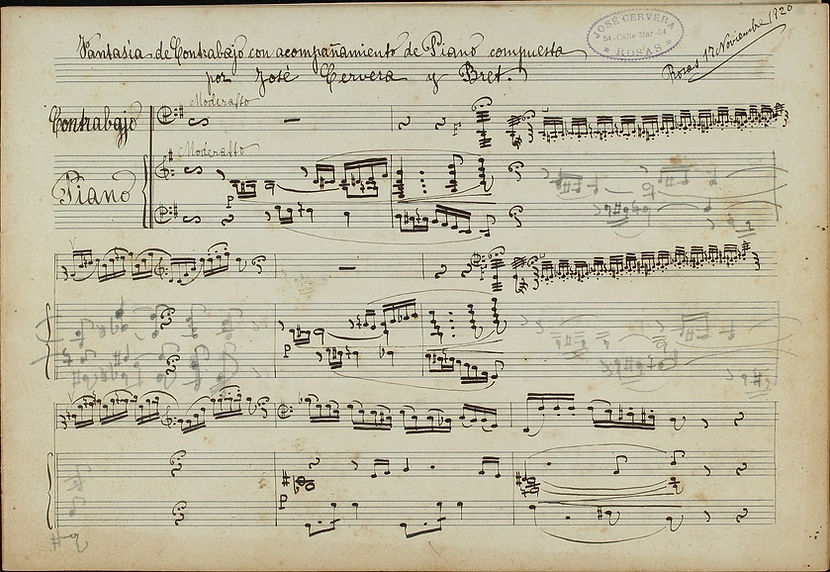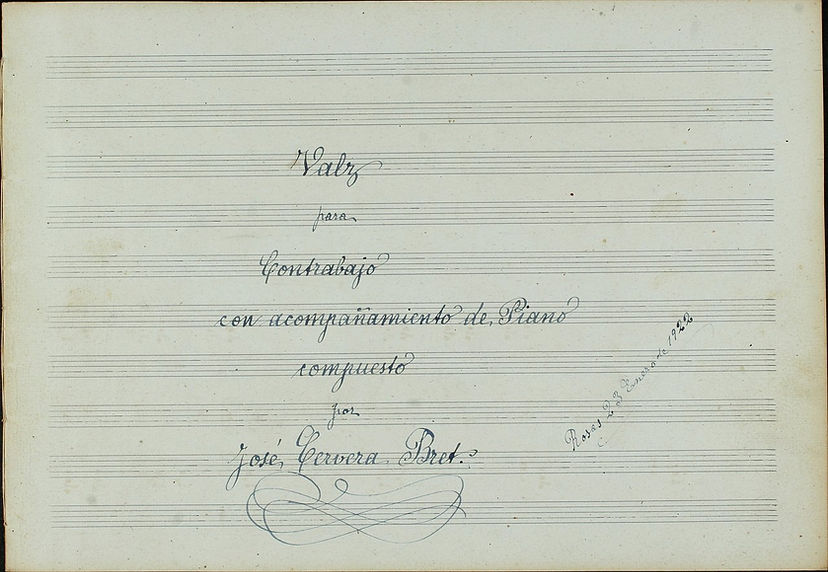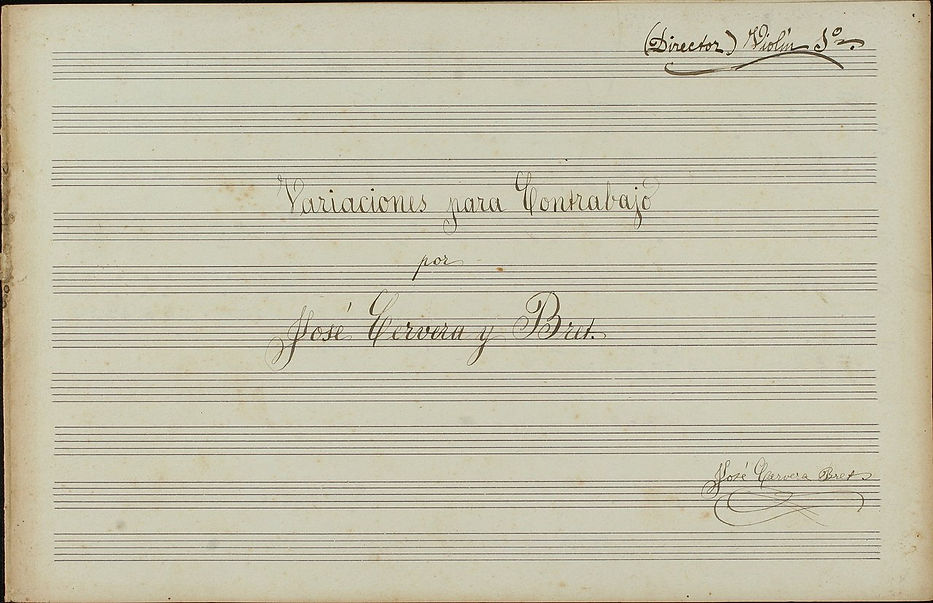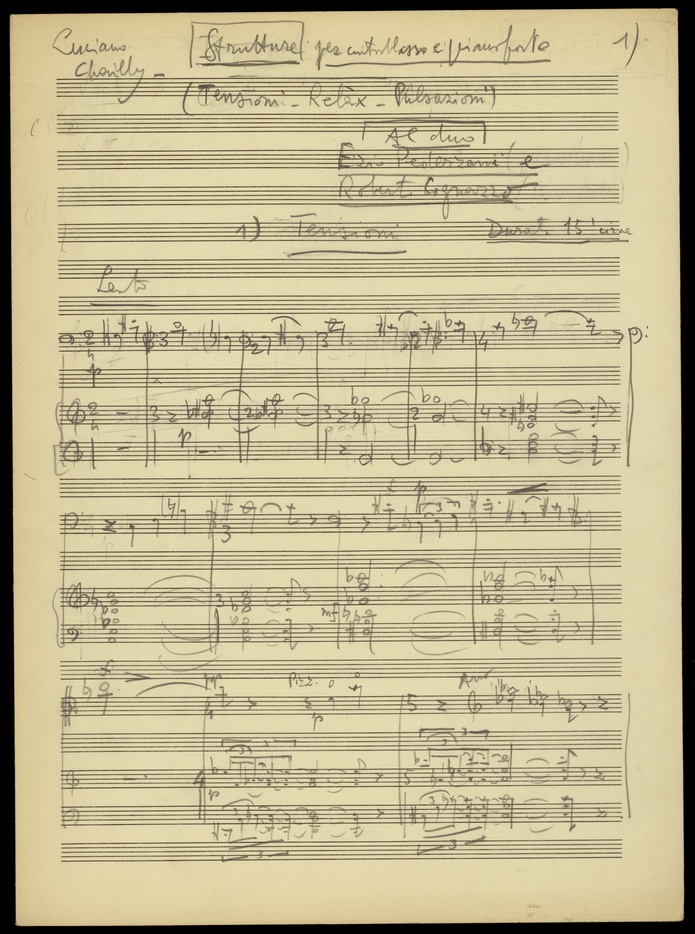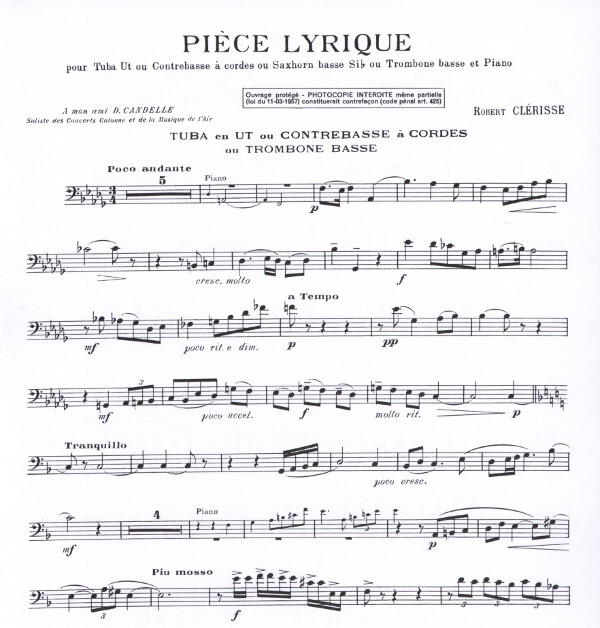
Welcome to the Solo Bass with Piano repertoire catalog, an online bibliography designed to present all original solo bass compositions with accompaniment of piano, organ, harpsichord, or any other keyboard instrument. Presented are all compositions with piano accompaniment of which some information could be gathered, whether composed originally for piano accompaniment, or composed initially for ensemble and later offered in piano reduction.
The catalog is organized alphabetically by the last name of composer and follows a custom design described in the Record Format and Record Format Map sections. The entry format itself was designed with goal to offer basic information on the author and the composition, and yet also afford the presentation of any other free data and media of relevance to cited works. Thus you will find here also links to manuscript data, free scores and along the Reference Recording online streams. The cataloging standards and procedures applied in this registry are all explained in the Classification Criteria & Organization section.
This catalog is designed to expand in stages by following the alphabet sequence.
–
–
A
–
Aarne, Els (1917-1995)
- A Tale, Op. 43 (1963)
- Humoresque ( )
- Sonata for Double Bass and Piano, Op. 63 (1976)
–
–
Aavik, Juhan (1884-1982)
- Double Bass Concerto, Op. 111 (1950)
Manuscript Data – Estonian MIC Record
Modern Day Premiere Report – Ajakirimuusika.ee
(In Estonian, use browser function “Translate to English” to read in English)
Notes: Dedicated to Ludwig Juht. Written for Double Bass and Piano. Unknown if an orchestra version exists.
–
- Fantasy-Paraphrase (1947)
In Estonian: Fantaasia-parafraas
Note: Dedicated to Ludwig Juht
–
–
Abbott, Alain (1938)
- Fusions pour Contrebasse et Piano (1974)
–
–
Aberdam, Eliane (1964)
- “Otohime” Concerto for Double Bass and Orchestra (2017)
Abert, Johann Joseph (1832-1915)
The complete double bass opus of J. J. Abert will need additional research in order to be fully systematized. Some of the listed pieces may represent later arrangements by Abert himslef, or possibly arrangements by other musicians. In addition, some of the pieces may feature separate movements from Abert’s own compositions. For the full listing of Abert’s bass opus please see Abert, Johann Joseph (1832-1915) – Solo with Ensemble listing.
–
- Concert in Drei Sätzen (1851)
Note: This concerto was apparently written by Abert originally with piano accompaniment, and orchestrated later in 20th century.
Reference Recording:
1. Maestoso – YouTube [ Thomas Lom ] (with orchestra)
2. Adagio – YouTube [ Thomas Lom ] (with orchestra)
3. Allegretto – YouTube [ Thomas Lom ] (with orchestra)
–
- Concertino Nr. 1 für Contrabasso und Pianoforte, Op. Posth. (1848)
Note: This Concertino exist in variants with both the ensemble accompaniment, and the piano reduction. This piece should be in F major.
–
- Concertino Nr. 2 für Contrabasso und Pianoforte, Op. Postuma. ( )
Note: At the present it is not clear when this Concertino Nr. 2 may have been written. Likewise, it is not clear whether either the orchestra score or the instrument parts are preserved.
–
- Divertissement für Kontrabass mit Klavierbegleitung ( )
Note: At this point it is not clear whether this Divertissement was written by Josef Hrabe or Joseph Abert. It is also possible that both authors may have contributed to the creation of this piece. Further inquiry is needed.
–
- Variationen und Rondo (C Dur) für Kontrabass und Orchester, Op. 1 (1849/1865)
Note: This composition was likely written when Abert was only 19 years old and it appears to be the first composition he wrote. This composition exists today in both piano reduction and orchestra score. Moreover, these Variations may be the same composition as Variationen für Kontrabass und Streichorchester (1865) that are mentioned in Solo with Ensemble listing.
Reference Recording:
1. Andantino – YouTube [ Renger Woelderink ] (with string orchestra)
2. Thema – Variations 1-3 – YouTube [ Renger Woelderink ] (with string orchestra)
3. Rondo: Allegro – YouTube [ Renger Woelderink ] (with string orchestra)
–
–
Ábrányi, Emil (1882-1970)
- Capricci Ungherese (1956)
Reference Recording:
Allegretto Scherzando – YouTube [ Ferenc Csontos ]
Note: The dating of this piece is based on the earliest edition. The actual date of composition may predate the edition.
–
–
Adair, James (1909-1999)
- String Bass Sonata with Piano, Op. 70 ( )
–
–
Adamis, Michael (1929-2013)
- Three Pieces for Double Bass and Piano (1962)
Title in Greek: Τρία κομμάτια, για κοντραμπάσο και πιάνο (1962)
–
–
Adams, Leslie (1932-2024)
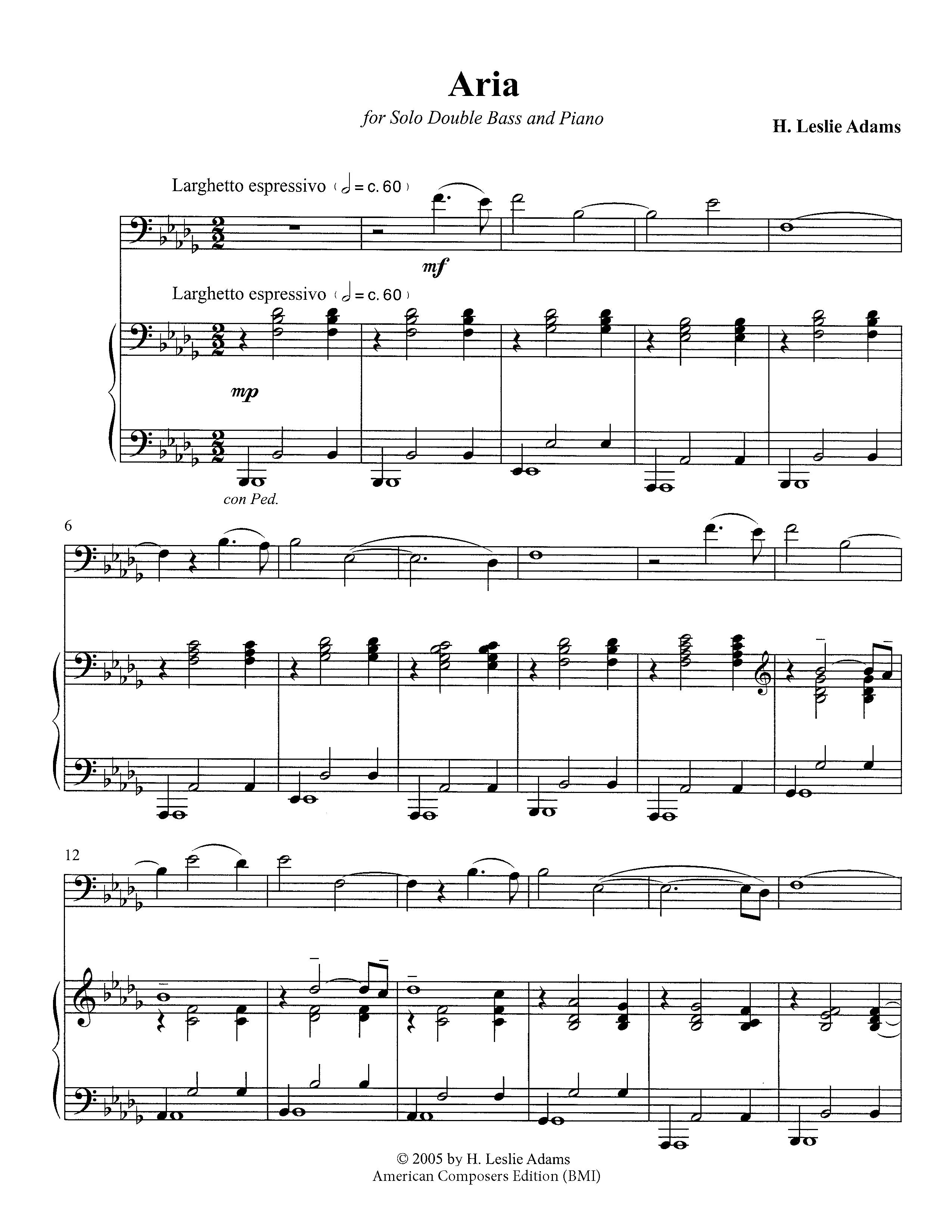
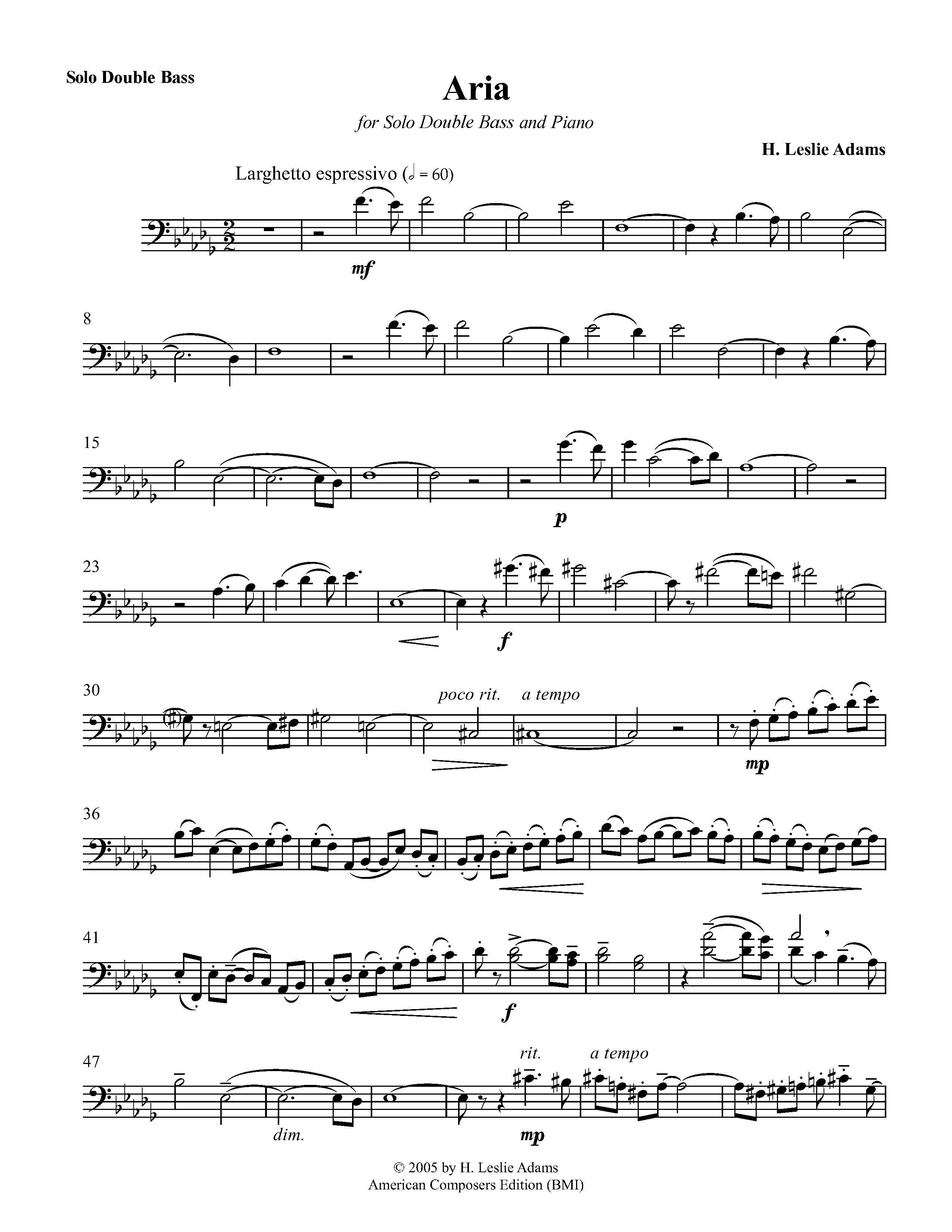
- Aria for Solo Double Bass and Piano (2005)
Note: This composition was initially conceived for both solo violoncello and solo double bass.
Score Sample – ACA (piano score)
Score Sample – ACA (solo bass)
Reference Recording – YouTube [ Joanna Frank ] (violoncello performance)
–
–
Adkins, Gregory Eugene ( )
- “The Longing” Concerto for Bass & Piano, Op.1 ( )
Note: Located in Gary Karr Library.
–
–
Agoshian, Ardashes (1977)
- 4 Mineatures for Double Bass and Piano, Op. 12 (2006)
- “Baracuda” for Double Bass and Piano, Op. 22 (2007)
- “Ephesus” for Double Bass and Piano, Op. 23 (2007)
–
–
Ahrens, Friedrich (1813–1881)
- Divertissement für Contrabaß (1852) [ Lost ]
Note: Assumed with piano accompaniment, possible with orchestra as well. Further inquiry needed.
–
–
Albright, Valerie Ann (1959)
- Esquisitango (1993)
–
–
Albright, William (1944-1998)
- Canon in D (Berimbau!) for Double Bass and Harpsichord (or Piano) (1984)
Note: Comissioned by Gary Karr.
–
–
Aleksandrov, Anatolii Nikolaevich (1888-1982)
- Aria dlia Kontrabasa i Fortepiano, Op. 32 (1965)
[ Aria for Double Bass and Piano ]
Reference Recording – YouTube [ D. V. Šamraenko] (with piano)
Reference Recording – YouTube [ Roman Muhametdinov ] (with orchestra)
Reference Recording – YouTube [ unknown ] (with orchestra, data unknown, slightly different version then above)
–
- Ditirambicheskaia Kantsona: Dlia Kontrabasa i Fortepiano, Op. 84 (1959)
[ Dithyrambic Canzona for Double Bass and Piano ]
Reference Recording – YouTube [ Rodion Azarkhin ] (score on screen, short biography)
Reference Recording – YouTube [ Rodion Azarkhin ]
Reference Recording – YouTube [ Knut Erik Sundquist ]
–
–
Alexander, John (1942)
- All the Birds (2015)
- Blues with Orange (2013)
- Haiku Journey (2009)
- Io (2000)
- Khroma Zones (2001)
Featured Pieces:
Yellow duster
Rhode Island red
A flutter on the grey
Comfy green settee
Floral blue frock
Pinks with African violets
Black cherry
–
- Narration Street (2015)
Composition Info – FB Hayes Post
Reference Recording – YouTube [ Thierry Barbé ]
–
- Portfolio : Five Miniature Works of Art (2003)
Featured Pieces:
Self portrait (after Francis Bacon)
Landscape (after Joan Miro)
Interior (after Edouard Vuillard)
Still life (after Giorgio Morandi)
Seascape (after Georges Braque)
–
- Setting Out : Seven Miniature Pieces (2020)
- Sonata in Three Movements (2016)
Notes: Written in memory of Edmund Rubbra. Dedicated to David Heyes (movement 1), Thierry Barbe, Dan Styffe (movement 2), Marco Anthony Quinones and Patricia Miravete (movement 3).
–
–
Alexander, Josef (1907-1992)
- Elegy and Epilogue for Double Bass and Piano ( )
Manuscript Data – Juilliard Record
–
–
Almila, Atso (1953)
- Konsertto Kontrabassolle ja Orkesterille, Op. 20 (1979)
[ Concerto for Double Bass and Orchestra ]
–
–
Alpert, Trigger (1916-2013)
- Trigger Fantasy (1943)
Publisher’s Advertisement Leaflet – Trigger Fantasy (solo bass line) – FB Link
Score Sample – ABP Repository
Reference Recording – Video [ Michael Wolf ]
Reference Recording – IArchive Audio [ Alpert Trigger jazz solo ]
–
–
Alt, Bernhard (1903-1945)
- Adagio und Scherzo (1933)
Note: Dedicated to H. Menzel.
–
- Canzonetta (1934)
Note: Dedicated to Linus Wilhelm.
–
- Double Bass Concerto ( )
Note: The source page does not offer much data, so it is not clear whether the concerto exists only in orchestral score manuscript, or may have been produced in piano reduction as well. Scomposers-c-m – Source Page
–
–
Altena, Maarten (1943)
- Lijn (1986)
Score Sample – Donemus
–
–
Alton, Ed ( )
- Canzone (1980)
Note: Located in Gary Karr Collection.
–
–
Åm, Magnar (1952)
- På glytt : Konsert for Kontrabass og Orkester (1981)
[ On the Move : Concerto for Double Bass and Orchestra ]
Title in English: Ajar : Concerto for Double Bass and Orchestra
–
–
Amato, Salvador (1928-1994)
- Carnavalito (1985)
- Fantasía Rapsódica Concertante ( )
Reference Recroding – YouTube [ Milton Masciardi ]
–
- Habanera (1973)
Reference Recording – YouTube [ Omar Arancibia ]
–
- Malambo (1978)
- Sonatina (1975)
- Vals Romantico de Anna ( )
- Variationes Rapsódicas ( )
–
–
Amellér, André (1912-1990)
- 4 Concertinos de Charles Labro, Op. 174 à 177 (1968)
Note: It appears that these Concertions may represent arrangements or adaptations of Labro’s works, or may have been composed à la Labro, so to say in the style of Labro. These concertinos are however listed under Ameller Opus numbers and that should imply Ameller’s authoriship.
Note: This collection features the following four concertinos:
Op. 174 : G major and D minor
Op. 175 : D minor and D major
Op. 176 : G major
Op. 177 : E minor
–
- 5 Petites Pièces, Op. 325 à 329 (1982)
Featured Pieces:
Fantique, Op. 325
Adacyl, Op. 326
Agumy, Op. 327
Modération, Op. 328
Expression, Op. 329
Score Sample – Ameller.org [ Fantique ]
–
- Arioso, Op. 213 (1974)
Score Sample – Ameller.org
–
- Cantabile e Leggero, Op. 164 (1966)
Score Sample – Ameller.org [ Cantabile ]
–
- Concertino, Op. 64 bis (1952)
Note: For Double Bass and Piano. Originally for Double Bass and Orchestra.
Score Sample – Ameller.org [ orchestra score ]
–
- Concerto pour Contrebasse, Op. 365 (1985)
Note: For Double Bass and Piano. Unpublished in Manuscript.
–
- Deux Pièces Brèves, Op. 305-306 (1982)
Featured Pieces:
Chant Elégiaque
Allégresse
Score Sample – Ameller.org [ Chant Elégiaque ]
Note: For Double Bass and Piano or Violoncello and Piano.
–
- Eglogue, Op. 370 (1986)
Score Sample – Ameller.org
–
- Fantaisie, Op. 1 ( )
Note: Unfinshed work for Double Bass and Piano. Manuscript.
–
- Kelapa, Op. 272 (1981)
Score Sample – Ameller.org
–
- Koala, Op. 210 (1973)
Score Sample – Ameller.org
–
- Kontrabassolo, Op. 178 bis (1968)
Note: Version for Double Bass and Piano. Originally for Solo Bass and Wind Orchestra.
–
- Krusavé, Op. 123 (1959)
–
- Lebel-Quevillon (Série Belle Province) Op. 185 (1971)
Score Sample – Ameller.org
–
- Petite Peine, Op. 322 (1982)
Score Sample – Ameller.org
–
- Pièce Elégiaque, Op. 197 (1972)
Score Sample – Ameller.org
–
- Première Sonate Pour Contrebasse et Piano, Op. 39 (1948)
Note: Also cited as 1ère Sonate.
–
- Rustique, Op. 345 (1983)
Score Sample – Ameller.org
–
- Scherzandino et Adagietto, Op. 379 (1986)
Score Sample – Ameller.org
–
- Six Pièces Faciles, Op. 159 (1965)
Score Sample – Ameller.org
–
- (Six) Pièces pour Trois Degrés de Contrebasse, Op. 235 (1976)
Note: This collection presents the following six pieces:
Prélude
Energico
Elégie
Scherzando
Adagio
Danse
–
- Treize Courtes Pièces pour Différents Degrés, Op. 309 à 321 (1986)
Note: This collection features the following thirteen pieces:
Barabas, Op. 309
Zougue, Op. 310
Kurtz, Op. 311
Kanta, Op. 312
Badinage, Op. 313
Lied, Op. 314
Arnicole, Op. 315
Yhrazim, Op. 316
Espressivo Assai Lento, Op. 317
Sifassy, Op. 318
Contraste, Op. 319
Scherzando, Op. 320
Satanique, Op. 321
–
- Trois Novelettes, Op. 220 (1975)
Score Sample – Ameller.org
–
- Wymsol et Ypers, Op. 323 and 324 (1982)
–
–
Ames, William (1901-1987)
- Sonatina for Double Bass and Piano (1969)
–
–
Amici, Vincenzo ( 19th c. )
- Fantasie per Contrabbasso Obligate e Orchestra ( )
–
–
Ammon, Ludwig G. ( 20th c. )
- Vortragsstück für Kontrabass und Klavier e-Moll ( )
–
–
Andersen, Arthur Olaf (1880-1958)
- Sonatina for String Bass and Piano (1942)
Online View & Download – Download Link
–
–
Anderson, Beth (1950)
- Ghent Swale for Double Bass and Piano (1999)
–
–
Anderson, David (1962)
- Concerto for Double Bass, Strings and Harp (1996)
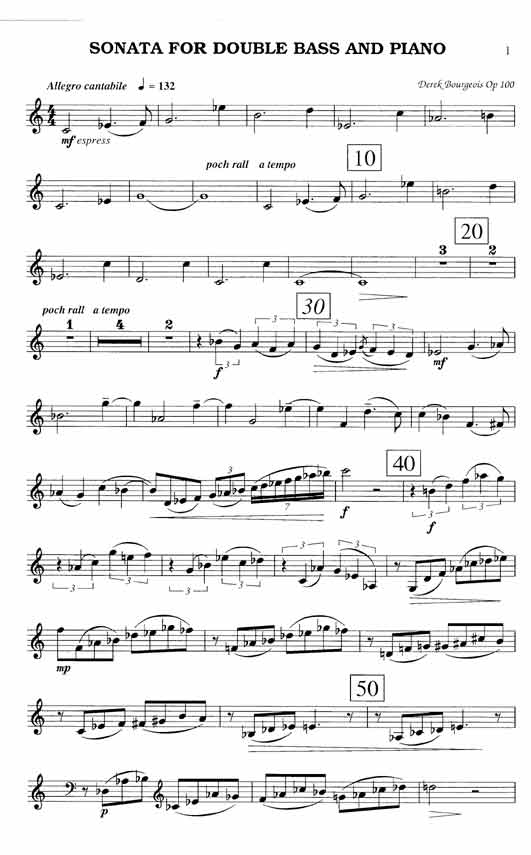
- Sonata for Double Bass and Piano (1992)
Reference Recording – YouTube [ John Mietus ]
–
- Sonata for Double Bass and Piano, No. 2 (2009)
–
–
Anderson, Philip Leon (1922- )
- Theme and Variations in D Minor for Violoncello or String Bass with Piano Accompaniment (1949)
Note: Composition manuscript located at the Library of Congress – LC Record Link
–
–
Andriessen, Louis (1939-2021)
- Elegy for Cello or Double Bass and Piano (1957)
Composition Page – LouisAndriessen.com
Note: It appears that this composition has started as a violoncello piece that was later adapted for double bass by composer with assistance of bassist Quirijn van Regteren Altena.
Reference Recording – YouTube [ Rick Stotijin ]
–
–
Angel, Amparo (1942)
- Meditacion para Contrabajo y Piano, Op.34 (2011)
–
–
Angerer, Paul (1927-2017)
- Gloriatio für Kontrabass und Kammerorchester (1957)
Composition Page – MusicaAustria.at
Reference Recording – YouTube [ Leopold Andreev ] (piano score on screen, with orchestra)
Reference Recroding – YouTube [ Yordano Nunez ] (with piano)
Reference Recording – YouTube [ Leopold Andreev ] (with orchestra)
–
- Quicquam für Streichers Kontrabass & Streicher (1977)
Composition Page – MusicaAustria.at
Reference Recording – YouTube [ Ludwig Streicher ] (piano score on screen)
Reference Recording – YouTube [ Ludwig Streicher ] (with orchestra)
–
–
Anglois, Luigi (1801-1872)
- Tema con Variazioni per Contrabasso (1837)
Note: It is unknown if these Variations were concieved for solo bass, or were simply cited in a solo bass line as featured in a preserved copy at Morgan Library, New York City – Morgan Library Record
–
–
Annunziata, Mauricio (1971)
In addition to featured pieces, Annunziata has also composed five double bass concertos with accompaniment of the orchestra. However, how many of these concertos offer a piano reduction is yet to be discovered. Please check the Annuziata concertos citations at the ABP Solo & Ensemble listing.
–
- Andante Nostalgico, Op. 142 ( )
–
- Balkan Whispers, Op. 136 ( )
Reference Recording – YouTube [ Dritan Gani ]
–
- Carnavalito, Op. 145 ( )
–
- Glaciares, Op. 127 ( )
Reference Recording – YouTube [ Dritan Gani ]
–
- Negros Aires, Op. 22b (1997)
Online View & Download – MauricioAnnunziata
–
- Rêverie, Op. 133 ( )
Reference Recording – YouTube [ Petru Iuga ]
–
- Sonata Para Contrabajo y Piano, Op. 132 ( )
–
- Tren a Las Nubes, Op. 134b ( )
Note: A version played by Gary Karr.
–
- Vidalita, Op. 146 ( )
–
- Violetas Porteñas, Op. 146 ( )
Reference Recording – YouTube [ Catalin Rotaru ]
–
–
Antonelli, Marino (1880-1951)
- Bagatella per Contrabasso da Concerto con Accompagnamento di Pianoforte (1921)
Note: Dedicated to Guido Gallignani.
–
- L’eco per Contrabasso e Pianoforte (1922)
Note: Dedicated to Guido Gallignani.
–
–
Aquino, Francisca (1956-2019)
- Beira-Mar (Seashore) (2001)
- Gosto de Brasil (Taste of Brazil) (1999)
- Música Brasileira Para o Iniciante ( )
[ Brazilian Music for Beginners ]
Note: This collection features the following seven pieces:
1. Baião
2. Valsa
3. Frevo
4. Balada
5. Canção
6. Modinha
7. Bossa
–
- Santa Teresa (2002)
- Sweet Suite (2002)
–
–
Arányi, György (1923-2018)
- A Kis Mackó Járni Tanul (1956)
[ A Little Bear Learns to Walk ]
–
- A Nagybőgő kis Panasza (1956)
[ Double Bass’ Little Complaint ]
–
- Concerto for Double Bass and Piano (1956)
–
- Ein kleiner Hexenwalzer ( )
[ A little Waltz of Witches ]
–
- Esti Seta ( )
[ Evening Walk ]
–
- Fantazia Gordonra es Zongorara ( )
[ Fantasy for Double Bass and Piano ]
–
- Variációk (1956)
[ Variations for Double Bass and Piano ]
Note: Unclear if Variációk may indeed be the same as Versenyvátozatok cited below. Further inquiry needed.
–
- Versenyvátozatok (1956)
[ Concert Variations ]
–
–
Archer, Violet (1913-2000)
- Six Miniatures for Double Bass and Piano (1984)
–
–
Ardévol, José (1911-1981)
- Duet for Contrabass and Piano (1959)
–
–
Árvai, Pál ( )
- Hőseg Nagybőgőre ( )
[ Hero for Double Bass ]
–
–
Ashkenazy, Benjamin (1940)
- “Cycle” for Double Bass and Piano, Op. 22 (1993)
Note: Commissioned by Milton Masciadri.
–
–
Ashton, J. Bruce (1941)
- Suite for Bass & Organ ( )
–
–
Askim, Peter (1971)
- Eight Solitudes for Bass and Piano (2002)
Composition Page – Peteraskim.com
Score Sample – Peteraskim.com
Reference Recroding – YouTube [ Peter Askim ]
–
–
Assis, Gilberto (1961)
- Brincadeiras (1996)
- Retirantes (1996)
–
–
Atehortúa, Blas Emilio (1933-2020)
- Pieza-Estudio para Contrabajo y Piano, Op.44, No.3 (1970)
- Sonata para Contrabajo y Piano, Op.10 (1961)
–
–
Aubain, Jean (1928-2015)
- Deux Études pour Contrebasse et Piano (1961)
Note: Written for Concours du Conservatoire National Supérieur de Musique.
–
–
Aubin, Francine (1938-2016)
- Chant d’amour à un Sphinx ( )
- Concerto pour Ariane (1988)
Note: Dedicated to Jean-Marc Rollez.
–
–
Aubrecht, Mathias (c1855-_)
- Romanze (19- )
Reference Recording – YouTube [ Théotime Voisin ]
–
–
Auerbach, Lera (1973)
- Six Preludes (2008)
Reference Recording – YouTube [ Matthew McDonald ]
–
–
Austin, Elizabeth R. (1938)
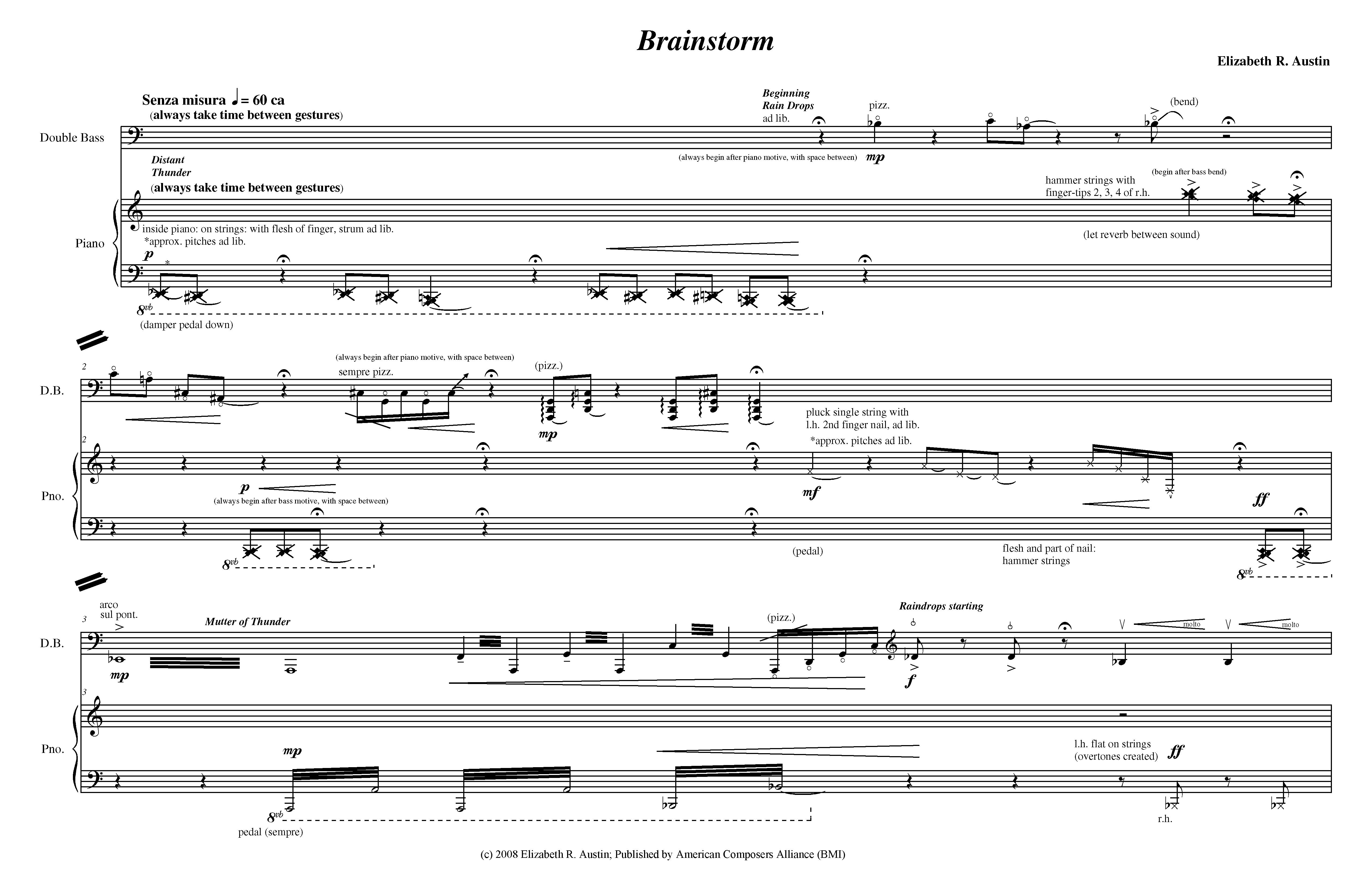
- Brainstorm (2008)
Score Sample – ACA
–
–
Axelrod, Lawrence (1960)
- Slow/Fast (2005)
–
–
Ayres, Nelson (1947)
- Ecos de um Maracatu (1996)
- Mantiqueira (1985)
–
–
Azarkhin, Rodion Mikhailovich (1931-2007)
- Suite “Wreath of Friendship” ( )
Title in Russian: Сюита “Венок Дружбы”
Reference Recording – YouTube [ Rodion Azarkhin ] (score on screen)
–
–
Azevedo, Carlos (1964)
- Um Dia (2000)
–
–
Azzi, Mario (1882-1965)
- Berceuse per Contrabasso e Pianoforte, Op. 6 ( )
Reference Recording – YouTube [ Mario Ricciuti ]
–
- Romanza ( )
Reference Recording – YouTube [ Mario Ricciuti ]
B
–
Bailey, Judith (1941-2025)
- Double Bass Concerto in the Style of Haydn (2008)
Composition Info – Musicweb-international.com
–
- Five Miniatures for Double Bass & Piano (2006)
- Shepherd’s Heyes (2012)
–
–
Bakaleinikoff, Vladimir (1885-1953)
- Allegro Moderato for String Bass and Piano (1939)
- Largo for String Bass and Piano (1939)
- Valse, Allegro Grazioso for String Bass and Piano (1939)
–
–
Baker, Claude (1948)
- Omaggi e Fantasie for Double Bass and Piano (1984)
–
–
Baker, David (1931-2016)
- Theme & Variations (Passacaglia) ( )
Note: Part of the Gary Karr collection. A recording of this composition with Gary Karr is also extant.
–
–
Baker, Michael Conway (1937)
- Combinations for Double Bass and Harpsichord (1974)
–
- Double Bass Concerto ( )
Note: The accompaniment type for this concerto is unknown at the present. Assumed that piano reduction exists.
–
–
Baksa, Robert (1938-2023)
- Contrabass Sonata (1998)
Note: Premiered by Lou Pappas.
–
–
Ballanda, J. [ Johann ? ] ( )
- Variationen [ 1 und 2 ] (1907)
- Conzertino für Contrabass ( ) [ Incomplete – Only Solo Part extant ]
- 2. Concertino für Contrabass ( ) [ Incomplete – Only Solo Part extant ]
–
–
Ballew, Bo ( )
- Introduction and Divertimento for Double Bass and Piano (199-?)
–
–
Barbieri, Ricardo ( )
- Contrastes (1981)
Notes: Dedicated to Sandrino Santoro. In manuscript.
–
–
Barbosa, Sérgio ( )
- Suspiro (1997)
Note: In manuscript.
–
–
Barce, Ramón (1928-2008)
- Duo, Contrabajo y Piano (1980)
- Preludio y Fuga (2007)
–
–
Barnes, Larry ( )
- Song of the Angels ( )
Note: Located in Gary Karr Collection.
–
–
Barnes, Milton (1931-2001)
- “Song of the Bow” A Concerto for String Bass and Orchestra (1991)
Note: Commissioned by Richard Murrin for Joel Quarrington.
–
- Papageno Variations for Double Bass and Piano (1988)
Full Title: Papageno Variations after The Magic Flute for Double Bass and Piano (1988)
Reference Recording – YouTube [ Nicola Malagugini ]
–
–
Barrell, Bernard (1919-2005)
- Opening Gambits for Double Bass and Piano, Op. 67 (1972)
Note: This may be one of the simplest pieces ever written for double bass. The located online citation states that “Double-Bass part requires open strings only.” Citation – Musicweb-international.com (middle of the page by the year “1972”)
–
–
Bartoň, Hanuš (1960-2023)
- Moto Continuo per Contrabbasso e Pianoforte (2014)
Composition Page – Musicbase.cz
Score Sample – Musicbase.cz
–
–
Bartoš, Jan Zdeněk (1908-1981)
- Sonáta pro Kontrabas a Klavír ( )
[ Sonata for Double Bass and Piano ]
–
–
Bartsch, Charles (1907-1979)
- Adagio et Allegro pour Tuba ou Contrebasse et Piano ( )
Note: in Manuscript.
–
–
Baur, John (1947)
- Concerto for Double Bass and Chamber Orchestra ( )
Note: Details on this concerto are sparse. Piano reduction assumed.
–
- Six Movements: For Double Bass and Piano (1965)
–
–
Beal, Jeff (1963)
- Concerto for Jazz Bass and Orchestra (1989)
Reference Recording – YouTube [ Andrew O’Connor ] (accompaniment with piano, performance on Bass Guitar)
–
–
Beall, John (1942)
- Little Fantasy for Double Bass and Piano (1985)
Manuscript Data – John Beall Papers – West Virginia University
–
–
Beaucamp, Albert (1921-1967)
- Cortège pour Tuba Ut ou Contrebasse à Cordes ou Saxhorn Basse Si ou Trombone Basse et Piano (1953)
[ Procession for Tuba in C or String Bass or Bass Saxhorn in B or Bass Trombone and Piano ]
Note: As presented in the title, this composition was conceived for a variety of bass instruments including double bass.
–
–
Becerra-Schmidt, Gustavo (1925-2010)
The catalogs of Becerra-Schmidt works indicate two sonatas for bass and piano with ascribed opus numbers 26 and 82. However, some of these catalogs mention the additional two sonatas for bass and piano with ascribed opus numbers 271 and 280. At this point it is not clear whether these later sonatas may possibly be updated versions of Op. 26 and Op. 82 or possibly separate compositions. Further inquiry may be needed to clarify this matter.
- Sonata para Bajo y Piano, No. 1, Op. 26 (1956)
Online View & Download – Tantaku.cl
Reference Recording:
1. Allegro giusto – YouTube [ Gonzalo Venegas ]
2. Andante – YouTube [ Gonzalo Venegas ]
3. Allegro Tranquilo – YouTube [ Gonzalo Venegas ]
Reference Recording – YouTube [ María Teresa Molina ]
–
- Sonata para Contrabajo y Piano, No. 2, Op. 82 (1963)
Note: Written for Adolfo Flores.
–
–
Bech, Václav (1877-1936)
- Humoreska ( )
- Fantasie, na Motivy Eugena Oněgina od P. I. Čajkovského ( )
[ Fantasy, on Themes from Eugene Onegin by P. I. Tchaikovsky ]
–
–
Beck, Mina von (19th c.)
- Albumblatt für Violoncello oder Contrabass und Klavier, Op. 7, (1890)
Note: Dedicated to Franz Simandl.
–
–
Benjamin, Thomas (1940)
- Assertions and Digressions (1983)
Manuscript Data – Peabody Insitute Thomas Benjamin Collection – Box 4 / Scores 1970s – 1999s
Note: Although the Assertions and Digressions are not directly cited in the collection holdings, the Scores section, Box 4 is likely the place where the composition manuscript would be held.
Score Sample – ABP Repository (courtesy of Andrew Kohn)
Note: Dedicated to Winston Budrow.
–
–
Benkert, Friedrich (19th c.)
- Notturno für Posaune oder Contrabass mit Pianoforte (1894)
–
–
Bennett, Richard Rodney (1936-2012)
- Concerto for Double Bass and Chamber Orchestra (1978)
Reference Recording:
1. Declamato – YouTube [ Jiří Hudec ] (with orchestra)
2. Elegiaco – YouTube [ Jiří Hudec ] (with orchestra)
3. Energico – YouTube [ Jiří Hudec ] (with orchestra)
–
–
Benstead, Christopher (1951)
- Four Episodes for Double Bass and Piano (1981)
Note: Commissioned for Gary Karr.
–
–
Bentzon, Niels Viggo (1919-2000)
- Margarine for Kontrabas og Klaver, Op. 403b (1977)
[ Margarine for Double Bass and Piano ]
–
–
Beovič, David (1977)
- Trije Preludiji za Kontrabas in Klavir ( )
[ Three Preludes for Double Bass and Piano ]
–
–
Berberean, Hamparatzum (1905-1999)
- Oror : Lullaby (1979)
–
–
Bergamo, John (1940-2013)
- Sonata II ( )
Note: Located in Gary Karr Collection.
–
–
Berkeley, Lennox (1903-1989)
- Introduction and Allegro for Double Bass and Piano, Op. 80 (1971)
Note: Written for Rodney Slatford.
Reference Recording – YouTube [ Leon Bosch ] (score on screen)
Reference Recording – YouTube [ Leon Bosch ]
Reference Recording – YouTube [ Lachlan Radford ]
–
–
Bernaud, Alain (1932-2020)
- D’une Extrême Gravité; Deux Pièces Concertantes Pour Contrebasse et Piano (1966)
- Petites Spéléophonies pour Contrebasse et Piano (2019)
Score Sample – Broekmans.com
–
–
Bernofsky, Lauren (1967)
- Adagio for Double Bass and Piano (1986)
- Lullaby for Carolina (1999)
–
–
Bersey, James ( )
- Double Bass Concerto (2006)
Score Sample – Sheetmusicplus.com
–
- Tranquility for Solo Double Bass and Piano (2024)
Score Sample – Sheetmusicplus.com
–
–
Beveridge, Thomas (1938)
- Sonata for Bass Viol and Piano ( )
Score Sample – ABP Repository (solo part, courtesy of Andrew Kohn)
Note: Located in Gary Karr Collection.
–
- Sonatina for Bass Viol and Piano (1973)
Score Sample – ABP Repository (solo part, courtesy of Andrew Kohn)
Note: Dedicated to Steve Brewster.
–
–
Beyer, Johanna Magdalena (1888-1944)
- Movement for Double Bass and Piano, K.12 (1936)
Composition Analysis
Craddock, Mary Christine. “Chapter Four: Range, Process, and Performance in Beyer’s Movement for Double Bass and Piano. ” Performance, Analysis, and Interpretation in the Solo Double Bass Works of Johanna Magdalena Beyer and Vivian Fine. D.M.A. Thesis, University of Oklahoma, 2015. pp. 32-45. Download Page
Compositio Info – CD Program Notes pdf , p. 14.
Reference Recording – YouTube [ Nicholas Synot ]
–
–
Bichels, Hans ( 19th c. )
- Concertino (Variationes Briliantes), Op. 4 (1892)
- Concertino für Contrabass mit Pianoforte, No. 2 (1896)
–
–
Bigot, Eugene (1888-1965)
- Capriccio (1960)
Note: Written for Concours du Conservatoire National Supérieur de Musique (1960), Paris, France.
Reference Recording – YouTube [ unknown ]
–
–
Bihari, Sándor (1900-1984)
- Szonáta ( )
Note: In Manuscript.
–
–
Bille, Isaia (1874-1962)
The music estate of Isaia Bille is held in the archives of Conservatorio di Musica G. B. Pergolesi in Fermo, Italy. It features some 500 (five hundred) music manuscripts, however its listing is not available in public. The very number of manuscripts nevertheless suggests that a number of Bille’s bass compositions await discovery.
The index of compositions featured below is based only on citations from published registries of bass music and library catalog entries, some of which unfortunately present only incomplete or ambiguous information. The legacy of Isaia Bille certainly deserves a more thorough research, and the work on such a project could also serve a basis for definitive scholarly book on Bille’s life and opus.
–
- Adagio e Tarantella per Contrabbasso e Pianoforte (1927)
Reference Recording – YouTube [ Giuseppe Ettorre ]
–
- Allegro Scherzoso per Contrabasso e Pianoforte, Op. 12 ( )
–
- Aria Antica per Contrabbasso e Pianoforte (1927)
Note: Aria Antica exists in four accompaniment versions: with Piano, with Organ, with Double String Quintet and with String Orchestra.
–
- Aria Antica per Contrabbasso Solo Accomp. di Organo ( )
Note: Aria Antica exists in four accompaniment versions: with Piano, with Organ, with Double String Quintet and with String Orchestra.
–
- Aria Antica per Contrabasso Obbligato con Accompagnemento di Doppio Quintetto D’Archi e Organo ad Libitum oppure Contrabasso e Organo Solo ( )
[ Aria Antica: for Obbligato Double Bass with Accompaniment of Double String Quintet and Organ ad libitum or Double Bass and Organ Solo ]
Note: This record features the Aria Antica version with accompaniment of Double String Quintet but also as a piece for Double Bass with Organ accompaniment, thus listed here in the Solo with Piano registry. Otherwise, Aria Antica exists in four accompaniment versions: with Piano, with Organ with Double String Quintet and with String Orchestra.
–
- Barcarola per Contrabbasso e Pianofrte (1922)
–
- Berceuse (Nina Nana) per Contrabbasso e Pianoforte (1927)
–
- Canzonetta per Contrabbasso e Pianoforte (1932)
–
- Concerto in Sol Majore per Contrabbasso e Pianoforte (1933)
–
- Danza Satanica per Contrabasso e Pianoforte (1930)
Note: This pieces was originally written as No. 6 piece of Sei Studii Caratteristici (1927) for solo bass. However, the original purpose of this piece is unknown, whether it was intended to be a solo concert etude or just a didactic piece. This piece was then arranged with piano accompaniment in 1930 by Bille for Anton Torello.
–
- Fantasia Caratteristica in Tre Tempi per Contrabbasso e Pianoforte (1933)
–
- Impromptu per Contrabasso con Accomganemento di Pianoforte (1931)
Note: Dedicated to Rudolf Malaric.
–
- Improviso e Allegro Spigliato per Contrabasso con accompagnamento di Pianoforte ( )
Note: Dedicated to Rudolf Malaric ( I. Billé. Al mio amico R. Malaric )
–
- Madrigale ( )
Note: Located in Gary Karr Library.
–
- Mazurka in Mi Maggiore, Compositioni per Contrabass e Pianoforte Nr. 16 ( )
–
- Melodia Pastorale, Op. 7 ( )
–
- Melodia per Controbasso con Accompagnamento di Pianoforte (1910)
Manuscript Data – RISM Record
Composition Info – SBN Record
Note: This composition is also known as Sonata in La Minore and is registered under this title with RISM Record. There is also a question of whether this Melodia per Controbasso bears any relation to Melodia Pastorale, Op. 7 listed in the prior record.
–
- Minuetto, Compositioni per Contrabass e Pianoforte Nr. 4 (1922)
–
- Quasi “Perpetuum Mobile” : Per Contrabbasso E Pianoforte : N. 1 Dei “Ventiquattro Capricci” per Contrabbasso Solo (1938)
[ Quasi “Perpetuum Mobile”: for Double Bass and Piano: No. 1 of the “Twenty-four Caprices” for Double Bass Solo ]
Note: This appears to be an arrangement of a Cappricio from Bille’s own etude compilation Venti-Quattro Studi-Capricci: Per Contrabbasso a 4 Corde first published in 1921. The Cappricio No. 1 is likely featured, yet a direct comparison is needed in order to confirm the identity of this piece.
–
- Saltarello Marchegiano dai Canti della Campagna Picena Pezzo di Folklore per Contrabasso e Pianoforte ( )
[ Saltarello Marchegiano from the Songs of the Picena Countryside, Folklore Piece for Double Bass and Piano ]
–
- Serenatella Spagnola per Contrabbasso e Pianoforte (1926)
–
- Sonata in Fa# Minore per Contrabbasso e Pianoforte ( )
Note: This sonata exists also in a corrected Mi Minore version.
–
- Sonata in La Minore ( )
Manuscript Data – RISM Record
Note: This composition is also known as Melodia per Controbasso con Accompagnamento di Pianoforte (1910). See record above.
–
- Sonata in Re (Stile Antico) per Contrabasso e Pianoforte (1934)
–
- Theme & Variations for Bass and Piano ( )
Note: Located in Gary Karr Library. Incomplete, solo part only.
–
- Vivace ( )
Note: This Vivace was printed in Bille’s Nuovo Metodo per Contrabbasso, Part 2, Vol. 6, pp. 79-83.
–
- Zanzarone per Contrabasso con Accompagnamento di Pianoforte ( )
Note: Dedicated to Rudolf Malaric.
–
–
Birkedahl, Walter ( )
- Fantasy on Themes of Erroll Garner (1997)
Note: This Fantasy uses two Garner tunes, “Misty” and “Paris Bounce.” Located in Gary Karr Collection.
–
–
Biscardi, Chester (1948)
- Companion Piece ( for Morton Feldman ) (1989)
Composition Page – Cnvill.net
Notes: Written as a homage to Morton Feldman. Written for Robert Black (double bass) and Anthony de Mare (piano).
Reference Recording – YouTube [ Mark Helias ]
–
–
Blank, Allan (1925-2013)
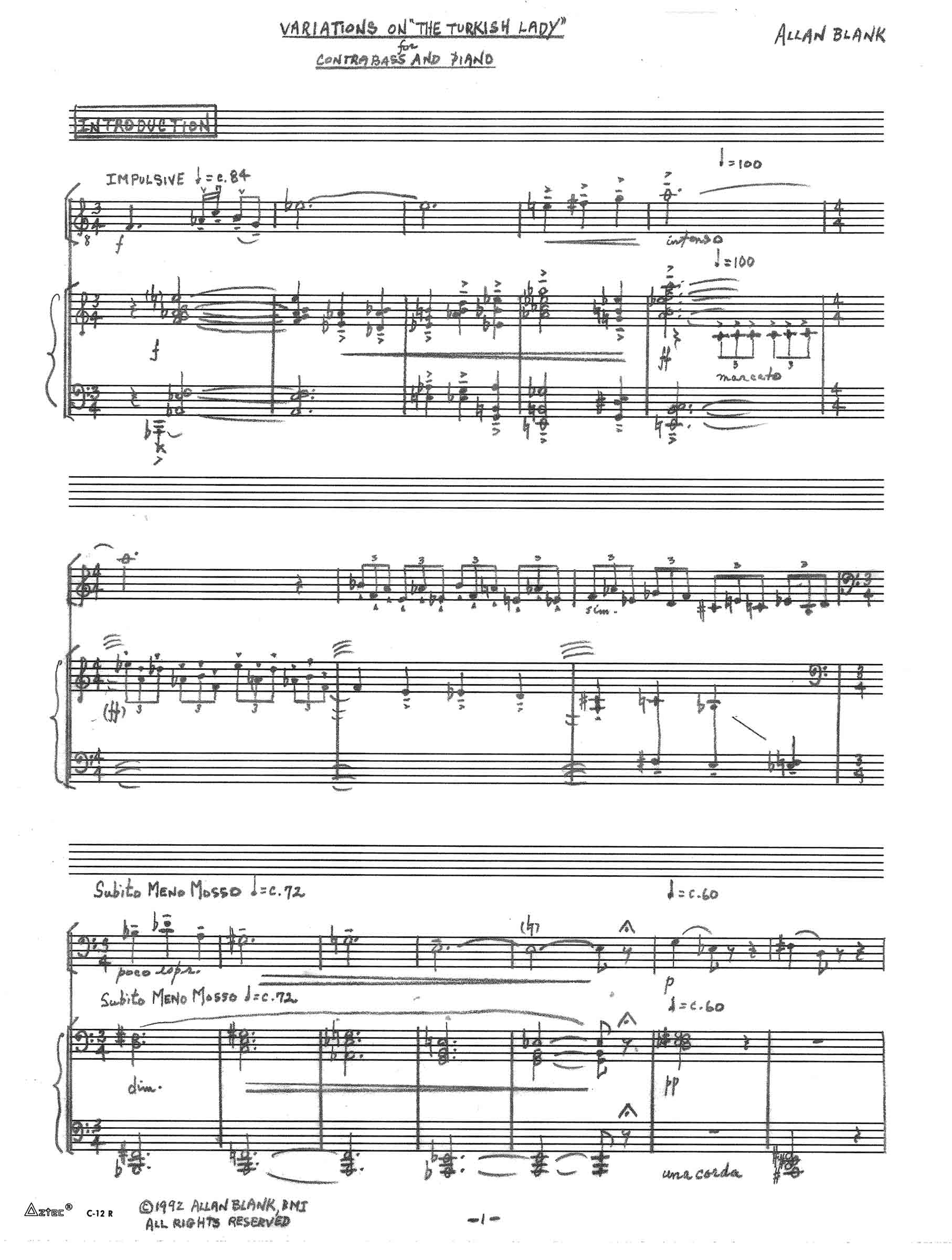
- Variations on ‘The Turkish Lady’ (1992)
Score Sample – American Composers Alliance
Note: Dedicated to David Murray.
Reference Recording – YouTube [ Andrew Kohn ]
–
–
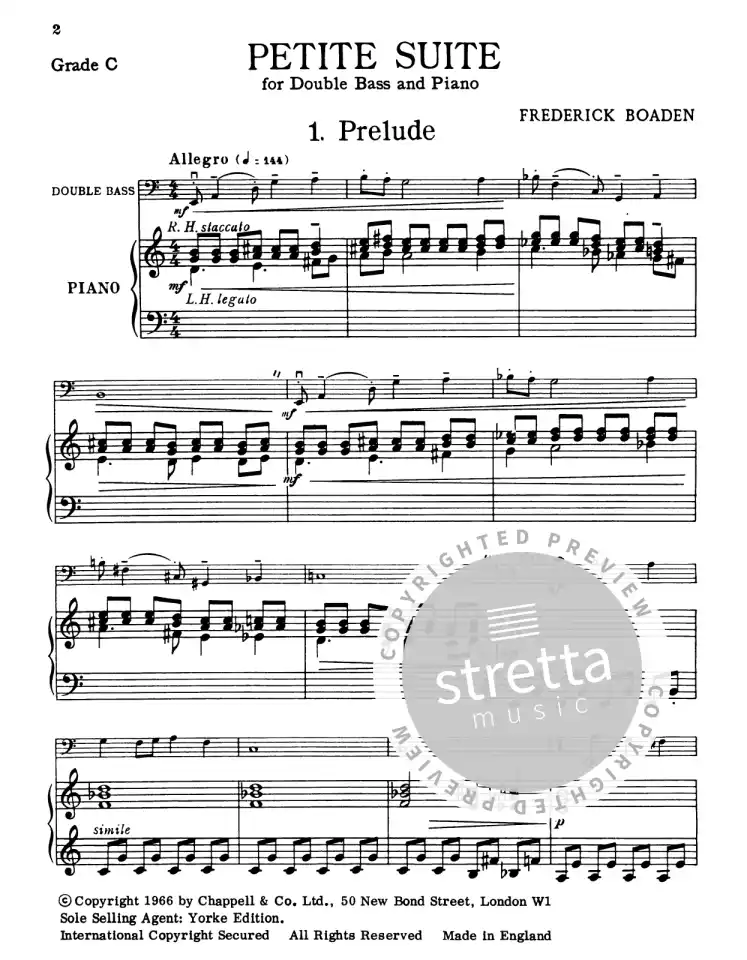
Boaden, Frederick ( )
- Petite Suite, for Double Bass and Piano (1966)
Score Sample – Stretta-music.com
–
–
Boda, John (1922-2002)
- Sonatina for String Bass and Piano (1956)
Manuscript Data – Florida State University – John Boda Collection ( See List of Score Titles pdf )
Note: Boda has used this Sonatina as a basis for his Concertino for String Bass and Orchestra (1956).
–
–
Bogar, Istvan (1937-2006)
- Szonata ( )
–
–
Bogatyrev, Anatoly (1913-2003)
- Kontsert dlia Kontrabasa s Orkestrom, Op. 44 (1963)
[ Concerto for Double Bass and Orchestra ]
Reference Recording – YouTube [ Jean-Marc Rollez ] (with orchestra – piano score on screen)
–
- Sonata dlia Kontrabasa i Fortepiano, Op. 49 (1983)
[ Sonata for Double Bass and Piano ]
Reference Recording – YouTube [ Daniel Gwin ]
–
–
Bois, Rob du (1934-2013)
- Basso Doble voor Contrabas en Piano (1973)
[ ‘Basso Doble’ for Double Bass and Piano ]
Score Sample – Donemus
Note: Dedicated to Maarten van Regtern Altena.
–
–
Bónicz, Márton ( )
- Nagybőgőverseny (kezirat)
[ Double Bass Concerto ]
Note: In Manuscript. Unknown if this concerto was written for piano or orchestra accompaniment.
–
–
Bordás, Tibor (1918-1985)
Bordas’ biography at Nagybogo.hu states that “He wrote sixty pieces of smaller and larger scale for piano accompaniment for secondary education.” Thus the featured pieces may represent only a smaller portion of his complete bass opus. The dating on presented pieces is commonly very spotty and often missing completely. Yet, it is reasonable to deduce that the majority of compositions date from early 60s to late 70s.
–
- Ballada és Romanc, Op. 7-8 ( )
[ Ballad and Romance ]
Note: The opus numbers differ on these two pieces, one source cites them as Op. 2-6 the other as Op. 7-8.
–
- Chanson, Op. 11 ( )
Note: In Manuscript.
–
- Harom Dal, Op. 18 ( )
[ Three Songs ]
Note: In Manuscript.
–
- In Memoriam, Op. 20 ( )
Note: In Manuscript.
–
- Koncertkeringő, Op. 14 ( )
[ Concert Waltz ]
–
- Koral es Valtozatok, Op. 1 ( )
[ Choral and Variations ]
Note: In Manuscript.
–
- Menüett és Bolero, Op. 9-10 ( )
[ Minuet and Bolero ]
–
- Miniaturak, I-II. Op. 16-17 ( )
[ Miniatures, I-II. ]
–
- Öt Darab (1980)
[ Five Pieces ]
Note: This entry is based on the 1980 edition citation. Yet, it was not indicated which five pieces are featured. Further inquiry needed.
–
- Szonatina ( )
Note: This Sonatina apparently exists in two piano score versions, one 10 pages long, the other 15 pages long. Yet, whether the difference is because one may be a printed edition, while the other a facsimile or a manuscript, is not known. The sources on both offer no information on score type. Further inquiry needed.
–
- Valtozatok egy Chopin Prelődre, Op. 22 ( )
[ Variations on a Chopin Prelude ]
Note: In Manuscript.
–
- Valtozatok egy G. Mahler Temara, Op. 19 ( )
[ Variations on a Theme by G. Mahler ]
Note: In Manuscript.
–
- Valtozatok egy Simandl-Etődre, Op. 15 ( )
[ Variations on a Simandl Etude ]
Note: In Manuscript.
–
–
Borém, Fausto (1960)
- O Colibri II (1987)
Note: In manuscript and electronic edition.
–
–
Borges-Cunha, António Carlos (1952)
- Musica para Contrabaixo e Piano (1983)
–
–
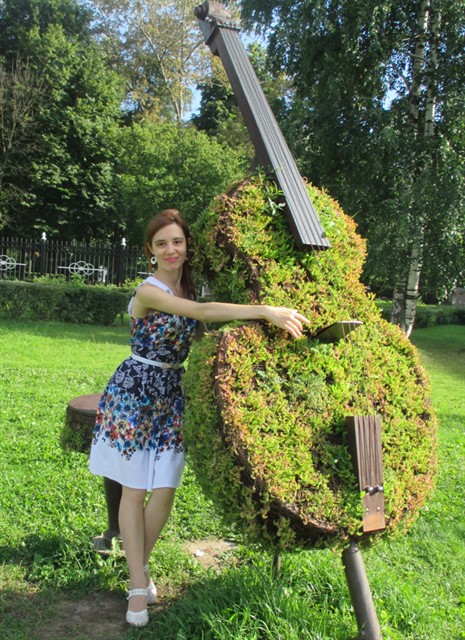
Borisova, Elena (1982) – a.k.a Lena Orsa
- Nocturne for Contrabass and Piano (2015)
Title in Russian: Ноктюрн для Контрабаса и Фортепиано
Score Sample – LenaOrsa.musicaneo.com
Images – Lena Orsa with Giant Green Bass – LenaOrsa.musicaneo.com/Gallery
–
–
Borlói, Rudolf (1927-2019)
- Andante e Allegro (1971)
Reference Recording – YouTube [ Daniel Gwin ]
–
- Chanson et Danse (2013)
–
–
Bornoff, George (1907-1998)
- Bornoff’s Fiddler’s Holiday for Solo Bass with Piano or String Orchestra Accompaniment. (1961)
Note: The exact pieces featured in this collection are unknown at this time, yet it appears that some may be the original Bornoff’s compositions, thus listed here.
–
- Bornoff’s Fun for Fiddle Fingers, 52 Easy Tunes for String Instruments with Piano Accompaniments. Bass (1951)
Note: The exact pieces featured in this collection are unknown at this time, yet it appears that some may be the original Bornoff’s compositions, thus listed here.
–
–
Borris, Siegfried (1906-1987)
- Capriccio für Kontrabaß und Klavier, Op. 117 ( )
Note: This Capriccio is also extant in a version for solo bass and three wind instruments.
–
- Dialoge für Kontrabass und Klavier (1967)
Note: No opus number was affiliated with the record of this composition.
–
- Sonate für Kontrabaß und Klavier, Op. 117 (1975)
Manuscript Data – Akademie Der Kunste Record
Score Sample – Stretta-music.net
Note: This Sonate bears the same opus number as Capriccio. This may be a mistake, or it may indicate that the opus number is shared between these two works?
–
–
Bota, João Victor (1980)
- Frequência Modulada ( )
- Música para Contrabaixo e Piano ( )
–
–
Botelho, Andréa Huguenin (1973)
- Suíte Brasileira para Contrabaixo e Piano (2023)
[ Brazilian Suite for Double Bass and Piano ]
Reference Recording:
1. Bossa – YouTube [ Buchbach Helen ]
2. Valsa Seresteira – YouTube [ Buchbach Helen ]
3. Choro – YouTube [ Buchbach Helen ]
4. Frevo – YouTube [ Buchbach Helen ]
Bottesini, Giovanni (1821-1899)
• Introduciton
• Bibliography
• Citation Format
• Index of Compositions
Introduction
–
Welcome to the catalog of Bottesini’s original compositions for solo double bass. Here you will find all the familiar pieces that you may have performed, or simply enjoyed as a Bottesini enthusiast. Yet, please accept apology if you do not find some known pieces which may either be period Bottesini arrangements (Elegie par Ernst), later arrangements of Bottesini’s non-bass compositions (Reverie) or concertato pieces for two solo instruments including one or two basses (Passione Amorosa). These pieces will be listed respectively in the Arrangements and Concertato catalog sections in the future. Otherwise, in order to understand this catalog and Bottesini bass legacy in general, it is important to point to the two unique features of Bottesini’s solo music. First, there are apparently no original solo bass parts among Bottesini’s manuscripts, and second, the unique use of two solo tuning variants in Bottesini’s opus.
In respect to the solo parts, it may sound as a surprise but there are no preserved solo bass parts among original Bottesini’s manuscripts in either Biblioteca Palatina in Parma, where the entire Bottesini estate is now located, or wider. The solo parts start to appear only with second generation manuscript copies affiliated with other bassists or within first printed editions, such as those by S. Richault, Paris and Lafleur and Son, London.
So, how did Bottesini perform his own music then? Likely and according to what is known today, he performed straight from memory. His musical ability was breathtaking, and not only in technical but also in cognitive area. From what is left to us today, it appears that Bottesini really did not need a solo part for his concerts, or if he needed to refresh himself on a particular piece, he may have used the preserved piano scores to update his readiness for the concert.
In respect to Bottesini’s tunings, all sources point that he used either the traditional Solo Tuning or a tuning for a half step higher than Solo Tuning. This higher tuning is witnessed only in his own opus, and thus in his honor named here Bottesini Tuning. So, to illustrate the tuning systems and how can you discern these two tunings in manuscripts, let us take the example of famous Bottesini concerto in B minor that should be familiar to most bassists. The solo bass part for this concerto in performed in A minor (bassist read it as written for E1, A1, D, G, although Bottesini used only three strings thus A1, D, G). Solo Tuning version for a score in B minor is then B1, E, A and that is how the majority of bassist performs this piece today. However Bottesini in some works tunes his instrument even for a half step higher up to C, F, B flat. That is the Bottesini Tuning. Thus if you look at the Sources for Bottesini’s concerto in B Minor, you will note the keys of the concerto versions in both B Minor and C minor. The C minor version is written for Bottesini Tuning, and you can observe that piano score version in Bottesini’s own hand here at Internetculturale.sbn.it scan.
Otherwise, for all other pieces listed in this catalog, every time you note two versions in two different keys, for example B minor and C Minor, the lower key version will be written for Solo Tuning, while the higher version for Bottesini Tuning. In respect to keys, two versions will always be apart for only half a step.
Bibliography
–
This catalog was created in larger part by indexing primary sources available in RISM and SBN databases, and then by cross-referencing those entries with citations in Bottesini’s compositions catalogs by Inzaghi, Járdányi and Street.
–
Databases
RISM – RISM is an acronym for Répertoire International des Sources Musicales, the world’s largest online database of music autographs & manuscripts that among many other resources indexes Bottesini manuscripts as well. Please note however that not all of Bottesini’s manuscripts are indexed in RISM, althogh it appears that all of the scores from the Biblioteca Palatina in Parma, where the Bottesini estate is held today, are indexed.
SBN – SBN is accronym for Servizio Bibliotecario Nazionale or the The National Library Service (of Italy). It is a database that unifies all online records from all Italian libraries and consequently also presents some Bottesini sources that for some reason are not indexed in RISM. At some instances these non-RISM records may be sparse and may offer just the basic data.
Internetculturale.it – This portal collects and presents all digitzed items from variety of Italian libraries. It also presents digital scans of Bottesini’ manuscripts from Biblioteca Palatina in Parma.
–
Catalogs of Bottesini’s Compositions
Inzaghi, Luigi. Giovanni Bottesini: Virtuoso Del Contrabbasso e Compositore. Milano: Nuove edizioni, 1989. (catalog at the back of the book, pp. 169-183). Compositions are designated with BOT. xx signatures. This same Inzaghi catalog is also availabe online at Flaminioonline.it – Bottesini Catalogo , however it presents only the abbreviated version, since it offers only the titles and Inzaghi numbers, yet lacks all the sources’ citations that the book presents.
Járdányi, Gergely. Giovanni Bottesini Élete és Nagybőgőművei A Készülő Műjegyzék Problematikája. D.L.A. Thesis, Liszt Ferenc Academy of Music, Budapest, 2010. Download Page (dissertazio.pdf). Compositions designated with JGB.Xxx signatures.
Translated: The Life and Works of Giovanni Bottesini for Double Bass. The Issues Encountered During the Creation of Catalogue.
This entire thesis may be considered a detailed catalog of Bottesini’s opus that presents information on all manuscript/autograph sources as well. With each composition entry Járdányi also offers a paragraph or two with valuable comments and points to various ambiguities that these sources present. If this thesis had also offered the music incipits for each composition in a way that RISM does, the work would be a true thematic catalog worthy of a shelf place in every music library reference section. For those who do not known Hungarian, the good news is that Google Translator will do a miracle of translating a section of interest in English. So in that respect you are welcome to check all the quotations related Járdányi’s expertise that are mentioned here.
Street, Stephen. Bottesini’s Catalog – Online Page . Compositions designated with GB.xx signatures. [ Some data in Street catalog also refer to information from West, Chris. Bottesini in Britain book Chris West ]
This catalog is in fact only a huge Excel list embedded in a web page. However it still offers an excellent overview of Bottesini’s opus along with valuable data on compositions and dating. The catalog is organized within Street’s own unique signature system, but it is easily searchable by the browser’s own keyword search option.
–
In respect to ABP Bottesini entries listed on this page, you will find that every composition is cited in a form that presents its Title, followed by the Járdányi / Inzaghi / Street Designation Number, and ending with the Year of composition. Under the title, every primary source, commonly a period manuscript is indexed separately with all past and present signature numbers cited. Thus in some cases you may experience the clutter of various old and new signatures somewhat tasking. Yet, for those who need to relate to the older research and old signatures this approach should prove of benefit.
Otherwise, the good news for all bassists and scholars of Bottesini’s work is that almost all manuscripts of Bottesini’s composition are preserved today at the Biblioteca Palatina in Parma, Italy (RISM abbreviation I-PAc). Not so good news is that Bottesini himself in various periods had used many titles, subtitles and alternative titles in designating his pieces. This naming practice has left a legacy of mystery on what pieces Bottesini may have performed at what concert, and challenges bassists even today to figure out what version under what title, or sub title may have someone recorded or edited in the more recent past.
In addition, it appears that Bottesini has left a type of his own opus chronology in plain numbers that apparently still needs a thorough research and dating. Furthermore the Parma library itself has undergone through some three different cataloging generations of labeling Bottesini’s manuscripts, each with its own signature system. Therefore, as mentioned, every source will be presented with (occasional) Bottesini’s own number, and along new, old and contemporary library signatures, and along all the signatures that pertain to Járdányi, Inzaghi and Street catalogs. Altogether, lots of signature numbers to look at and figure out.
Yet, the final good news is that the majority of Bottesini’s manuscripts are now scanned and available online for everyone to view them. Therefore you will find here a unique tool to compare and estimate all these sources with your own editions and along enjoy the opportunity to look directly in Bottesini’s writing while listening to world’s top interpretations in the Reference Recording sections of each listed piece.
Citation Format
–
In order to make Bottesini manuscript citations easier to understand this chapter offers a small guide on the elements that constitute each citation.
–
Composition Title Guide
Concerto in Si Minore [ B Minor, No. 2 ], JGB 9.02, GB.70 (1845-1857)
–
Title head:
Concerto in Si minore
The title head statement commonly consists of a title taken directly from one of the manuscripts, or represents a compound title from several manuscripts of which some parts or the entire statement may be in common use among bassists and publishers. In some cases the title was extended to include all variants of a title in order that search engines may recognize the title better.
–
Title section in brackets:
[ B Minor, No. 2 ]
This section may or may not be present, but indicates some elements of a title that are important for identifying the piece. In this instance the general key by which the composition is known and the general sequence number of the particular concerto.
–
Signatures from three Bottesini catalogs:
JGB 9.02, GB.70
This section cites Járdányi JGB, Inzaghi BOT and Street GB signatures as identified in their catalogs. With some title statements Inzaghi signatures may be missing due to the fact that Inzaghi often ascribes his signature numbers to individual Bottesini manuscripts instead of assigning one number to a single composition that encompasses all manuscripts of a certain piece. Still, Inzaghi numbers are cited with entries of individual manuscript sources, and where those numbers could be correlated to the manuscript.
–
Composition Year:
(1845-1857)
This section will cite a year, or a year span for a particular composition. If no year is available, then section will show only empty brackets. Also, in cases where dating may diverge between various catalogs an explanation on the decided date will be offered in the Notes section.
–
Composition – Citation Fields Guide
–
LC Name Title Authority:
Example:
LC Title Authority: Concertos, double bass, orchestra, no. 2, B minor. LC Record
This field shows how the Library of Congress in their official cataloging system recognizes and defines the name of a particular Bottesini composition. This title statement may not be the most intuitive from the perspective of a working bassist, yet it is formed by the Library of Congress rules that allow librarians to precisely identify certain composition. These LC records are commonly used by the library catalogers in a process of cataloging the edition or the recording of a particular piece. Reference librarians also use these LC Records when the public inquires for more information on the piece. At the end of statement, you will also find a direct link to the official LC Title Authority page.
–
Sources section:
Example
1. 1.o Tempo | Concerto Si minore | G. Bottesini, 2. piano score in B minor, 3. I-PAc, 4. Bott.72/I-III 5. [ Old Signatures: 47537, 47537a, 47537b ] 6. Cited as: JGB 9.02b, Inzaghi BOT. 29 – 7. Solo Tuning.
8. Manuscript Data – RISM Record – SBN Record
9. Manuscript – Online View & Download – Internetculturale.sbn.it
–
1. This section presents the exact title as written on the particular manuscript, or in some instances, the title of the period edition that is preserved in Bottesini estate and was familiar to Bottesini. The initial title statement will be in Italics.
2. Score type and a key in which the piece is written. Please Note the key is always the key of piano or the orchestra accompaniment, while the solo bass staff line will be written in that same key. So, in the case of Bottesini B minor concerto, your solo bass part is in A minor, while the accompaniment is in B minor, therefore the B minor is the key in which this piece sounds.
3. Here stands the RISM abbreviation for the library that keeps the particular manuscript, in this case the I-PAc, the Biblioteca Palatina in Parma, Italy, where the complete Bottesini estate is held.
4. This signature represents the present-day call number of the particular manuscript in catalogue of the holding library (in this instance in Biblioteca Palatina in Parma). So, if you were visiting Biblioteca Palatina in Parma and you wanted to see this manuscript in person, this is the signature you would present to the librarian.
5. The section in square brackets will cite the old cataloging signatures for the holding library. Biblioteca Palatina may contain several generations of old signatures that are still visible on manuscripts, but are no longer in official use in general and electronic catalogues. Yet, these numbers may still be mentioned in older scholarly works on Bottesini and that is the reason they are cited.
6. “Cited as” field presents Járdányi JGB and Inzaghi BOT signature numbers for this particular manuscript. With Járdányi these signatures will have a small letter at the end of JGB which directly pertains to section that describes the cited manuscript.
7. Tuning statement. This is where you will find the tuning for which the composition was written. There are only two options: Solo Tuning and Bottesini Tuning since no preserved Bottesini manuscript indicates that he ever played a solo concert in Orchestra Tuning.
–
8. The Manuscript Data statement will present you with a direct link to RISM and SBN Records when these are available. In some instances there will be a RISM record, but SBN Record will lack, respectively with other sources there will be only SBN Record while for some reason RISM record will lack.
–
9. The Manuscript – Online View & Download statement will offer you the link to the actual manuscript scan. This is the beauty of the modern technology as even a decade ago one would need to take a trip to Parma in order to see this manuscript, while now you can view it from just about any place with internet access. These scans are provided by courtesy of Biblioteca Palatina and Internetculturale.sbn.it portal.
–
Notes Section:
Example
Notes: This piano score manuscript presents all three movements of what we know today as Bottesini’s B Minor Concerto. It is of interest to note that each movement is presented on different manuscript which suggests that movements may have been written in sequence in different times. Also, all three movements have a slightly different old signature number (see old signatures above). A curious detail to all bassists who may wish to perform this concerto is that finishing chords of the third movement in original (ink) indicate B Major, while later corrections equalize it to B minor (?)
Notes Purpose:
The Notes Section will commonly address what kind of accompaniment formats are available for the featured composition, and whether there are both piano and orchestra accompaniments, or just one of them. Notes section will also address any dating issues and the sources for cited dates. Likewise, and as seen in the example above, it will offer comments on the manuscript itself that may be of interest to practicing bassists.
Index of Compositions
–
Index of Bottesini’s original compositions is organized in two sections: Concertos and Solo Compositions. Concerto section follows the numeric sequence, while the Solo Compositions feature pieces in alphabetical order. Thus you will find here all Fantasias among Solo Compositions, although in some instances the manuscript titles of these Fantasias may not mention the world Fantasia at all. Otherwise, all the composition titles, whether in present or past use, are cross-referenced and the details on particularities of each composition presented in the Notes section. For the sake of easier orientation this listing also cites manuscripts with both piano and orchestra accompaniments.
–
Concertos
• Concerto di Bravura – No. 1
• Concerto in B Minor – No. 2
• Grande Concerto in F# minor – No. 3
–
Solo Compositions
• Addio a Bologna
• Allegretto Capriccio per Violone à la Chopin
• Andantino
• Auld Robin Gray
• Bolero – also known as Introduzione e Bolero
• Capriccio di Bravura
• Carnevale di Venezia
• Contrabass – Polka
• Divertimento Straniera – Please see Fantasia Straniera
• Elegia in Re – No. 1
• Elegia No. 2 – Please see Romanza Dramatica also known as Nuova Elegia
• Elegia No. 3 – Please see Romanza Patetica also known as Melodia
• Elegia No. 4 – also known as Elegia par Ernst or Adagio Melanconico ed Appassionato
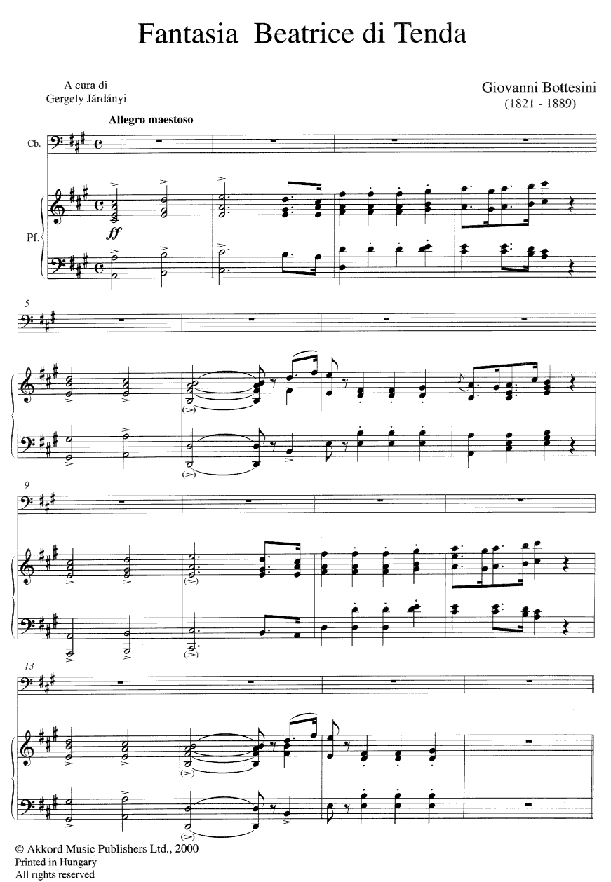
• Fantasia Beatrice di Tenda
• Fantasia Cerrito
• Fantasia Lucia di Lammermoor
• Fantasia Norma
• Fantasia Puritani
• Fantasia Sonnambula
• Fantasia Straniera
• Grande Allegro di Concerto alla Mendelssohn
• Introduzione e Gavotta
• Melodia – Please see Romanza Patetica also known as Elegia No. 3
• Nel cor più non mi sento
• Ninna Pazza per Amore
• Romanza Dramatica – also known as Elegia No. 2 and Nuova Elegia
• Romanza Patetica – also known as Elegia No. 3 and Melodia
• Tarantella
Concertos
- Concerto di Bravura [ A Major, No. 1 ], JGB 9.01, BOT. 84, GB.69 (1840/1841)
LC Title Authority:Concertos, double bass, orchestra, no. 3, A major. LC Record
Note: Among the Bottesini scholars such as Járdányi, Street and Ricciuti there is a general consensus that Concerto di Bravura is the first bass concerto Bottesini wrote. They date it to 1840 or 1841, in the years immediately after Bottesini studies in Milan. Furthermore, the piano score title in Bottesini’s own handwriting states Concerto di bravura N°1 , where the N°1 may imply Bottesini’s own numbering system, and according to which this may not only be the very 1st concerto he wrote, but also the very first piece he conceived.
Sources:
Concerto di bravura N°1 – piano score in A Major, I-PA-c, Bott.60.b [ Old Signatures: No. 1, CB. II 3 and 47532 ] Cited as: JGB 9.01, Inzaghi BOT. 84 – Solo Tuning
Manuscript Data – RISM Record – SBN Record
Manuscript – Online View & Download – Internetculturale.sbn.it
Contained in Collection:
Composizioni per Contrabasso – piano score, I-PAc , Bott.60.a-f [ Old Signatures: No. 60, CB. II 3 and 47532 ]
Record Notes:
1 partitura (cc.48 (c.48v vuota))
Il manoscritto contiene: Fantasia sulla Beatrice di Tenda, Concerto di bravura, Fantasia Cerrito, Capriccio di bravura, Elegie par Ernst, Grande allegro di concerto
partitura
Manuscript Data – RISM Record – SBN Record
Manuscript – Online View & Download – Internetculturale.sbn.it
–
General Note: This composition is preserved only in a single piano score. The manuscript however bears Bottesini’s markings for future orchestration that was never completed (See Clar. Fag. Violoncello indications on scan page c. a 16r at Internetculturale.sbn.it). Inzaghi cites also the Naples Conservatory ( I-Nc ) manuscript that could not be located in either SBN or RISM. In respect to dating, Street dates this concerto according to Brescia 1840 or Crema 1841 performances, while Járdányi suggests Crema 1841.
Online View & Download – IMSLP
Reference Recording:
1. Andante mosso – Allegro moderato – YouTube [ Mario Ricciuti ]
2. Andante – YouTube [ Mario Ricciuti ]
3. Allegretto – YouTube [ Mario Ricciuti ]
- Concerto in Si Minore [ B Minor, No. 2 ], JGB 9.02, GB.70 (1845-1857)
LC Title Authority:Concertos, double bass, orchestra, no. 2, B minor. LC Record
Sources:
1.o Tempo | Concerto Si minore | G. Bottesini, piano score in B minor, I-PAc, Bott.72/I-III [ Old Signatures: 47537, 47537a, 47537b ] Cited as: JGB 9.02b, Inzaghi BOT. 29 – Solo Tuning
Manuscript Data – RISM Record – SBN Record
Manuscript – Online View & Download – Internetculturale.sbn.it
Note: This piano score manuscript presents all three movements of what we know today as Bottesini’s B Minor Concerto. It is of interest to note that each movement is presented on a different manuscript, which suggests that movements may have been written in sequence in different times. Also, all three movements have a slightly different old signature number (see old signatures above). A curious detail to all bassists who may wish to perform this concerto is that finishing chords of the third movement in original (ink) indicate B Major, while later corrections equalize it to B minor (?)
–
1.o tempo | 2.o Concerto contrabasso, piano score in C minor, I-PAc, Bott.71/I-III [ Old Signature: 25759 ] Cited as: JGB 9.02/c, Inzaghi BOT. 85 – Bottesini Tuning
Manuscript Data – RISM Record – SBN Record
Manuscript – Online View & Download – Internetculturale.sbn.it
–
1.o Tempo / (Altra Mano) Concertino per contrabasso, full orchestra score in B minor (1st movement), I-PAc, Bott.40 [ Old Signature: No. 40, CB-II-4, 47601 ] Cited as: JGB 9.02/a, Inzaghi BOT. 29 – Solo Tuning
Manuscript Data – RISM Record – SBN Record
Manuscript – Online View & Download – Internetculturale.sbn.it
Note on Manuscript:
Di altra mano a c.1r: Concertino per contrabasso. E’ il concerto, chiamato anche concertino, di cui esiste la variante in do minore. (Source SBN Record)
Note on Manuscript – Translated:
By another hand on c.1r: Concertino for double bass. This is the concerto, also called concertino, of which there is a variant in C minor.
Note: This orchestra score manuscript presents only the First Movement of the concerto that we know today as Bottesini’s B Minor Concerto. Járdányi (p. 40) believes this score represents the original independent piece to which two additional movements were added later to create what we know today as the B Minor Concerto.
–
Concertino in do min | per contrabasso | G. Bottesini, string orchestra score and parts in C minor, I-PAc , Bott.39/I-V [ Old Signatures: CB-II-4, 47596 to 47600 ] Cited as: JGB 9.02/d, Inzaghi BOT. 27 – Bottesini Tuning
Manuscript Data – RISM Record – SBN Record
Manuscript – Online View & Download – Internetculturale.sbn.it
Note: This source was also considered as featuring a string quartet accompaniment (Inzaghi BOT. 27)
–
Composition Page – Wiki en – Bottesini Db Concerto No. 2
Note on Dating: Various authorities date this concerto differently. Slatford in Grove’s article (followed by wikipedia) cites 1845, which implies an early work of Bottesini written when he was about 24 years of age and while employed in Venice. Suggested is also that he may have written this concerto even earlier during his study days in Milan. Street and West cite 1853 as related to Dublin performance. Lastly, Járdányi cites 1857 as related to Paris performance.
Note on Versions: You may have noticed that some performances feature more then standard four measures of introduction in the first movement. Those longer introductions are likely of later date, since all four of preserved Bottesini’s manuscripts feature only four measures of introduction.
General Note: This concerto is preserved with both piano and orchestra accompaniments.
–
Online View & Download – IMSLP
–
Reference Recording – YouTube [ Rinat Ibragimov ] (with piano, original three string instrument setup)
Reference Recording – YouTube [ Giuseppe Ettorre ] (with orchestra – alive)
Reference Recording – YouTube [ Thomas Martin ] (with orchestra in C Minor)
Note: This recording by Prof. Martin should be in Bottesini Tuning.
Reference Recording – YouTube [ Enrico Fagione ] (with orchestra – alive)
Reference Recording – YouTube [ Ödön Racz ] (with orchestra – alive)
- Grande Concerto per Contrabbasso [ F # Minor, No. 3 ], JGB 9.04, GB.71 (1871, 1878)
LC Title Authority:Concertos, double bass, orchestra, no. 1, F# Minor. LC Record
Note: While some recordings cite this concerto as No. 1, there is a general consensus among Bottesini scholars, such as Járdányi and Street, that this work represents the third and the last bass concerto Bottesini wrote. In fact Járdányi states that “It is the maestro’s longest, most mature, heaviest and probably last composition for double bass” (translated). Street in his online catalog, under GB.71 designation, also presents an argument on why Concerto in F # Minor should be ranked as Concerto No. 3.
Sources:
Concerto per contrabasso, Orchestra score and parts in F# minor, I-PAc, Bott.36/I-XXVI [ Old Signatures: No. 36, CB-II-7 and 47639 ] Cited as: JGB 9.04/a, Inzaghi BOT. 42 – Solo Tuning
Orchestra Score Cover Title: Grande Concerto per Contrabasso / Partitura
Orchestra Score Heading Title: Concerto per Contrabasso
Manuscript Data – RISM Record – SBN Record
Manuscript – Online View & Download – Internetculturale.sbn.it
Note: Score and parts used in performances at Lausanne 1878 and Baden Baden (presumably the same year).
–
Concerto in Sol Minore, orchestra score and parts in G minor, I-PAc, Bott.37/I-XXII [ Old Signature: No. 37, CB-II-6 and 25692-25713 ] Cited as: JGB 9.04/b, Inzaghi BOT. 28 – Bottesini Tuning
Manuscript Data – RISM Record – SBN Record
Manuscript – Online View & Download – Internetculturale.sbn.it
–
Concerto in Fa [diesis] Minore per Contrabasso con accompagnamento di Pianoforte di G. Bottesini, piano score in F# minor, I-PAc, Bott.68 [ Old Signature: CB.II. 3 and 47533 ] Cited as: JGB 9.04/c, Inzaghi BOT. 86 – Solo Tuning
Manuscript Data – RISM Record – SBN Record
Manuscript – Online View & Download – Internetculturale.sbn.it
–
Concerto / Sol minore, piano score in G minor, I-PAc, Bott.67 [ Old Signature: 25757 ] Cited as: JGB 9.04/d, Inzaghi BOT. 87 – Bottesini Tuning
Manuscript Data – RISM Record – SBN Record
Manuscript – Online View & Download – Internetculturale.sbn.it
–
General Note: This composition is preserved with both piano and orchestra accompaniments. In respect to dating Street cites 1871 as related to Dublin perfomance. Járdányi cites 1878 as related to Lausanne and Baden-Baden performances.
–
Reference Recording – YouTube [ Dominik Wagner ]
Reference Recording:
1. Allegro Moderato – YouTube [ Ali Kian Yazdanfar]
2. Andante – YouTube [ Ali Kian Yazdanfar]
3. Finale – YouTube [ Ali Kian Yazdanfar]
Reference Recording – YouTube [ Hojung Jung ]
Reference Recording – YouTube [ Thomas Martin ] (with orchestra)
Reference Recording:
1. Allegro Moderato – YouTube [ Wies de Boevé ] (with orchestra – original 3 string setup)
2. Andante – YouTube [ Wies de Boevé ] (with orchestra – original 3 string setup)
3. Finale – YouTube [ Wies de Boevé ] (with orchestra – original 3 string setup)
Reference Recording:
1. Allegro Moderato – YouTube [ Théotime Voisin] (with orchestra)
2-3. Andante and Finale – YouTube [ Wies de Boevé ] (with orchestra)
Reference Recording:
1. Allegro Moderato – YouTube [ Dominik Wagner ] (with orchestra)
2. Andante – YouTube [ Dominik Wagner ] (with orchestra)
3. Finale – YouTube [ Dominik Wagner ] (with orchestra – real time video of the recording session)
Reference Recording:
1. Allegro Moderato – YouTube [ Ovidiu Badila ] (with orchestra)
2. Andante – YouTube [ Ovidiu Badila ] (with orchestra)
3. Finale – YouTube [ Ovidiu Badila ] (with orchestra)
Solo Compositions
- Addio a Bologna, BOT. 232, GB 62, (c 1862) [ Lost ]
Note: Járdányi does not cite this work in his thesis catalog and believes this composition may have been one of Bottesini’s slow pieces such as Elegy or Melody, later renamed as Addio a Bologna for the occasion of Bottesini’s last performance in Bologna.
- Allegretto Capriccio per Violone à la Chopin, JGB 9.53, GB.64 ( )
Sources:
Allegretto Capriccio (per Violone) in F# minor – piano score in F# minor, I-PAc , Bott.80 [ Old Signatures: CB.II.3 and 47589 ] Cited as: JGB 9.53/a, Inzaghi BOT. 73 – Solo Tuning
Manuscript Data – RISM Record – SBN Record
Manuscript – Online View & Download – Internetculturale.sbn.it
–
Allegretto Capriccio in G minor – piano score in G minor, I-PAc, Bott.81 [ Old Signatures: CB.II.3 and 47588 ] Cited as: JGB 9.53/b, Inzaghi BOT. 72 – Bottesini Tuning
Manuscript Data – RISM Record – SBN Record
Manuscript – Online View & Download – Internetculturale.sbn.it
–
Allegretto Capriccio per Violone – 5 parts (vln 1, vln 2, vla, vcl, basso) in F# minor, I-PAc , Bott.49/I-V [ Old Signatures: CB.II.7 and 61356 ] Cited as: JGB 9.53/c, Inzaghi BOT. 74 – Solo Tuning
Manuscript Data – RISM Record – SBN Record
Manuscript – Online View & Download – Internetculturale.sbn.it
–
General Note: The I-PAc, Bott.80 and Bott.49/I-V sources bear an inscription per Violone. In practice however this composition had also acquired a second name à la Chopin. For that reason both of these designations are included in the main title. This composition is preserved with both piano and string ensemble accompaniments.
–
Reference Recording – YouTube [ Alberto Bocini ]
Reference Recording – YouTube [ Laurène Durantel ]
Reference Recroding – YouTube [ Francesco Siragusa ]
Reference Recording – YouTube [ Ovidiu Badila ]
Reference Recording – YouTube [ Michael Reiber ]
Reference Recording – YouTube [ Massimo Giorgi ] (with orchestra)
Reference Recording – YouTube [ Gergely Járdányi ] (with orchestra)
- Andantino, GB.63 ( ) [ Lost ]
Note: Musical citation – fragment. This piece is cited in Street catalog.
- Auld Robin Gray, JGB 9.51, BOT. 78, GB.80 (1887)
LC Title Authority:Auld Robin Gray. LC Record
Alternative Titles:Melodie No. 4
–Variations on a Scottish Air
Source:
Auld Robin Gray – piano score in E Major, I-PAc, Bott.65 [ Old Signatures: CB.II.3 and 47595 ] Cited as: JGB. 9.51, Inzaghi BOT. 78 – Solo Tuning
Manuscript Data – RISM Record – SBN Record
Manuscript – Online View & Download – Internetculturale.sbn.it
–
General Note: This composition is preserved only with piano accompaniment. Chris West dates this composition to 1887.
–
Reference Recording – YouTube [ Thomas Martin ] (score on screen)
Reference Recording – YouTube [ Thomas Martin ]
Reference Recording – YouTube [ Gergely Járdányi ]
Reference Recording – YouTube [ Leon Bosch ]
Reference Recording – YouTube [ Théotime Voisin ]
- Bolero, JGB 9.55, GB.66 (1885)
Alternative Title:Introduzione e Bolero
Sources:
Bolero – piano score in A minor, I-PAc, Bott.69 [ Old Signatures: CB.II.3 and 47535 ] Cites as: JGB 9.55/a, Inzaghi BOT. 79 – Solo Tuning
Manuscript Data – RISM Record – SBN Record
Manuscript – Online View & Download – Internetculturale.sbn.it
–
Bolero in Sib – piano score in B flat minor, I-PAc, Bott.70.a [ Old Signatures: 47534 ] Cited as: JGB 9.55/b , Inzaghi BOT. 80 – Bottesini Tuning
Manuscript Data – RISM Record – SBN Record
Manuscript – Online View & Download – Internetculturale.sbn.it
Contained in Collection:
Composizioni per Contrabasso e Pianoforte – piano score, I-PAc, Bott.70.a-b [ Old Signatures: 47534 ]
Record Notes:
1 partitura (cc.24 (cc.22,23,24v vuote))
Il manoscritto contiene due composizioni: Bolero in Sib e Allegro di concerto
partitura
Manuscript Data – RISM Record – SBN Record
Manuscript – Online View & Download – Internetculturale.sbn.it
–
Bolero per Contrabasso – orchestra score and parts in A minor, I-PAc, Bott.38/I-XXXVII [ Old Signatures: No. 38, CB.II.4, 47602 (score) ; 47631-8 (parts) ] Cited as: JGB 9.55/c, Inzaghi BOT. 24 – Solo Tuning
Manuscript Data – RISM Record – SBN Record
Manuscript – Online View & Download – Internetculturale.sbn.it
–
Sources Note: Járdányi (p. 52) cites also a fourth Parma manuscript source titled Bolero [ undated orchestral score in A ] under old signature 47603. That score however could not be located in either in RISM or SBN. Possibly it may be a score that was not yet catalogued?
–
General Note: This composition is preserved with both piano and orchestra accompaniments. Chris West dates this composition to 1885 while Járdányi references it to the first London perfomance in 1886.
–
Reference Recording – YouTube [ Francesco Siragusa ]
Reference Recording – YouTube [ Francesco Siragusa ] (score on screen)
Reference Recroding – YouTube [ Dominik Wagner ]
Reference Recroding – YouTube [ Thomas Martin ]
Reference Recording – YouTube [ Wies de Boevé ]
Reference Recording – YouTube [ Théotime Voisin ]
Reference Recording – YouTube [ Mikyung Sung ( 성미경 ) ]
Reference Recording – YouTube [ Gergely Járdányi ] (with orchestra)
- Capriccio di Bravura, JGB 9.54, BOT. 82, GB.67 (1858)
LC Title Authority:Capriccio di bravura. LC Record
Alternative Titles:Capriccio bravura
Sources:
Capriccio di Bravura. N° 14 – piano score in A major, I-PAc, Bott.60d [ Old Signatures: No. 14, CB.II.3 and 47532 ] Cited as: JGB 9.54, Inzaghi BOT. 82 – Solo Tuning
Manuscript Data – RISM Record – SBN Record
Manuscript – Online View & Download – Internetculturale.sbn.it
Contained in Collection:
Composizioni per Contrabasso – piano score, I-PAc, Bott.60.a-f [ Old Signatures: No. 60, CB. II 3 and 47532 ]
Record Notes:
1 partitura (cc.48 (c.48v vuota))
Il manoscritto contiene: Fantasia sulla Beatrice di Tenda, Concerto di bravura, Fantasia Cerrito, Capriccio di bravura, Elegie par Ernst, Grande allegro di concerto.
partitura
Manuscript Data – RISM Record – SBN Record
Manuscript – Online View & Download – Internetculturale.sbn.it
–
General Note: This composition is preserved only with piano accompaniment. Chris West dates this composition to 1858.
–
Reference Recording – YouTube [ Alberto Bocini ]
Reference Recording – YouTube [ Thomas Martin ]
Reference Recording – YouTube [ Ludwig Streicher ]
Reference Recording – YouTube [ Francesco Siragusa ]
Reference Recording – YouTube [ Théotime Voisin ]
Reference Recording – YouTube [ Mikyung Sung ]
Reference Recroding – YouTube [ Ovidiu Badila ]
- Carnevale di Venezia, JGB 9.37, GB.83 (1849)
LC Title Authority:Introduzione e variazioni sul Carnevale di Venezia. LC Record
Alternative Titles:Introduzione e Variazioni sul Carnevale di Venezia
–Introduction et Variations sur le Carnaval de Venesi
–Carnaval de Venise
Sources:
Carneval de Venise – piano score in A major, I-PAc, Bott.87 [ Old Signature: 25686 ] Cited as: JGB 9.37/a, Inzaghi BOT. 122 – Solo Tuning
Manuscript Data – RISM Record – SBN Record
Manuscript – Online View & Download – Internetculturale.sbn.it
–
Carneval de Venise [ No. 3 ] – orchestra parts in A major, I-PAc, Bott.57/I-XXXV [ Old Signatures: No. 57, (No. 35), 61361 ] Cited as: JGB 9.37/b, Inzaghi BOT. 46 – Solo Tuning
Manuscript Data – RISM Record – SBN Record
Manuscript – Online View & Download – Internetculturale.sbn.it
Note: Internetculturale scan starts with wind parts and continues with string parts. Solo bass part is missing. Also, Járdányi points that the title page for violin 1 indicates big N° 3 signature, and while initially the number may appear to be just the number of the violin part, the size and the unique smaller (likely older) format of this part suggests that the number may also be a designator of the initial Bottesini chronology (page c. n1r of the scan). So it is included in the main title for the manuscript as well. Further research should address if indeed Carneval de Venise may be the third composition Bottesini composed.
–
Introduction et Variations sur le Carnaval de Venesi – piano score and solo bass part in B flat major, D-B, Mus.ms. 2321/7 – Bottesini Tuning
Manuscript Data – RISM Record
Note: This RISM record represents a solo bass part manuscript held in Staatsbibliothek zu Berlin under signature Mus.ms. 2321/7. The record for this item however could not be located in the online Staatsbibliothek catalog since the search had shown only records for manuscripts 2321/5 and 2321/6. As indicated in the RISM record notes, this part is likely 1891 copy made from some other source. Also, what is interesting is that this part is in B flat major, which a half step above A major and that implies the use of Bottesini Tuning.
–
General Note: This composition is preserved with both piano and orchestra accompaniments.
Online View & Download – IMSLP
–
Reference Recording – YouTube [ Alberto Bocini ]
Reference Recording – YouTube [ Francesco Siragusa ]
Reference Recording – YouTube [ Stefano Sciascia ]
Reference Recording – YouTube [ Gergely Járdányi ]
Reference Recording – YouTube [ Miriam Barbierato ] (alive)
Reference Recording – YouTube [ Ovidiu Badila ]
Reference Recording – YouTube [ Giuseppe Ettorre ] (with orchestra)
- Contrabass – Polka, JGB 6.04, BOT. 30, GB.72 (1887)
Sources – printed edition of piano score and orchestra score:
Contra-Bass Polka – Orchestral and P. F. Parts, GB-Lbl, f.400.ii.(15.) [ printed edition ] Cited as: JGB 6.04, Inzaghi BOT. 30, BOT. 92.
Edition Data – British Library Record
–
Score Sample – StringVirtuoso.com (ed. Michele Celaro)
Score Sample – StringVirtuoso.com (ed. Thomas Martin)
–
General Note: Contrabass Polka has apparently survived only in the 1887 printed edition by J. R. Lafleur & Son, London. Both Inzaghi and British Library indicate versions (accompaniments) for piano and orchestra.
–
Reference Recording – YouTube [ Gergely Járdányi ] (with orchestra)
- Divertimento Straniera
Please see: Fantasia Straniera also known as Divertimento per Contrabbasso and Variazioni per Contro-Basso sopra un tema nell’opera La Straniera.
- Elegia in Re – No. 1, JGB 9.56, GB. 73 (1857)
LC Title Authority:Elegies, double bass, piano, D major. LC Record
Alternative Titles:Elegia e Tarantella *
–Elegia Melodica
–Elegie
–Elegy
–Melodia
––
–* Note: Only Elegia No. 1 is paired with Tarantella.
Sources:
Elegie – piano score in D Major, I-PAc, Bott.74.a [ Old Signatures: No. 74, CB.II.3 and 47593 ] Cited as: JGB 9.56/a – Solo Tuning
Manuscript Data – RISM Record – SBN Record
Manuscript – Online View & Download – Internetculturale.sbn.it
–
Elegia – string orchestra score in D Major, I-PAc, Bott.74.b [ Old Signatures: CB-II-4 and 47530 ] Cited as: JGB 9.56/b, Inzaghi (possibly) BOT. 97 – Solo Tuning
Manuscript Data – RISM Record – SBN Record
Manuscript – Online View & Download – Internetculturale.sbn.it
–
Elegia / Melodia per Contrabasso con accompagnamento di Pianoforte – piano score and solo bass part in D major, I-Bacp, Q – III – 7.16 – Solo Tuning
Manuscript Data – RISM Record – SBN Record
Note: This score is held at Biblioteca del Conservatorio Statale di Musica Niccolò Piccinni in Bari, and is classified as possible but spurious autograph by Bottesini. It is interesting to note that this source for Elegia in Re bears autograph title of both Elegia and Melodia.
–
Elegia Melodica dall’Esimio Artista Bottesini / N° 7 – piano score in D major, I-Nc (call number missing) – Solo Tuning
Manuscript Data – SBN Record
Note: Járdányi (p. 52) cites this score as Elegia Melodica dall’Esimio Artista Bottesini / No. 7 with location in Biblioteca del Conservatorio di Musica S. Pietro a Majella, Napoli (I-Nc), yet he does not assign his own JGB number to this score. The record for this item exists in SBN (link above) but not in RISM. Furthermore the Naples Conservatory does not have its own online library catalog but uses the SBN, therefore the search for more information on this score did not yield much beyond the sparse SBN record. It is of interest however that Járdányi citation shows No. 7 in the title, which may imply a sequence of composition for this piece. Further inquiry should address if this score represents Elegia in Re, No. 1 or possibly some other Elegia.
–
Elegie – piano score in D Major, I-PAc, Bott.75.a [ Old Signatures: No. 75, CB-II-5 and 47583 ] Cited as: JGB 9.56/c – Solo Tuning
Manuscript Data – RISM Record – SBN Record
Manuscript – Online View & Download – Internetculturale.sbn.it
Contained in Collection:
Composizioni per Contrabasso – piano score, I-PAc , Bott.75.a-b [ Old Signatures: No. 75, CB-II-5 and 47583 ]
Record Notes:
1 partitura (cc.6 (c.6v vuota))
Il fascicolo contiene: Elegie, Tutto che il mondo serra (Chopin Terzetto)
Manuscript Data – RISM Record – SBN Record
Manuscript – Online View & Download – Internetculturale.sbn.it
–
Elegia N.1 – piano score in E flat Major, I-PAc, Bott.73.a [ Old Signatures: 47531 ] * followed by Tarantella. Cited as: JGB 9.56/d, Inzaghi BOT. 96 – Bottesini Tuning
Manuscript Data – RISM Record – SBN Record
Manuscript – Online View & Download – Internetculturale.sbn.it
Note (!): Pagination and scan sequence in the Internetculturale link cited above are out of order. Yet, for some reason the same link at the collection below presents the proper sequence. So, please check the Internetculturale link below for a better overview of Elegia and Tarrantella manuscripts, since these two pieces are bound at the beginning of the collection.
Contained in Collection:
Composizioni per Contrabasso e Pianoforte – piano score, I-PAc, Bott.73.a-g [ Old Signatures: 47531 ]
Record Notes:
1 partitura (cc.32)
Il fascicolo contiene: Elegia n.1 e Tarantella, Meditazione Bach, Nel cor più non mi sento, Fantasia sulla Lucia di Lammermoor, Elegia n.2, Elegia n.3, Introduzione e gavotta
partitura
Manuscript Data – RISM Record – SBN Record
Manuscript – Online View & Download – Internetculturale.sbn.it
–
Elegia per Contrabasso – orchestra parts in D Major, I-PAc, Bott.46/I-XLVIII [ Old Signatures: 61364 and 148043 to 148088 ] Cited as: JGB 9.56/e, Inzaghi BOT. 36 – Solo Tuning
Manuscript Data – RISM Record – SBN Record
Manuscript – Online View & Download – Internetculturale.sbn.it
Note: Parts contain also Tarantella in D. This set of parts lacks the solo bass part.
–
Elegia e Tarantella – orchestra parts in E flat Major, I-PAc, Bott.47/I-XXIV [ Old Signatures: 61365 and 148304 to 148326 ] JGB 9.56/f, Inzaghi BOT. 37 – Bottesini Tuning
Manuscript Data – RISM Record – SBN Record
Manuscript – Online View & Download – Internetculturale.sbn.it
Note: This set of parts lacks the solo bass part. This score is listed also under Tarantella
–
General Note: Elegia (Elegy) was one of the favorite pieces of Bottesini and has remained popular to this day. So, it should not come as a surprise that this piece is preserved in some eight period manuscript sources than include several piano scores along with two ensemble accompaniment versions. Bottesini has often performed Elegia in pair with Tarantella and there are sources that features both pieces as a joint composition as well. However, in this listing Elegia and Tarantella are listed separately.
Furthermore, the favorite piece that everyone simply knows as “Elegy” is also known as Elegy No. 1 since there are two additional Elegies that are numbered sequentially as No. 2 and No. 3. These other Elegies however have been known also by other names that Bottesini himself has used, and both the Library of Congress and Járdányi use those other titles. Therefore such a classification is applied here as well. For Elegia No. 2 please see Romanza Dramatica and for Elegia No. 3 please see Romanza Patetica . All Elegies under various titles are well cross-referenced, so it should not be a problem to locate the one you wish to find.
–
Reference Recording – YouTube [ Alberto Bocini ]
Reference Recording – YouTube [ Francesco Siragusa ]
Reference Recording – YouTube [ Joel Quarrington ]
Reference Recoridng – YouTube [ Ödön Racz ]
Reference Recording – YouTube [ Dominik Wagner ]
Reference Recording – YouTube [ Thomas Martin ]
Reference Recording – YouTube [ Massimo Giorgi ] (with orchestra – integral version)
Note: In this recording Giorgi presents integral version of Elegia and Tarantella with a small bridging Andante that connects these two pieces. You can see this Andante at the end of Elegia orchestra score scan at Internetculturale.sbn.it (scan page c. 4r), and also in piano version of Elegia e Tarantella at Internetculturale.sbn.it (scan page c. 3r). This integral version represents how Bottesini often performed these pieces and which in this instance may be considered a single piece titled Elegia e Tarantella. It may also be of interest to note that in this integral version the cadenza (solo bass section) which we commonly associate with the beginning of Tarantella, is in fact the cadenza for a small Andante, while the very Tarantella starts right at the fast 6/8/ tempo.
Reference Recording – YouTube [ František Pošta ] (with orchestra)
Reference Recording – YouTube [ Gergely Járdányi ] (with orchestra)
- Elegia No. 2
Please see: Romanza Dramatica also known as Nuova Elegia
- Elegia No. 3
Please see Romanza Patetica also known as Melodia
- Elegia No. 4
Elegia No. 4 is better known as Elegia par Ernst and this piece is actually Bottesini’s arrangement, thus it will be listed under Arrangements & Transcriptions when this listing is ready for presentation. This piece is also known as Adagio Melancolico ed Appassionato.
- Fantasia Beatrice di Tenda, JGB 9.32, GB.82 (1843)
LC Title Authority:Concerto nell’opera Beatrice di Tenda. LC Record
Alternative Titles:Concerto per Contrabasso nell’opera Beatrice di Tenda
–Fantasia Beatrice di Tenda
–Fantasia o Concerto per Contrabasso nell’Opera Beatrice di Tenda
–Fantasia sulla “Beatrice di Tenda” di V. Bellini
–Fantasia sulla “Beatrice di Tenda”
–Souvenir de la Beatrice Tenda
Sources:
N.7 / Fantasia / Beatrice di Tenda – piano score in A major, I-PAc, Bott.60.a [ Old Signatures: No. 7, CB.II.3 and 47532 ] JGB 9.32/a, Inzaghi BOT. 91.
Manuscript Data – RISM Record – SBN Record
Manuscript – Online View & Download – Internetculturale.sbn.it
Contained in Collection:
Composizioni per Contrabasso – piano score, I-PAc, Bott.60.a-f [ Old Signatures: No. 60, CB. II 3 and 47532 ]
Record Notes:
1 partitura (cc.48 (c.48v vuota))
Il manoscritto contiene: Fantasia sulla Beatrice di Tenda, Concerto di bravura, Fantasia Cerrito, Capriccio di bravura, Elegie par Ernst, Grande allegro di concerto
partitura
Manuscript Data – RISM Record – SBN Record
Manuscript – Online View & Download – Internetculturale.sbn.it
Note: The Collection scan presents also the title page of the Beatrice di Tenda, while the separate composition scan (link at the top) for some reason does not include it.
–
Concerto per Contrabasso nell’opera Beatrice di Tenda – piano score in A major, I-BAcp, Q-II-10.1
Manuscript Data – RISM Record – SBN Record
Note: This score is held at the Biblioteca del Conservatorio Statale di Musica Niccolò Piccinni in Bari.
–
Concierto per Contrabasso, Nell’opera Beatrice Di Tenda. Ms. (photocopy)
[ From the Anton Torello Bequest, Curtis Institute, no. 5. ]
Manuscript Data – Indiana University Record
Note: This source in Indiana University is apparently a piano score copy that was made from the original manuscript held in Curtis Institute within Anton Torello collection. However an online search of Curtis Institute holdings could not yield a record for this manuscript. Otherwise it appears that the score at Curtis is either a personal copy of Anton Torello, or a copy of his teacher Pedro Valls. Further inquiry on the history and location of this Curits Institute score is needed.
Deduced from Legacy of Double Bass (at Curtis) [ online article ]
Top Paragraph Citation:
Giovanni Bottesini and Pedro Valls inspired Curtis’s first double bass teacher, the Catalàn virtuoso Anton Torello, who brought to Philadelphia original manuscripts of their compositions when he became principal bass of the Philadelphia Orchestra.
–
Fantasia o Concerto per Contrabasso nell’Opera Beatrice di Tenda – piano score in A major, I-BAcp, Q – III – 7.14
Manuscript Data – RISM Record – SBN Record
Note: This score is held at the Biblioteca del Conservatorio Statale di Musica Niccolò Piccinni in Bari.
–
Fantasie über “Beatrice di Tenda” für Contra=Basso – piano score in A major, D-B, Mus.ms. 2321/4
Manuscript Data – RISM Record – Stabicat Record
Manuscript – Online View & Download – Stabicat Digital
Note: Staatsbibliothek zu Berlin record and digital scan offer only the solo bass part althogh RISM indicates a piano score as well. Please note also a difference in RISM record number 2321/4 from the Stattsbibliothek 2321/5.
Contained in Collection:
Concertstücke für Contrabass von Bottesini – solo bass part, D-B , Mus.ms. 2321/5
Record Notes:
part (cb solo): 12f.
• Bottesini, Giovanni: Fantasies – cb Beatrice di Tenda
• Bottesini, Giovanni: Fantasies – cb Fantasia Sonnambula
• Mareš, Jan Antonín: Polonaises – cb Polonaise
• Anonymus: Polonaises – Arr; cb Polonaise – Andante
• Bottesini, Giovanni: Duets – Fragments; vl, cb Grand Duo Concertant
• Dunkler, Emile: Instrumental pieces – i, pf Berceuse in E: Dunkler
• Ernst, Heinrich Wilhelm: Le Carnaval de Venise – cb; HopE p.472 Der Carnelval, Ernst
• Anonymus: Rigoletto – Excerpts; cb; HopV 53 Contrabass Solo aus Rigoletto
• Bottesini, Giovanni: Forellen Quintett – Excerpts; Arr; cb; op.114/1; D-2 667 Forellen Quintett
Note: Forellen Quintett consitis of only two solo lines at the bottom of page.
Manuscript Data – RISM Record
Manuscript – Online View & Download – Staatsbibliothek Record
–
Fantasie für Contrabass über “Beatrice di Tenda” – orchestra parts in A Major, D-B, Mus.ms. 2321/4
Manuscript Data – RISM Record
Note: RISM record clearly indicates the possession of orchestra parts for Beatrice di Tenda by Staatsbibliothek Berlin, yet the record for these parts can not be located in Staatsbibliothek online catalog. It is possible that these parts may not have been catalogued yet for some reason? Also, please note that these parts bear the same signature 2321/4 as the piano score 2321/4 cited in the record above.
–
Souvenir de la Beatrice Tenda – string parts in A major, I-PAc , Bott.62/I-VI [ Old Signatures: No. 62, CB-II-3 and 47661-47666 ] JGB 9.32/b, Inzaghi BOT. 69.
Manuscript Data – RISM Record – SBN Record
Manuscript – Online View & Download – Internetculturale.sbn.it
Note: This manuscript collection presents the set of string orchestra parts with the solo bass and viola parts are missing. SBN record suggests “cb-solo, vl1, vl2, vla, vlc, cb” setup. However, preserved are only Vln 1 (two parts), Vln 2 (two parts) and Contrabasso tutti (also two parts).
–
Score Sample – Accordmusic.com
General Note: This composition is preserved with both piano and string orchestra accompaniments. It appears that all extant copies are in the key of A major which should indicate only a Solo Tuning use.
–
Reference Recording – YouTube [ Thomas Martin ]
Reference Recording – YouTube [ Luigi Milani ]
Reference Recording – YouTube [ Francesco Siragusa ]
Reference Recording – YouTube [ Ovidiu Badila ]
Reference Recording – YouTube [ Joel Quarrington ]
Reference Recording – YouTube [ Wies de Boevé ] (alive)
Reference Recroding – YouTube [ Gergely Járdányi ] (with orchestra)
- Fantasia Cerrito, JGB 9.36, BOT. 102, GB.68 (1847)
LC Title Authority:Fantasia Cerrito. LC Record
Alternative Titles:Cerrito
Sources:
N.12 | Fantasia Cerrito, piano score in G major, I-PAc , Bott.60.b [ Old Signatures: No. 12, CB-II-3 and 47532 ]
Manuscript Data – RISM Record – SBN Record
Manuscript – Online View & Download – Internetculturale.sbn.it
Contained in Collection:
Composizioni per Contrabasso – piano score, I-PAc , Bott.60.a-f [ Old Signatures: No. 60, CB-II-3 and 47532 ]
Record Notes:
1 partitura (cc.48 (c.48v vuota))
Il manoscritto contiene: Fantasia sulla Beatrice di Tenda, Concerto di bravura, Fantasia Cerrito, Capriccio di bravura, Elegie par Ernst, Grande allegro di concerto
partitura
Manuscript Data – RISM Record – SBN Record
Manuscript – Online View & Download – Internetculturale.sbn.it
–
General Note: This composition is preserved only with piano accompaniment. Chris West dates this composition to 1847.
–
Reference Recording – YouTube [ Théotime Voisin ]
Reference Recording – YouTube [ Gergely Járdányi ] (score on screen)
Reference Recording – YouTube [ Gergely Járdányi ]
Reference Recording – YouTube [ Leon Bosch ]
Reference Recording – YouTube [ Nate West ]
Reference Recording – YouTube [ Mario Ricciuti ]
- Fantasia Lucia di Lammermoor, JGB 9.34, GB.93 ( )
LC Title Authority:Fantasia sulla “Lucia di Lammermoor” di G. Donizetti. LC Record
Alternative Titles:Fantasia Lucia
–Fantasia “Lucia di Lammermoor”
–Fantasia sulla “Lucia di Lammermoor”
Sources:
Fantasia – Lucia – – piano score in D flat major, I-PAc, Bott.73.d [ Old Signature: 47531 ] Cited as: JGB 9.34/a – Bottesini Tuning
Manuscript Data – RISM Record – SBN Record
Manuscript – Online View & Download – Internetculturale.sbn.it
Contained in Collection:
Composizioni per Contrabasso e Pianoforte – piano score, I-PAc, Bott.73.a-g [ Old Signatures: 47531 ]
Record Notes:
1 partitura (cc.32)
Il fascicolo contiene: Elegia n.1 e Tarantella, Meditazione Bach, Nel cor più non mi sento, Fantasia sulla Lucia di Lammermoor, Elegia n.2, Elegia n.3, Introduzione e gavotta
partitura
Manuscript Data – RISM Record – SBN Record
Manuscript – Online View & Download – Internetculturale.sbn.it
–
Fantasia Lucia – piano score in C major, I-PAc, Bott.86 [ Old Signatures: No. 86 and 47585 ] Cited as: JGB 9.34/b – Solo Tuning
Manuscript Data – RISM Record – SBN Record
Manuscript – Online View & Download – Internetculturale.sbn.it
–
Fantasia sui motivi dell’Opera Lucia di Lamermoor – piano score in C major, I-PAc, Bott.55.a [ Old Signatures: CB-II-3 and 47585 ] Cited as: JGB 9.34/c – Solo Tuning
Manuscript Data – RISM Record – SBN Record
Manuscript – Online View & Download – Internetculturale.sbn.it
Note: This score can be easily identified as it has only a single “m” after “a” in Lamermoor instead of two as commonly written in Lammermoor.
–
Fantasia per Contrabasso sopra motivi dell’Opera Lucia di Lamermour – orchestra parts in C major, I-PAc, Bott.55.b/I-XXXVIII [ Old Signatures: CB.II.3 and 47535 ] Cited as: JGB 9.34/d, Inzaghi BOT. 41 – Solo Tuning
Manuscript Data – RISM Record – SBN Record
Manuscript – Online View & Download – Internetculturale.sbn.it
Note: This source is easily identified by its bass part since the Violoncello e Basso title page has only one “m” and “o” in Lamermor instead of two of each as commonly written in Lammermoor. Also the second violin part bears inscription N° 9 / Fantasia Lucia which does not appear to be a designation for a part number but looks rather as a sequence number for entire Fantasia Lucia composition (scan page c. u1r ). Further research should address if indeed Fantasia Lucia may be the ninth piece Bottesini wrote.
–
Fantasia per Contrabasso con accompagnamento di Pianoforte sull’opera Lucia di Lammermoor – piano score in C major, I-BAcp, Q – III – 8.32 – Solo Tuning
Manuscript Data – RISM Record – SBN Record
Note: This item is held by Biblioteca del Conservatorio Statale di Musica Niccolò Piccinni in Bari.
–
General Note: This composition is preserved with both piano and orchestra accompaniments. In respect to dating neither Járdányi nor Street offer any time reference for this composition. However, the Parma I-PAc, Bott.55.b/I-XXXVIII source in the second violin part bears inscription N° 9 / Fantasia Lucia, and should N° 9 prove to be the sequence number for Fantasia Lucia, then this work may be dated as an early Bottesini composition, likely written in 1840s (see – Internetculturale.sbn.it scan page c. u1r )
–
Reference Recording – YouTube [ Laurène Durantel ]
Reference Recording – YouTube [ Alberto Bocini ]
Reference Recording – YouTube [ Rinat Ibragimov ]
Reference Recording – YouTube [ Francesco Siragusa ]
Reference Recording – YouTube [ Francesco Siragusa ] (alive)
Reference Recording – YouTube [ Julio Pastor ] (alive)
Reference Recording – YouTube [ Julian Medina ] (alive)
Reference Recording – YouTube [ Gergely Járdányi ] (with orchestra)
- Fantasia Norma, JGB 9.39, BOT. 104, JGB 9.39 ( )
LC Title Authority:Fantasia sulla Norma di Bellini. LC Record
Alternative Titles:Fantasia sulla “Norma” di V. Bellini
–Fantasia sulla “Norma”
Sources:
Street sates in his web catalog that “Score is in private hands – The autograph score was copied in Turin in 1938 by Pasquale Forgione.” On the other side, the only available edition of this piece was produced by Mario Ricciuti (Edizioni Bongiovanni) who was a student of Pasquale Forgione. Otherwise, the second manuscript copy is also extant at Malaric Collection in Mozarteum and this particular copy may have also come from Italy – see Mozarteum Record .
In addition, Nicola Malagugini in his article Bellini’s Esthetics and the Interpretation of Bottesini’s Fantasias presents a good argument that this piece may have likely been composed by Guido Gallignani, whose library has been later acquired by Pasquale Forgione. See WebArchive – Malagugini – Bottesini’s Fantasias . Járdányi also expresses doubts that Norma is the original work of Bottesini, while Inzaghi (BOT. 104) actually cites Bongiovanni 1984 edition as the source. Presently however, bassists perform Norma as the work of Bottesini and several good recordings of this piece have been produced since Ricciuti’s edition was published.
In the future and when access to the private manuscript may be granted, a thorough research and examination of this source may reveal more data and possibly some details that may offer a definitive answer on the authorship and provenance of this piece. For now it is classified as Bottesini’s work, until better assessment is possible.
–
General Note: This composition is preserved only with piano accompaniment.
–
Reference Recording – YouTube [ Ovidiu Badila ]
Reference Recording – YouTube [ Gergely Járdányi ]
Reference Recording – YouTube [ Ljubinko Lazić ] (alive)
- Fantasia Puritani, JGB 9.33, GB.89 (1858)
Sources:
Fantasia / Puritani – piano score in A major, I-PAc, Bott.85.a [ Old Signatures: CB.II.6 and 25690 ] Cited as: JGB 9.33/a – Solo Tuning
Manuscript Data – RISM Record – SBN Record
Manuscript – Online View & Download – Internetculturale.sbn.it
Contained in Collection:
Composizioni per Contrabasso – piano score, I-PAc, Bott.85.a-b [ Old Signatures: CB-II-6 and 25690 ]
Record Notes:
1 partitura (cc.12 (cc.9v,10 vuote))
Il manoscritto contiene due composizioni: Fantasia | Puritani, Aria Bach.
partitura
Manuscript Data – RISM Record – SBN Record
Manuscript – Online View & Download – Internetculturale.sbn.it
–
Fantasia sopra motivi dell’Opera I Puritani – orchestra parts in A major, I-PAc, Bott.54/I-XLIV [ Old Signatures: No. 19, CB – II – 5 and 25690 ] Cited as: JGB 9.33/b, Inzaghi BOT. 40 – Solo Tuning
Manuscript Data – RISM Record – SBN Record
Manuscript – Online View & Download – Internetculturale.sbn.it
Note: Violino Principale (first part) bears a number designation: Parti No. 19 which at the first sight appears to indicate just the number of parts (page scan c. p1r). Yet, after counting all the parts, of which there are more then 19, even if considering only the string parts, it appears that this may also be the old signature, or the chronology number similar to the other No. designators located on the title pages of Bottesini manuscripts. Thus the signature may also be interpreted as “Parts for the composition No. 19.” Further research should address this marking as a possible indicator of composition chronology, while addressing a prospect that Fantasia Puritani may be the 19th piece Bottesini wrote.
–
I Puritani – piano score and parts in A major, D-B, Mus.ms. 2321/3 – Solo Tuning
Manuscript Data – RISM Record
Note: This RISM record represents piano score and part affiliated with certain Schlufter. This items should be held by Staatsbibliothek zu Berlin under signature Mus.ms. 2321/3. However the online record for Mus.ms. 2321/3 could not be located in the online Staatsbibliothek catalog since the search had shown only records for manuscripts 2321/5 and 2321/6. Furthermore, RISM indicates that the same Mus.ms. 2321/3 is registered for another source in Staatsbibliothek zu Berlin which represents the orchestra score and parts. See below.
–
Puritaner=Fantasie für Contrabass-Solo, mit Begleit. des Orchesters – orchestra score and parts in A major, D-B, Mus.ms. 2321/3 – Solo Tuning
Manuscript Data – RISM Record
Note: This RISM record represents orchestra score and parts that are apparently an orchestration by certain Ernst Tritoche made from the piano score in 1875. These items should be held by Staatsbibliothek zu Berlin under signature Mus.ms. 2321/3. However the online record for Mus.ms. 2321/3 could not be located in the online Staatsbibliothek catalog since the search had shown only records for manuscripts 2321/5 and 2321/6.
–
General Note: This composition is preserved with both piano and orchestra accompaniments. Chris West dates this composition to 1858.
–
Reference Recording – YouTube [ Giuseppe Ettore ]
Reference Recording – YouTube [ Théotime Voisin ]
Reference Recording – YouTube [ Stefano Sciascia ]
Reference Recording – YouTube [ Catalin Rotaru ]
Reference Recording – YouTube [ Ovidiu Badila ]
Reference Recording – YouTube [ Gergely Járdányi ] (with orchestra)
- Fantasia Sonnambula, JGB 9.35, GB.90 (1840)
LC Title Authority:Sonnambula. LC Record 1 – LC Record 2
Alternative Titles:Fantasia Sonnambula
–Fantasia La Sonnambula
–Fantasia sulla Sonnambula di Bellini
–Fantasie Sonambula [ one ‘n” ]
–Fantasie Sonnambula
Sources:
Fantasie Sonambula (!) : pour la contrebasse. Piano score in A major, S. Richault : Paris, 1879 – piano score, I-PAc, Bott.111 [ Old Signature: 61358 ] Cited as: JGB 9.35/a – Solo Tuning
Edition Data (as a substitute for Manuscript Data) – SBN Record
Note: Járdányi states that the original manuscript of piano score for Fantasia Sonnambula was lost. However since the printed edition (S. Richault : Paris, 1879) was issued during Bottesini’s lifetime, and the same edition is preserved in Bottesini estate, it is reasonable to assume that Bottesini approved this print.
–
Fantasia per Contrabasso sopra motivi dell’Opera Sonnambula – orchestra parts in A major, I-PAc, Bott.56/I-XLI [ Old Signatures: 61357 (cit. Járdányi) and 148423 to 148462 ] Cited as: JGB 9.35/b, Inzaghi BOT. 39 – Solo Tuning
Manuscript Data – RISM Record – SBN Record
Manuscript – Online View & Download – Internetculturale.sbn.it
Note: Independent Solo Bass part is missing, yet the solo part music is included in Violino Principale part. Please see Internetculturale.sbn.it start page c. s1v.
–
Fantasia per contrabbasso e strumenti sull’opera «La Sonnambula» di Bellini – orchestra parts in A major, I-Mc, A. 30. 18. 9. Cited as: Inzaghi BOT. 39 – Solo Tuning
Manuscript Data – SBN Record
Manuscript – Online View & Download – Internetculturale.sbn.it
Note: This set of orchestra parts is located in Biblioteca del Conservatorio di Musica Giuseppe Verdi di Milano. This may be the second version of La Sonnambula according to Street, GB. 91.
–
Fantasia Seconda Sull’ Opera “Sonnambula” per Contrabbasso e Pianoforte – piano score and solo bass part, A-Sm , Malaric 111.
Manuscript Data – OBV Record – Mozarteum Record
Note: This source apparently presents the Second Sonnambula version, which Malaric copied in 1939 from the original in “Reggio Bibl. in Torino.” The search for this library in RISM Siglum database has yielded I-Tt : Teatro Regio, Archivio Musicale, that is, the Teatro Regio Opera Archive in Turin, RISM Siglum Record. However the very RISM catalog search for any holdings from Teatro Regio, Archivio Musicale has yielded no entries. Apparently the I-Tt : Teatro Regio, Archivio Musicale holdings are yet to be catalogued by RISM.
–
Fantasia Sonnambula – solo bass part in G major (composition in A major with Solo Tuning), D-B, Mus.ms. 2321/5 (2) – Solo Tuning
Manuscript Data – RISM Record – Stabicat Record
Manuscript – Online View & Download – Stabicat Digital and Stabicat Digital
Note: Staatsbibliothek zu Berlin record and the digital scan present only the solo bass part, althogh RISM indicates piano score as well. Please observe also the difference between RISM record that cites manuscript number as 2321/4 and the Stattsbibliothek record that cites it as 2321/5.
Contained in Collection:
Concertstücke für Contrabass von Bottesini – solo bass part, D-B , Mus.ms. 2321/5 (2)
Record Notes:
part (cb solo): 12f.
• Bottesini, Giovanni: Fantasies – cb Beatrice di Tenda
• Bottesini, Giovanni: Fantasies – cb Fantasia Sonnambula
• Mareš, Jan Antonín: Polonaises – cb Polonaise
• Anonymus: Polonaises – Arr; cb Polonaise – Andante
• Bottesini, Giovanni: Duets – Fragments; vl, cb Grand Duo Concertant
• Dunkler, Emile: Instrumental pieces – i, pf Berceuse in E: Dunkler
• Ernst, Heinrich Wilhelm: Le Carnaval de Venise – cb; HopE p.472 Der Carnelval, Ernst
• Anonymus: Rigoletto – Excerpts; cb; HopV 53 Contrabass Solo aus Rigoletto
• Bottesini, Giovanni: Forellen Quintett – Excerpts; Arr; cb; op.114/1; D-2 667 Forellen Quintett
Note: Forellen Quintett consitis of only two solo lines at the bottom of page.
Manuscript Data – RISM Record
Manuscript – Online View & Download – Staatsbibliothek Record
–
Fantasia Sonnambula. Jos. Schlufter – piano score in A major, D-B , Mus.ms. 2321/6 (1873) – Solo Tuning
Manuscript Data – RISM Record
Manuscript – Online View & Download – Staatsbibliothek Digital
Note: This item represents Fantasia Sonnambula piano score made for – or affiliated with certain Josef Schlufter in 1873.
–
General Note: This composition is preserved with both piano and orchestra accompaniments. Járdányi states that the first version of Fantasia Sonnambula was presented by Bottesini at the Trieste Opera concert in 1840. Street states that there are two versions of Fantasia Sonnambula that differ in the solo part (GB.90 and GB.91). Chris West dates the second version to 1862. In this listing however and for now Fantasia Sonnambula is cited as a single piece.
–
Online View & Download – IMSLP
–
Reference Recording – YouTube [ Alberto Bocini ]
Reference Recording – YouTube [ Laurène Durantel ]
Reference Recording – YouTube [ Michael Reiber ]
Reference Recording – YouTube [ Francesco Siragusa ]
Reference Recording – YouTube [ Nina Bernat ] (alive)
Reference Recording – YouTube [ Luigi Milani ]
Reference Recording – YouTube [ Gergely Járdányi ] (with orchestra)
- Fantasia Straniera, JGB 9.31, BOT. 32, GB.92 (1836) or (late 1830s to early 1840s)
LC Title Authority:Fantasia sulla Straniera di Bellini. LC Record
Alternative Titles:Divertimento per Contrabbasso
–Fantasia sulla “Straniera” di V. Bellini
–Fantasia sulla “Straniera”
–Variazioni per Contro-Basso sopra un tema nell’opera «La straniera»
–Variazioni per Contro-Basso sopra un tema nella opera «La Straniera»
Sources:
Divertimento La Straniera – handwritten orchestral score and parts in A major, I-Mc, A-30 / 19-1, Cited as: JGB 9.31, Inzaghi BOT. 32 – Solo Tuning
Manuscripts Note: It appears that there may be two sources of La Straniera in the Milan Conservatory Library, the orchestra score and possibly set of orchestra parts. Furthermore, the Milan Conservatory Library should also have the copy of Malaric manuscript edition from 1938 in photocopy format. These items are not digitized, and neither their records exist in SBN. Lastly, the additional original Bottesini autograph of the orchestra score should be held in private ownership according to Street, see GB.92.
–
General Note: Járdányi classes this work with Bottesini’s Fantasias since it belongs to the genre that features theme and variations based on opera arias. However, he does not ascribe it the title of Fantasia, but simply calls it Divertimento Straniera. Gaspare Nello Vetro in his book Giovanni Bottesini, 1821-1889, Parma (1989), p. 191 cites this work as Variazioni per Contro-Basso sopra un tema nella opera «La Straniera» and states that this work belongs among the first three compositions Bottesini wrote during the time of his studies at Milan in 1836. That would be at the time when Bottesini was only about 15 years of age. Street cites this work more liberally as “Late 1830s to Early 1840s” and again as the work of young Bottesini. Lastly the Library of Congress classifies the title of this work as: Fantasia sulla Straniera di Bellini.
All this information leaves a question of how to present the title of this piece. Period sources apparently do not mention Fantasia in title inscriptions, while the composition itself still represents the form of theme and variations based on opera arias. The titles of the preserved manuscript sources mention this composition only as Divertimento La Straniera – and – Variazioni per C. … La Straniera. However, in common use among bassists, in published editions and recordings, and even in the official Library of Congress classification, this piece is known as Fantaisa sulla Straniera. Thus it was decided to class this composition together with Fantasias by following the spirit and form of the piece, rather than period source titles.
This composition is preserved only with orchestra accompaniment.
–
Reference Recording – YouTube [ Théotime Voisin ] (score on screen)
Reference Recording – YouTube [ Théotime Voisin ]
Reference Recroding – YouTube [ Ovidiu Badila ]
Reference Recroding – YouTube [ Gergely Járdányi ] (with orchestra)
- Grande Allegro di Concerto alla Mendelssohn, JGB 9.03, GB.65 (before 1857)
LC Title Authority:Grande allegro di concerto. LC Record
Alternative Titles:Allegro di concerto alla Mendelssohn
–Grand allegro de concert
–Grand allegro di concerto
–Grande allegro
Translated in Spirit:Great Allegro of a Concerto in the style of Mendelssohn.
Sources:
No. 6. Grande Allegro di Concerto – piano score in E minor, I-PAc, Bott.60.f [ Old Signature: No. 6 and 47532 ] Cited as: JGB 9.03/a, Inzaghi BOT. 114 – Solo Tuning
Manuscript Data – RISM Record – SBN Record
Manuscript – Online View & Download – Internetculturale.sbn.it
Contained in Collection:
Composizioni per Contrabasso – piano score, I-PAc, Bott.60.a-f [ Old Signatures: No. 60, CB-II-3 and 47532 ]
Record Notes:
1 partitura (cc.24 (cc.22,23,24v vuote))
Il manoscritto contiene due composizioni: Fantasia sulla Beatrice di Tenda, Concerto di bravura, Fantasia Cerrito, Capriccio di bravura, Elegie par Ernst, Grande allegro di concerto
partitura
Manuscript Data – RISM Record – SBN Record
Manuscript – Online View & Download – Internetculturale.sbn.it
–
Allegro di Concerto – piano score in F minor, I-PAc, Bott.70.b [ Old Signature: 47534 ] Cited as: JGB 9.03/b, Inzaghi BOT. 75 – Bottesini Tuning
Manuscript Data – RISM Record – SBN Record
Manuscript – Online View & Download – Internetculturale.sbn.it
Contained in Collection:
Composizioni per Contrabasso e Pianoforte, piano score, I-PAc, Bott.70.a-b [ Old Signatures: 47534 ]
Record Notes:
1 partitura (cc.24 (cc.22,23,24v vuote))
Il manoscritto contiene due composizioni: Bolero in Sib e Allegro di concerto
partitura
Manuscript Data – RISM Record – SBN Record
Manuscript – Online View & Download – Internetculturale.sbn.it
–
Grande Allegro di Concerto – string parts in E minor, I-PAc, Bott.61/I-V [ Old Signatures: No. 61, CB-II-7 and 47657 to 47660 ] Cited as: JGB 9.03/c, Inzaghi BOT. 76 – Solo Tuning
Original title: Allegro di concerto alla Mendelsohn
Manuscript Data – RISM Record – SBN Record
Manuscript – Online View & Download – Internetculturale.sbn.it
Note: Solo Bass part missing.
–
Note on Classification: This “concerto” was conceived as an Allegro movement-like piece inspired by the first movement of Mendelsohn’s famous violin concerto. There are no second or third movements to this composition, which brings a question of where to classify it? The options are to class it as a type of concerto since the title in translation reads Allegro of-from-in Concerto, so in a way affiliated with Concerto genre. If this approach is taken, then this would make it chronologically No. 3 Bottesini concerto. The other option was to include it with other general and character pieces. Járdányi in his thesis catalog considers it a type of concerto and assigns it classification number JGB 9.03 right after the Concerto in Si Minore JGB 9.02.
However, and in respect to professional cataloging, the Library of Congress within its LC Name/Title Authorities system does not classify this composition as a Concerto, yet as a separate piece. On how the official LC Name-Title Authority for Grande Allegro di Concerto looks please consult the official link – LC Title Authority Record
For now and for this listing it was thought prudent to follow the LC classification, yet if a good argument appears and general opinion prevails that Grande Allegro di Concerto is in fact a concerto, it may easily be (re)classified as a concerto too.
Note on Nomenclature: Please note that the individual titles of preserved manuscripts (sources) vary in length and content. The official title for this listing is thus composed of all elements from manuscript titles to make the most complete statement that search engines may recognize in any search variant, whether short or long. Lastly, you may note that the title of the first source (I-PAc, Bott.60.f) starts with No. 6. inscription. This is definitely not the concerto number but likely Bottesini’s own sequential (opus) number. Further research should address if indeed Grande Allegro di Concerto was the sixth piece Bottesini composed.
General Note: This composition is preserved with both piano and orchestra accompaniments. Chris West dates this composition to 1857 according to the first known performance of Allegro in Fa minore.
–
Reference Recording – YouTube [ Lorraine Campet ] (alive)
Reference Recording – YouTube [ Phoebe Russell ] (alive)
Reference Recording – YouTube [ Alberto Bocini ]
Reference Recording – YouTube [ Laurène Durantel ]
Reference Recording – YouTube [ Rinat Ibragimov ]
Reference Recroding – YouTube [ Giuseppe Ettorre ]
Reference Recroding – YouTube [ Thomas Martin ]
Reference Recording – YouTube [ Wies de Boevé ] (with orchestra)
- Introduzione e Gavotta, JGB 9.52, GB.76 (1887)
LC Title Authority:Introduzione e gavotta. LC Record
Alternative Titles:Emma Gavotte (later arrangement)
–Gavotta
–Gavotta per Contrabasso
–Queen Mary Gavotte (later arrangement)
Sources:
Introduzione e Gavotta – piano score in A major, I-PAc , Bott.77 [ Old Signatures: No. 77, CB.II.3 and 47591 ] Cited as: JGB 9.52/a, Inzaghi BOT. 120 – Solo Tuning
Manuscript Data – RISM Record – SBN Record
Manuscript – Online View & Download – Internetculturale.sbn.it
–
Introduzione e Gavotta – piano score in B flat major, I-PAc , Bott.73.g [ Old Signatures: CB-II-3 and 47531 ] Cited as: JGB 9.52/b, Inzaghi BOT. 119 – Bottesini Tuning
Manuscript Data – RISM Record – SBN Record
Manuscript – Online View & Download – Internetculturale.sbn.it
Contained in Collection:
Composizioni per Contrabasso e Pianoforte – piano score, I-PAc, Bott.73.a-g [ Old Signatures: 47531 ]
Record Notes:
1 partitura (cc.32)
Il fascicolo contiene: Elegia n.1 e Tarantella, Meditazione Bach, Nel cor più non mi sento, Fantasia sulla Lucia di Lammermoor, Elegia n.2, Elegia n.3, Introduzione e gavotta
partitura
Manuscript Data – RISM Record – SBN Record
Manuscript – Online View & Download – Internetculturale.sbn.it
–
Gavotta per Contrabasso – piano score in A major, I-PAc, Bott.78 [ Old Signatures: No. 78, CB.II.3 and 47590 ] Cited as: JGB 9.52/c, Inzaghi BOT. 109 – Solo Tuning
Manuscript Data – RISM Record – SBN Record
Manuscript – Online View & Download – Internetculturale.sbn.it
–
Gavotta – piano score in B flat major, I-PAc, Bott.79 [ Old Signatures: No. 79, CB-II-3 and 47592 ] Cited as: JGB 9.52/d, Inzaghi BOT. 110 – Bottesini Tuning
Manuscript Data – RISM Record – SBN Record
Manuscript – Online View & Download – Internetculturale.sbn.it
–
Introduzione e gavotta – orchestra parts in A major, I-PAc, Bott.48/I-V [ Old Signatures: No. 28 (or No. 48, illegible) CB.I.7 and 61353 ] Cited as: JGB 9.52/e, BOT. 120 – Solo Tuning
Manuscript Data – RISM Record – SBN Record
Manuscript – Online View & Download – Internetculturale.sbn.it
–
General Note: According to Járdányi Introduzione e Gavotta had gone through the evolution process since the initial piece was just a plain Gavotta that was later extended with Introduzione and coda section to make the final version of the piece. You can observe the difference by comparing Gavotta scans with Introduzione e Gavotta sources. This composition is preserved with both piano and orchestra accompaniments. Chris West dates this composition to 1887.
–
Reference Recording – YouTube [ Francesco Siragusa ]
Reference Recording – YouTube [ Thomas Martin ] (score on screen)
Reference Recording – YouTube [ Thomas Martin ]
Reference Recording – YouTube [ Théotime Voisin ] (alive)
Reference Recroding – YouTube [ Sasha Witteveen ]
Reference Recording – YouTube [ Luigi Milani ]
Reference Recording – YouTube [ Gergely Járdányi ] (with orchestra)
- Melodia
Please see Romanza Patetica also known as Elegia No. 3
- Nel cor più non mi sento, JGB 9.38, GB.95 (1885)
LC Title Authority:Nel cor più non mi sento – LC Record
Alternative Titles:Nel cor più non mi sento Variazioni
Title Translated:I do not feel it in my heart any longer
Sources:
Nel cor più non mi sento, Op. 23 – piano score in E major, I-PAc , Bott.83 [ Old Signatures: CB.II.6 and 25685 ] Cited as: JGB 9.38/a, Inzaghi BOT. 127 – Solo Tuning
Manuscript Data – RISM Record – SBN Record
Manuscript – Online View & Download – Internetculturale.sbn.it
Note: Opus 23 in the title citation refers to the title page inscription visible at Internetculturale.sbn.it scan p. c. 1r. Commonly, Bottesini manuscripts would either have the “No.” ascription, or would not have any numeric designation. This “Op.” citation appears to be an exception.
–
Nel cor più non mi sento – piano score in E major, I-PAc, Bott.84.a [ Old Signatures: 25687 ] Cited as: JGB 9.38/b, Inzaghi BOT. 127 – Solo Tuning
Manuscript Data – RISM Record – SBN Record
Manuscript – Online View & Download – Internetculturale.sbn.it
Contained in Collection:
Composizioni per Contrabasso e Pianoforte – piano score, I-PAc, Bott.84.a-b [ Old Signatures: CB-II-6 and 25687 ]
Record Notes:
1 partitura (cc.8)
Il fascicolo contiene: Nel cor più non mi sento | Tema e variazioni | e | Romanza Patetica
partitura
Manuscript Data – RISM Record – SBN Record
Manuscript – Online View & Download – Internetculturale.sbn.it
–
Nel cor più non mi sento – piano score in F major, I-PAc , Bott.73.c [ Old Signatures: 47531 ] Cited as: JGB 9.38/c, Inzaghi BOT. 127 – Bottesini Tuning
Manuscript Data – RISM Record – SBN Record
Manuscript – Online View & Download – Internetculturale.sbn.it
Contained in Collection:
Composizioni per Contrabasso e Pianoforte – piano score, I-PAc, Bott.73.a-g [ Old Signatures: 47531 ]
Record Notes:
1 partitura (cc.32)
Il fascicolo contiene: Elegia n.1 e Tarantella, Meditazione Bach, Nel cor più non mi sento, Fantasia sulla Lucia di Lammermoor, Elegia n.2, Elegia n.3, Introduzione e gavotta
partitura
Manuscript Data – RISM Record – SBN Record
Manuscript – Online View & Download – Internetculturale.sbn.it
–
Nel cor più non mi sento Variazioni per Contrabasso – orchestra score and parts in E major, I-PAc, Bott.58/I-XLIII [ Old Signatures: CB-II-3, 47540 (score), 47545-45582 (parts) ] Cited as: JGB 9.38/d (orchestra score) and JGB 9.38/e (orchestra parts), Inzaghi BOT. 52, BOT. 127 – Solo Tuning
Manuscript Data – RISM Record – SBN Record
Manuscript – Online View & Download – Internetculturale.sbn.it
Note: Solo bass part missing.
–
Nel cor piu’ non mi sento / Variazioni – piano score and solo part in E major, I-BAcp, Q-II-10.2 [ Old Signature: c.I anteriore: 4/4/209 ] – Solo Tuning
Manuscript Data – RISM Record – SBN Record
Note: This item is held by Biblioteca del Conservatorio Statale di Musica Niccolò Piccinni in Bari.
–
Nel cor piu non mi sento op. 23. – score type and key unknown, I-Mc, A. 30. 38. 8. Cited as: Inzaghi BOT. 127.
Note: This score should be held by Biblioteca del Conservatorio Statale di Musica Giuseppe Verdi in Milano. Inzaghi cites this Milano score at BOT. 127 signature along with several other Nel cor piu non mi sento manuscripts. This manuscript however could not be located in either RISM or SBN.
–
Nel cor più non mi sento | Variazioni per contrabasso | di | G. Bottesini. Parma [copia], 1886. – likely a solo bass part (?), I-PAVi, VIT 2701 / Cb III 00001
Manuscript Data – SBN Record – Catalogo Unico Pavese Record
Note: This score is held in Biblioteca del Conservatorio di Musica Franco Vittadini in Pavia. The inscription on the last page reads: Parma 21 febbraio 1886″, Zucchi Dante. This may indicate that copy was made by young Dante Zucchi who appears to have graduated his bass studies in Parma in 1886. So it seems that this score was his graduation project.
–
Ninna[!] pazza per Amore (1900) – piano score [ key not indicated ], I-Nc, M.S. App. 8.6.1(11-12) [ Old Signatures: M.S. App. B 681-682 ; Jardanyi cites signature as MS B 681 ] JGB 9.38. Inzaghi BOT. 158.
Full Title:
Al Distintissimo Prof. Gaetano Negri | offre l’amico e collega F.Pignataro | Ninna[!] pazza per Amore | Tema e variazioni | per Contrabbasso e Piano | di | G. Bottesini
Full Title Translated:
To the Most Distinguished Professor Gaetano Negri | offered by his friend and colleague F. Pignataro | Ninna[!] pazza per Amore | Theme and Variations | for Double Bass and Piano | by | G. Bottesini
Manuscript Data – SBN Record
Note: This score is held by in Biblioteca del Conservatorio San Pietro a Majella di Napoli and is not registered in RISM. The inscription on the score in translation states: “To the Most Distinguished Professor Gaetano Negri | offered by his friend and colleague F. Pignataro.” This implies that the score was owned by F. Pignataro and then presented to Gaetano Negri. This source may also be the copy of the manuscript with the same composition titled Tema e Variazioni, that is estimated at the 1860-1890 while this one is dated to 1900. So it appears that this source may be a second copy? Yet, why two copies and how they relate to each other, is to be figured out.
Járdányi cites this composition under Nel cor più non mi sento – JGB.9.38 sources, while Street cites it as a separate piece under GB.97. The SBN incipit for Ninna pazza per amore also does not match the RSIM incipits for Nel cor più non mi sento. Therefore for now this manuscipt will be listed in two places, both here under Nel cor più non mi sento and as a separate piece under Ninna Pazza per Amore.
–
General Note: Nel cor più non mi sento is preserved with both piano and orchestra accompaniments. Street dates this composition to 1885 according to the date written on ms. Nel cor più non mi sento, Op. 23 – piano score in E major, I-PAc, Bott.83.
–
Reference Recording – YouTube [ Gabriele Ragghianti ] (alive)
Reference Recording – YouTube [ Théotime Voisin ]
Reference Recording – YouTube [ Alberto Bocini ] (alive)
Reference Recording – YouTube [ Wies de Boevé ]
Reference Recording – YouTube [ Boguslaw Furtok ]
Reference Recording – YouTube [ Mark Morton ]
Reference Recording – YouTube [ Enzo Ferraris ]
Reference Recording – YouTube [ Stefano Sciascia ]
Reference Recording – YouTube [ Gergely Járdányi ] (with orchestra)
- Ninna Pazza per Amore, GB.97 (1847)
Sources:
Tema e Variazioni per Contrabbasso e Pianoforte | nell’Opera Ninna pazza per amore, di G. Bottesini | con un largo aggiunto della stessa opera e cambiato | il finale da Gaetano Negri – piano score and part in E major, I-Nc, M.S.App. 9.2.12(3-4) [ This score is not cited by Járdányi or Inzaghi ] – assumed Solo Tuning
Manuscript Data – SBN Record
Title in Translation:
Theme and Variations for Double Bass and Piano | in the Opera Ninna pazza per amore, by G. Bottesini | with a large addition from the same opera and changed | the finale by Gaetano Negri
Notes: This score is held by in Biblioteca del Conservatorio San Pietro a Majella di Napoli and is not registered in RISM. The score itself is dated by SBN to 1861-1890 as “autografo incerto.” Yet still, the dating implies that the score precedes the other Ninna Pazza in the collection dated to March of 1900. It is of interest to also note that Gaetano Negri was involved in some way with this composition and apparently may have even written the Finale for this piece. Otherwise, no score or any recordings of this piece could be located.
–
Ninna[!] pazza per Amore (1900) – piano score [ key not indicated ], I-Nc, M.S. App. 8.6.1(11-12) [ Old Signatures: M.S. App. B 681-682 ; Jardanyi cites signature as MS B 681 ] JGB 9.38. Inzaghi BOT. 158.
Full Title:
Al Distintissimo Prof. Gaetano Negri | offre l’amico e collega F.Pignataro | Ninna[!] pazza per Amore | Tema e variazioni | per Contrabbasso e Piano | di | G. Bottesini
Full Title Translated:
To the Most Distinguished Professor Gaetano Negri | offered by his friend and colleague F. Pignataro | Ninna[!] pazza per Amore | Theme and Variations | for Double Bass and Piano | by | G. Bottesini
Manuscript Data – SBN Record
Note: This score is also held by in Biblioteca del Conservatorio San Pietro a Majella di Napoli and likewise it is not registered in RISM. The inscription on the score states: “To the Most Distinguished Professor Gaetano Negri | offered by his friend and colleague F. Pignataro.” This implies that the score was owned by F. Pignataro and then presented to Gaetano Negri. This source may also be the copy of the manuscript cited above Tema e Variazioni, yet this source is dated to 1900, while the first one is estimated at the 1860-1890. So it appears that this may be a second copy? Yet, why two copies and how they relate to each other, is to be figured out.
This composition is also cited by Járdányi under Nel cor più non mi sento – JGB.9.38 sources, while Street cites it as a separate piece under GB.97. The SBN incipit for Ninna pazza per amore also does not match the RSIM incipits for Nel cor più non mi sento. Therefore for now this piece will be listed in two places, both under Nel cor più non mi sento and here as a separate piece under Ninna Pazza per Amore.
–
General Note: This composition is preserved only with piano accompaniment. Street dates Ninna Pazza to Bottesini performance during the opera tour in New York in 1847. It is also interesting to note that Street dates Nel cor più non mi sento (op. 23) to 1885 while Ninna Pazza is dated to 1847 New York tour. So, it appears that Ninna Pazza should be a much earlier work, or possibly even a predecessor to Nel cor più non mi sento if they share the same thematic material.
- Romanza Dramatica, JGB 9.58, GB.74, Op. 20 (1885)
LC Title Authority:Romanza drammatica. LC Record
Alternative Titles:Elegia No. 2
–Nuova Elegia
Sources:
Romanza Drammatica per Contrabasso con accompagnamento di Pianoforte, Op. 20 – piano score in E minor, I-PAc, Bott.64 [ Old Signatures: No. 64, CB-II-3 and 47536 ] Cited as: JGB 9.58/a, Inzaghi BOT. 153 – Solo Tuning
Manuscript Data – RISM Record – SBN Record
Manuscript – Online View & Download – Internetculturale.sbn.it
Note: This manuscript bears an opus number which commonly lacks in other Bottesini sources. It would be of interest to look further in this opus marking and see if it can help to determine the proper chronology of this composition in relation to the other Bottesini compositions. This score also bears a dedication to Guido Papini (cover page) and a date of composition which is 1 january 1885 (last page of the score – c. 6r). Lastly and as curiosity, the last two pages of this source present Bottesini’s solo part version of Mozart’s Per Questa Bella Mano aria for solo double bass and bass voice (c 6.v – c. 7r).
–
Elegia per Contrabasso – piano score in E minor, I-PAc, Bott.76 [ Old Signatures: No. 76, CB.II.3 and 47539 ] Cited as: JGB 9.58/b, Inzaghi BOT. 98 – Solo Tuning
Manuscript Data – RISM Record – SBN Record
Manuscript – Online View & Download – Internetculturale.sbn.it
Note: Inzaghi cites several sources under his BOT. 98 entry and among them this Elegia cited only as “I-PAc: partitura.” However, under his BOT. 98 he also cites I-Nc: Nuova Elegia per Contrabbasso e Pianoforte, and which should be the Nuova Elegia from the Naples conservatory, I-Nc, M.S. App. 8.6.1(13) [ Old Signatures: M.S. App. B 683 ] cited below.
–
Elegie in F minor [ No. 2 ] – piano score in F minor, I-PAc, Bott.73.e [ Old Signature: 47531 ] Cited as: JGB 9.58/c – Bottesini Tuning
Manuscript Data – RISM Record – SBN Record
Manuscript – Online View & Download – Internetculturale.sbn.it
Contained in Collection:
Composizioni per Contrabasso e Pianoforte – piano score, I-PAc, Bott.73.a-g [ Old Signatures: 47531 ]
Record Notes:
1 partitura (cc.32)
Il fascicolo contiene: Elegia n.1 e Tarantella, Meditazione Bach, Nel cor più non mi sento, Fantasia sulla Lucia di Lammermoor, Elegia n.2, Elegia n.3, Introduzione e gavotta
partitura
Manuscript Data – RISM Record – SBN Record
Manuscript – Online View & Download – Internetculturale.sbn.it
–
Elegia N.2 – orchestra score and parts in E minor, I-PAc, Bott.45/I-XXXII [ Old Signatures: No. 41, CB-II-6, 25719 (score), 25720-25750 (parts) ] Cited as: JGB 9.58/d, Inzaghi BOT. 38 – Solo Tuning
Manuscript Data – RISM Record – SBN Record
Manuscript – Online View & Download – Internetculturale.sbn.it
–
Elegia per Contrabasso con Accompagnamento di Pianoforte – piano score in E minor, I-BAcp, Q – III – 7.15 ; Solo Tuning
Manuscript Data – RISM Record – SBN Record
Note: This is an early 20th century manuscript copy of Elegy No. 2 – Romanza Dramatica held at Biblioteca del Conservatorio Statale di Musica Niccolò Piccinni in Bari. Apparently this copy was made for and/or performed by Italian bassist Vincenzo Ottomano from Bari.
–
Nuova Elegia per Contrabasso – piano score in E minor, I-Bl (UBO3851639)
Manuscript Data – RISM Record – SBN Record
Note: This manuscript copy is held at Biblioteca del Conservatorio statale di musica Gian Battista Martini in Bologna. The score has belonged to bassist Umberto Buldrini and is dated to 1880s, which implies that it was made during Bottesini’s life time. It is also interesting to note Nuova Elegia title, which may indicate that there was some other Elegia before the Nuova came about. It would be of interets to find out what Elegia this manuscript represents and whether there may be any differences between this copy and other preserved manuscripts. Also, RISM cites the key for Nuova Elegia as E minor, which is the same key as with all other sources of Elegia No. 2 – Romanza Dramatica, yet the record does not offer a music incipit for a final proof. Lastly, Inzaghi cites Nuova Elegia copy from Naples (see below) under the heading of Elegia in Mi minore N. 2, BOT. 98 and which should imply that Nuova Elegia is in fact Elegia no. 2 – Romanza Dramatica. Thus for now Nuova Elegia copies are classified here under Romanza Dramatica.
–
Nuove Elegia | (in mi minore) | per | Contrabbasso e Pianoforte – piano score in E minor, I-Nc, M.S. App. 8.6.1(13) [ Old Signatures: M.S. App. B 683 ] – Likely cited by Inzaghi under BOT. 98 since he cites it also as Nuova Elegia.
Manuscript Data – SBN Record
Note: This Nuova Elagia is located in Biblioteca del Conservatorio San Pietro a Majella di Napoli, and it is not registered in RISM. Inzaghi cites this composition under the heading of Elegia in Mi minore N. 2, BOT. 98 and the actual citation reads: I-Nc: Nuova Elegia per contrabbasso e pianoforte. That should imply that Nuova Elegia is in fact Elegia no. 2 – Romanza Dramatica composition. As with the Bologna copy of Nuova Elegia the question remains if and how this Elegia relates to the other known Elegias listed here and elsewhere.
–
Nuova Elegia per Contrabbasso e Piano-forte, Op. 20 – piano score in E minor, I-Baf, Fondo antico FA1 3827.
Manuscript Data – SBN Record
Note: This manuscript is located in Archivio-Biblioteca dell’Accademia Filarmonica in Bologna and affilated with bassist Pasquale Forgione. It is dated to Bologna 1920. It is interesting to note the date on the score as Gennaio 1885 ( January 1885) which may imply that this manuscript is a copy from Parma Bott.64 original ms. dedicated to Pappini and dated 01 gennaio del 1885. Cited top of the list.
–
General Note: Dedicated to Guido Papini. This composition is preserved with both piano and orchestra accompaniments. Dating is based on Romanza Drammatica I-PAc, Bott.64 score that shows date 1 January 1885.
–
Online View & Download – IMSLP
–
Reference Recroding – YouTube [ Francesco Siragusa ]
Reference Recording – YouTube [ Mikyung Sung ( 성미경 ) ] (alive)
Reference Recording – YouTube [ Thomas Martin ] (piano score on screen)
Reference Recording – YouTube [ Thomas Martin ]
Reference Recroding – YouTube [ Alberto Bocini ]
Reference Recording – YouTube [ Luigi Milani ]
Reference Recroding – YouTube [ Ovidiu Badila ]
Reference Recording – YouTube [ Gergely Járdányi ] (with orchestra)
- Romanza Patética, JGB 9.59, GB.75 (1879)
LC Title Authority:Romanza patética – LC Record
Alternative Titles:Elegia No. 3
–Melodia
Sources:
Melodie pour la Contrebasse avec accomp.nt de Piano – piano score and part in E minor, I-BAcp, Q – III – 8.29 – Solo Tuning
Manuscript Data – RISM Record – SBN Record
Note: This manuscript is held by Biblioteca del Conservatorio Statale di Musica Niccolò Piccinni in Bari. Of interest is that the title is written in French and likewise that it matches word for word the title of the Melodie in S. Richault, Paris, printed edition. This manuscript may be a handwritten copy of the S. Richault edition, or may also be the original that comes from the time Bottesini was in France.
–
Mèlodie pour la Contrebasse aves accomp.t de Piano – piano score and solo bass part in E minor, I-Nc, M.S.App. 8.2.8 as part of the collection. Cited as: JGB 9.59/a, Inzaghi BOT. 126 – Solo Tuning
Manuscript Data – SBN Record
Note: This score is held both Biblioteca del Conservatorio San Pietro a Majella di Napoli. The title is in French and coincidentally it matches word for word the title of S. Richault, Paris printed edition (cited above). This manuscript may be a handwritten copy of the S. Richault edition, or may also be the original that comes from the time Bottesini was in France.
–
Romanza Patetica – piano score in E Minor, I-PAc, Bott.66 [ Old Signatures: No. 66, CB.II.3 and 47538 ] Cited as: JGB 9.59/b, Inzaghi BOT. 154 – Solo Tuning
Manuscript Data – RISM Record – SBN Record
Manuscript – Online View & Download – Internetculturale.sbn.it
–
Romanza Patetica – piano score in E minor, I-PAc, Bott.84.b [ Old Signatures: CB. II. 6. and 25687 ] Cited as: JGB 9.59/c, Inzaghi BOT. 154 – Solo Tuning
Manuscript Data – RISM Record – SBN Record
Manuscript – Online View & Download – Internetculturale.sbn.it
Contained in Collection:
Composizioni per Contrabasso e Pianoforte – piano score, I-PAc, Bott.84.a-b [ Old Signatures: CB-II-6 and 25687 ]
Record Notes:
1 partitura (cc.8)
Il fascicolo contiene: Nel cor più non mi sento | Tema e variazioni | e | Romanza Patetica
partitura
Manuscript Data – RISM Record – SBN Record
Manuscript – Online View & Download – Internetculturale.sbn.it
–
Elegia No. 3 – piano score in F minor, I-PAc, Bott.73.f [ Old Signature: 47531 ] Cited as: JGB 9.59/d, Inzaghi BOT. 100 – Bottesini Tuning
Manuscript Data – RISM Record – SBN Record
Manuscript – Online View & Download – Internetculturale.sbn.it
Contained in Collection:
Composizioni per Contrabasso e Pianoforte – piano score, I-PAc , Bott.73.a-g [ Old Signatures: 47531 ]
Record Notes:
1 partitura (cc.32)
Il fascicolo contiene: Elegia n.1 e Tarantella, Meditazione Bach, Nel cor più non mi sento, Fantasia sulla Lucia di Lammermoor, Elegia n.2, Elegia n.3, Introduzione e gavotta
partitura
Manuscript Data – RISM Record – SBN Record
Manuscript – Online View & Download – Internetculturale.sbn.it
–
Melodia / per / Contrabasso / con / accompagnamento di Pianoforte / per / Giovanni Bottesini / Dr Scontrino proprietario / Firenze 18 Marzo 187? – piano score in E minor, I-PAc, Sco I J 43. Cited as: JGB 9.59/e – Solo Tuning
Note: This manuscript is cited by Járdányi as JGB 9.59/e at p. 54, yet could not be located in either RISM or SBN.
–
Melodie für Contrabass – solo bass part in D Minor, D-B, Mus.ms. 2321/2
Manuscript Data – RISM Record
Note: This Melodie is preserved in a form of a solo bass part held in Staatsbibliothek zu Berlin under signature Mus.ms. 2321/2. The record for this item could not be located in the online Stabicat since this catalog shows only records for manuscripts 2321/5 and 2321/6. Yet, RISM record indicates that it exists, so likely in the future the Stabicat record and online scan just may become available as well. RISM’s incipit also points that this should be Melodia – Elegia No. 3 – Romanza Patetica. Street classifies this source also as Elegia No.3, Romanza Patetica GB.75(F).
–
General Note: This composition is preserved only with piano accompaniment. The RISM records of extant scores and along the solo bass part from Staatsbibliothek zu Berlin offer a nice chance to observe how the tuning systems work in Bottesini’s compositions. We can observe here what the bassist plays in the preserved solo part, as a piece in D tonality. The accompaniment scores are in E minor and F minor. The RISM records offer also the inicipits for the solo part and accompaniments in E while the Interculturale offers the actual manuscript scan for the F minor piano score version.
–
Online View & Download – IMSLP
–
Reference Recording – YouTube [ Laurène Durantel ]
Reference Recording – YouTube [ Rinat Ibragimov ] (score on screen)
Reference Recording – YouTube [ Francesco Siragusa ]
Reference Recording – YouTube [ Théotime Voisin ]
Reference Recording – YouTube [ Jean-Marc Rollez ]
- Tarantella, JGB 9.57, GB.73 (1851) – see also Elegia No. 1 (details in General Note)
LC Title Authority:Tarantellas, double bass, orchestra, A minor; arranged – LC Record
Alternative Titles:Elegia e Tarantella
Sources:
Tarantella pour la Contrebasse Avec accompagnement de Piano – piano score in A minor, [ holding library and call number not cited ] Cited as: (likely) JGB 9.57/a – Solo Tuning
Manuscript Data – SBN Record
Note: This is a very sparse record with no indication of either the holding library or its call number. However, Járdányi cites the manuscript under the exact same name as JGB 9.57/a with location in I-NAbcm (updated I-Nc), which is Biblioteca del Conservatorio San Pietro a Majella di Napoli. The title is in French, so this copy may either be related to Bottesini’s French period or may be derived from S. Richault, Paris edition.
–
Elegia N.1 (e Tarantella) – piano score in E flat Major, I-PAc, Bott.73.a [ Old Signatures: 47531 ] * Tarantella (in B flat minor). Cited as: JGB 9.57/b (also as Elegia JGB 9.56/d), Inzaghi BOT. 155 – Bottesini Tuning
Manuscript Data – RISM Record – SBN Record
Manuscript – Online View & Download – Internetculturale.sbn.it
Note (!): Pagination and the sequence of scans in the Internetculturale link cited above are out of order. Yet, for some reason the same link at the collection below presents the proper sequence. So, please check the Internetculturale link below for a better overview of Elegia and Tarrantella manuscripts, since these two pieces are bound at the beginning of the collection.
Contained in Collection:
Composizioni per Contrabasso e Pianoforte – piano score, I-PAc, Bott.73.a-g [ Old Signatures: 47531 ]
Record Notes:
1 partitura (cc.32)
Il fascicolo contiene: Elegia n.1 e Tarantella, Meditazione Bach, Nel cor più non mi sento, Fantasia sulla Lucia di Lammermoor, Elegia n.2, Elegia n.3, Introduzione e gavotta
partitura
Manuscript Data – RISM Record – SBN Record
Manuscript – Online View & Download – Internetculturale.sbn.it
–
Tarentelle pour la contrebasse avec accompagnement de piano – piano score and solo bass part in A minor. Paris : S. Richault, 1879. Cited as: JGB 9.57/c – Solo Tuning
Edition Data (as a substitute for Manuscript Data) – SBN Record
Note: Although this is a printed edition, Járdányi has still included it in his catalog as a source under JGB 9.57/c, and probably because this score is located in the Bottesini estate in Parma under call number Bott.104/a/I-II. This score may in that respect be considered a Bottesini’s authorized edition and may imply how Bottesini’s envisioned the final version of this piece. Unfortunately, Internetculturale does not offer a scan of this score, although it would be of value to consult it as a reference to the other Tarantella manuscripts.
–
Tarantella (1858) – piano score in A minor, I-Nc, M.S. App. 8.6.1(14) [ Old Signature: M.S. App. B 690 ] – Solo Tuning
Manuscript Data – SBN Record
Note: This Tarantella is dated to 1858 and dedicated to Paolo Rotondo, Bottesini’s good friend and amateur cellist. The manuscript is located in Biblioteca del Conservatorio San Pietro a Majella di Napoli and appears not be listed by Járdányi, Street or Inzaghi.
–
Tarantella pour la Contrabasse avec accompagnament de Piano – piano score in C major, I-BAcp, Q-II-5.10 – Solo Tuning
Manuscript Data – RISM Record – SBN Record
Note: This item is held by Biblioteca del Conservatorio Statale di Musica Niccolò Piccinni in Bari. This manuscript is held jointly with the printed edition of Tarantella by C. Franchi (Paris, Richault et C.ic Editeurs). The cited key signature implies the introduction key, and so the key of the fast section of Tarantella is still in A minor.
–
Tarantella – (solo bass part) score in A minor, I-BAcp, Q – III – 8.31 – Solo Tuning
Manuscript Data – RISM Record – SBN Record
Note: This item is held by Biblioteca del Conservatorio Statale di Musica Niccolò Piccinni in Bari. This record appears to present only a solo bass part. Furthermore, this record may need an update or clarification and particularly in respect to the Q-II-5.10 copy (cited above) which is also held in Bari.
–
Tarentelle für Contra=Basso Solo mit Piano=Forte Begleitung – piano score and parts in A minor, D-B, Mus.ms. 2321/3 – Solo Tuning
Manuscript Data – RISM Record
Note: This RISM record represents piano score and part affiliated with certain Schlufter, held by Staatsbibliothek zu Berlin under signature Mus.ms. 2321. However the online record for Mus.ms. 2321/3 in Staatsbibliothek catalog could not be located since the search had shown only records for manuscripts 2321/5 and 2321/6. As indicated in the RISM record within the Source Type field, this part is likely a copy made from some other source.
–
Elegia per Contrabasso (e Tarantella) – orchestra parts in D Major / A Minor (48 parts), I-PA-c , Bott.46/I-XLVIII [ Old Signatures: 61364 and 148043 to 148088 ] Cited as: JGB 9.57/d, Inzaghi BOT. 70 – Solo Tuning
Manuscript Data – RISM Record – SBN Record
Manuscript – Online View & Download – Internetculturale.sbn.it
Note: This set of parts contains Tarantella in A with an extended introduction of 16 bars before the fast 6/8 Tarantella commences. This version also bears inscription Tarantella No. 4 in Contrabasso part (check c. rr3r page in Internetculturale.sbn.it ) and this number may indicate that this particular version was written as a separate piece as No. 4 in sequence, before Tarantella became integrated with Elegia No. 1. As with other instances where sequential composition numbers are noted, this number should also be taken into consideration. As with all other sets of parts, this one also lacks the solo bass part.
–
Elegia e Tarantella – orchestra parts in E flat Major/ B flat Minor (24 parts), I-PA-c , Bott.47/I-XXIV [ Old Signatures: 61365 and 148304 to 148326 ] Cited as: JGB 9.57/e, Inzaghi BOT. 71 – Bottesini Tuning
Manuscript Data – RISM Record – SBN Record
Manuscript – Online View & Download – Internetculturale.sbn.it
Note: This set of parts contains Tarantella in B flat minor with 4 bar Andante bridge between Elegia and Trantella. In that respect this set of parts overlaps with Elegia N.1 (e Tarantella) piano score in E flat Major presented at Internetculturale.sbn.it .
–
Incomplete Mansucripts
Tarantelle – piano score in A minor, 8 measures long with signature, dated 1856 Paris, F-Pn, W-24 (94) – BnF Record Cited as: Inzaghi BOT. 55
Note: This dedicatory manuscript is located in Département Musique, Bibliothèque nationale de France, Paris.
–
General Note: Tarnatella is preserved with both piano and orchestra accompaniments in two keys and with two versions of introduction. When Tarantella is performed as a separate piece the Introduction is 14 measures long and titled Adagio after which the well known unaccompanied solo begins that leads into the fast 6/8 Tarantella. When Tarantella is performed as a joint piece with Elegia, then the bridge section between Elegia and Tarantella is a 4 measure long Andante section which at the end contains a cadenza that is the same as solo bass introduction of the independent Tarantella version.
In regard to the classification, Street considers Elegia e Tarnatella as a joint composition and classifies them both under GB.73 signature, while Járdányi classifies them as two separate pieces as Elegia JGB.9.56 and Tarantella JGB.9.57. In respect to dating, Tarantella as an independent composition was first noted as performed in 1851 London concert, while Elegia e Tarantella as a joint composition appears to have been first performed in 1857. Sources for dating were located in Street Catalog, and are likely referred by Chris West.
–
Online View & Download – IMSLP
Note: Tarantella scores at IMSLP page are listed at the second half of the page below Elegia. You will note that as with piano and orchestra manuscript scores, the printed versions also offer two versions with different introductions. One with 4 measure Andante and the other with 14 measure Adagio introduction. Both are legitimate since Bottesini himself has performed both versions, although it appears that the 4 measure introduction Andante was used only with integral performances of Elegia with Tarantella.
–
Reference Recording – YouTube [ Franco Petracchi ] (please ignore the introductory talk )
Reference Recording – YouTube [ Alberto Bocini ] (alive)
Reference Recording – YouTube [ Minje Sung ]
Reference Recording – YouTube [ Théotime Voisin ]
Reference Recording – YouTube [ Claudio Bartolamai ] (score on screen)
Reference Recording – YouTube [ Massimo Giorgi ] (with orchestra – Ellegia e Tarantella integral version)
Note: In this recording Giorgi presents integral version of Ellegia and Tarantella with a small bridging Andante that connects those two pieces. You can see this Andante at the end of Elegia orchestra score manuscript scan at Internetculturale.sbn.it , and also in piano version of Elegia e Taranatella at Internetculturale.sbn.it . This integral version represents how Bottesini often performed these two pieces and which in this instance may be considered a single composition titled Elegia e Taranatella. It may also be of interest to note that in this integral version the cadenza (solo bass section) which we commonly associate with the beginning of Tarantella, is in fact the cadenza for a small Andante, while the very Tarantella starts right at the fast 6/8 tempo.
–
Reference Recording – YouTube [ Massimo Giorgi ] (with string orchestra – Independent Tarnatella version)
Note: This performance was based likely on the set of parts cited in Elegia per Contrabasso (e Tarantella) in D major located in Parma Conservatory Bott.47/I-XXIV and scanned at Internetculturale.sbn.it . Although the orchestra score for this version is not preserved, if you go to Contrabbasso part at c. rr3r page, you will note that the music and score match, which is not the case with the Elegia e Tarantella version.
–
Reference Recording – YouTube [ Gergely Járdányi ] (with full symphony orchestra Independent Tarantella version)
Note: This performance was based likely on the set of parts cited in Elegia per Contrabasso (e Tarantella) in D major located in Parma Conservatory Bott.47/I-XXIV and scanned at Internetculturale.sbn.it . Although the orchestra score for this version is not preserved, if you go to Contrabbasso part at c. rr3r page, you will note that the music and score match, which is not the case with the Elegia e Tarnatella integral versions. This full orchestra performance is a match with Bottesini’s own parts that now reside in Parma.
–
–
Bottje, Will Gay (1925-2018)
- Heavy Strings in Lighter Moods (1990)
Manuscript Data – William Gey Bottje Collection – Eastman School – Sibley Library pdf
Note: This sonata was written for harpsichord or piano accompaniment. There may be two versions, the initial one from 1990 and the revision from 1998.
–
- Little Sonata No. IV (1980 / 2005)
Manuscript Data – William Gey Bottje Collection – Eastman School – Sibley Library pdf
Score Sample – ACA
Note: This sonata was written for organ accompaniment. There are apparently two versions of this Sonata, the original one from 1980 and the revised version from 2005.
–
- Modules II (1975)
Composition Page – ACA
–
- Sonatina for String Bass and Piano (2001)
Manuscript Data – William Gey Bottje Collection – Eastman School – Sibley Library pdf
–
–
Bourgeois, Derek (1941-2017)
- Journey into the Unknown : Variations for any instrument and piano, Op. 148 (1996)
Note: The web citation at Derekbourgeois.com catalog mentions several suitable instruments and among them “Bass” at the end.
–
- Romance for Double Bass and Chamber Orchestra, Op. 64 (1979)
–
- Sonata for Double Bass and Piano, Op. 100 (1986)
Score Sample – Braswindpubliscations.co.uk
Note: Dedicated to Duncan McTier.
Reference Recording:
1. Allegro cantabile – YouTube [ Nicholas Bayley ]
2. Allegro ritmico – YouTube [ Nicholas Bayley ]
3. Andante con variazione – YouTube [ Nicholas Bayley ]
–
–
Boutry, Roger (1932-2019)
- Mouvements pour Contrebasse à Cordes et Piano (1970)
Note: Written apparently for Concours du Conservatoire National Supérieur de Musique, Paris, 1970 contest.
–
–
Bozza, Eugene (1905-1991)
- Allegro et Finale pour Contrebasse à Cordes (1953)
Reference Recording – YouTube [ Jürgen Michel ] (score on screen)
Reference Recording – YouTube [ Jürgen Michel ]
–
- Pièce sur Le Nom d’ÉDouard Nanny pour Contrebasse et Piano (1956)
[ Piece on the Name of Edouard Nanny: For Double Bass and Piano ]
–
- Prélude et Allegro pour Contrebasse à Cordes (1953)
Note: Dedicated to Moulard, Professor of Double Bass at the National Conservatory of Valenciennes, France.
Reference Recording – YouTube [ Jürgen Michel ] (score on screen)
Reference Recording – YouTube [ Jürgen Michel ]
–
–
Bradshaw, Samuel Lockwood ( )
- Three Pieces (1976)
Note: Located in Gary Karr Collection.
–
–
Breuer, Paul (1918-1993)
- 5 Szenen für Kontrabaß und Klavier ( )
- Sonatine für Kontrabass und Klavier (1966)
–
–
Brewster, Herbert Stevens Jr. (1936-1984)
- Portrait of a Lady & Valse Blue (1974)
Note: Located in Gary Karr Collection. The cited title appears to consist of two compositions.
–
–
Bright, Colin (1949)
- Night (1976)
- Young Tree Green : A Song of The Republic : Concerto for Double Bass (1988)
Note: It appears that there is a piano reduction version. Located in Gary Karr Collection. Further check needed.
–
–
Briquet, Marc (1896-1979)
- Elegie : Pour Contrabasse et Piano (Event. Orgue) (1931)
Note: Dedicated to Hans Fryba.
–
–
Brochocka, Katarzyna (1982)
- Fantasia on Themes from the Opera “The Young Wife” (2021)
Reference Recording – YouTube [ Karol Kowal (Double Bass) ; Katarzyna Brochocka (Piano) ]
Recording Note: This video features composer Brochocka on piano.
–
- Koncert Kontrabasowy (2007)
[ Double Bass Concerto ]
Reference Recording:
1. Andante moderato – YouTube [ Karol Kowal ]
2. Allegro energico – YouTube [ Karol Kowal ]
3. Adagio vivace – YouTube [ Karol Kowal ]
Reference Recording – YouTube [ Verena Wurzer ]
–
- Oberek na Kontrabas i Fortepian (2002)
[ Oberek for Double Bass and Piano ]
Note: Oberek is Polish national dance.
Reference Recording – YouTube [ Karol Kowal (Double Bass) ; Katarzyna Brochocka (Piano) ]
–
- Sonata for Double Bass and Piano (2007)
Reference Recording – YouTube [ Karol Kowal (Double Bass) ; Katarzyna Brochocka (Piano) ]
Recording Note: This video features composer Brochocka on piano.
Reference Recording – YouTube [ Karol Kowal ] (score on screen)
Reference Recording:
1. Adagio – Presto – YouTube [ Karol Kowal ]
2. Andante semplice – YouTube [ Karol Kowal ]
3. Allegretto scherzando – YouTube [ Karol Kowal ]
4. Largo – YouTube [ Karol Kowal ]
–
–
Brotons, Salvador (1959)
- Elegia per a Contrabasse i Piano ( )
–
–
Brott, Alexander (1915-2005)
- Profundum Praedictum (1964)
Note: Located in Gary Karr Collection.
–
–
Brousse, Pierre ( )
- Rapsodie : Pour Contrebasse à Cordes et Piano (1966)
- Esquisse : Pour Contrebasse et Piano (1970)
–
–
Bruns, Victor (1904-1996)
- Konzert für Kontrabaß und Streichorchester, Op. 73 (1982)
–
–
Bryars, Gavin (1943)
- Double Bass Concerto: “Farewell to St. Petersburg” (2002, Arr. 2003)
Composition Page – GavinBryars.com IA
Score Sample – Schott-music.com
Note: Dedicated to Duncan McTier.
Reference Recording – YouTube [ Daniel Nix ] (with orchestra, piano reduction on screen)
–
–
Brys, Isabelle ( )
- Bagatelle for Double Bass and Piano – 1st & 3rd Position (2007)
Score Sample – Isabellebrys.musicaneo.com
–
–
Bucchi, Valentino (1916-1976)
- Concerto Grottesco per Contrabbasso e Archi (1967)
–
–
Buchtel, Forrest L. (1899-1996)
- Ambition (1961)
- Happy Days (1961)
- Home on the Range (1989)
- Jolly Felllows (1961?)
- Life on the Ocean Wave (1961)
- Old McDonald in the Dell (1961)
- When Love Is Kind (1961)
–
–
Buchwald, Roland (1940)
- Informationen : Vier Stücke für Kontrabaß und Klavier (1980)
–
–
Buczynski, Walter (1933)
- Duo for Double Bass and Piano (1974, revised 1979)
Manuscript Data – University of Toronto Archives
Composition Page – CMCCanada.org ( sellect “works” browse to the title)
Score Sample – CMCCanada.org
Note: Dedicated to Irvin Glick.
–
–
Bullerjahn, Rudolf (1856-1910)
- Etwas für die Alteste, Konzert-Polka für Contra-Bass oder Fagott Solo mit Pianoforte, Op.53 (1884)
–
–
Bumcke, Gustav (1876-1963)
- Andante und Rondo, Op. 92 (1958)
Note: In Manuscript.
–
–
Burger, Willem N. ( )
- Sonate Vir Kontrabas En Klavier (1980)
[ Sonata for Double Bass and Piano ]
–
–
Burkett, Bryan (1961)
- Sisyphus for Solo Contrabass and Piano (1994)
–
–
Buschmann, Ludwig (1864-1961)
- Adagio ( )
- Albumblatt ( )
- Le Lac de Come ( )
–
–
Bush, Alan (1900-1995)
- Meditation, Op. 93, No. 1 (1980)
Reference Recording – YouTube [ Leon Bosch ]
–
- Scherzo, Op. 93, No. 2 (1980)
Reference Recording – YouTube [ Leon Bosch ]
–
–
Busser, Henri (1872-1973)
- Concertino pour Contrebasse à Cordes ou Basson avec Accompagnement de Piano, Op. 80 (1928)
- Pièce en La, pour Contrebasse à Cordes avec Accompagnement de Piano, Op. 62 (1916)
- Pièce en Ut pour Contrebasse à Cordes, avec Accompt. se Piano, Op. 45 (1912)
–
–
Büttner, Max (1891-1959)
- Sonate für Kontrabaß und Klavier, Op. 17 (1924)
–
–
Byers, Patrick (1950)
- Moby Dick Sonata (2002)
Note: Premiere presented by Lynn Peters.
C
–
Cahill, Susan ( )
- Blue Light ( )
Composition Info – Susancahill.com/performances-interviews
Reference Recording – YouTube [ Susan Cahill ]
–
–
Caimmi, Italo (1871-1964)
- Allegretto Giocoso (1926)
- Andante e Scherzo ( )
Note: It is possible that Andante form this composition may be the same one presented in Andante Mesto. Further inquiry needed.
–
- Andante Mesto ( )
Online View & Download – IMSLP
Reference Recording – YouTube [ Andrea Cocco ]
–
- Barcarolla (1941)
Online View & Download – IMSLP
Note: From Due Pezzi per Contrabbasso.
Reference Recording – Audio [ Riccardo Donati ]
Reference Recording – YouTube [ Michelangelo Mercuri ] (1-3-4 finger system)
–
- Berceuse per Contrabasso e Pianoforte ( )
- Cantabile e Scherzo ( )
- Due Pezzi (1941)
Note: Due Pezzi consist of Barcarola and Gavotta which were printed in edition Due Pezzi per Contrabbasso e Pianoforte. Milano : G. Ricordi, 1941. These two pieces however exist also in a solo version as part of Caimmi’s method La Tecnica Superiore del Contrabbasso that contains Venti Studi di Tecnica Superiore (Twenty Studies in Advanced Technique). In this method Barcarola and Gavotta are featured together as a Study No. 6 (pp. 14-17).
Online View & Download – IMSLP ( Due Pezzi )
Online view & Download – IMSLP ( La Tecnica Superiore – method )
–
- Gavotta (1931)
Online View & Download – IMSLP
Note: From Due Pezzi per Contrabbasso.
Reference Recording – Audio [ Riccardo Donati ]
–
- Melodia ( )
–
- Minuetto e Tarantella per Contrabbasso (1920)
Note: Dedicated to Ettore Cesa-Bianchi, a student of Italo Caimmi.
Online View & Download – IMSLP
–
- Sarabande e Gavotte ( )
Note: Dedicated to Lebrecht Goedecke.
–
- Souvenir D’Amour (1900)
Note: Dedicated to Friederich Warnecke. Source Obscure Music Today – Italo Caimmi which states that Souvenir D’Amour “was written around 1900, and dedicated to another double bassist, Friedrich Warnecke.”
Online View & Download: IMSLP
Reference Recording – YouTube [ Alessandro Serra ]
Reference Recording – YouTube [ Taís Gomes ]
–
–
Calmel, Roger (1920-1998)
- Danse Finlandaise pour Contrebasse avec Accompagnement de Piano (1967)
–
–
Campbell, Karen (1954)
- Symbiosis for Double Bass and Piano (1975)
Note: This composition is available also in a version for Double Bass and String Orchestra.
–
–
Capdeville, Constança (1937-1992)
- Keuschheits Waltz (1987)
Composition Page – Mic.pt
–
–
Capua, Giovanni de ( )
- Romanza Senza Parole, per Contrabasso e Pianoforte (1960)
Note: No information on composer could be located.
–
–
Capuzzi, Antonio (1755-1818)
- Concerto per Violone (18th c.)
Manuscript Data – BL Link ( Manuscript Number: Add MS 17834)
Composition History Paper – GreatBassViol.com (author Joëlle Morton)
Score Sample – ABP Repository (solo part)
Online View & Download – IMSLP
Note: IMSLP offers various free editions along with scan of the original manuscript located in The British Library.
General Note: This concerto is commonly known as Capuzzi Double Bass Concerto although the Manuscript indicates Concerto per Violone.
Reference Recording – YouTube [ Gerd Reinke ] (with orchestra, piano score on screen)
–
–
Carl, Robert (1954)
- Surge (1987)
Score Sample – ACA (piano score)
Note: Dedicated to Robert Black.
–
–
Carpenter, Bud ( )
- Circuit Breaker, Study in Solo Breaks (1963)
–
–
Carroll, Ida (1905-1995)
- Five Simple Pieces for Double Bass and Piano (1951)
Featured Pieces:
Prelude
Courante
Gavotte
Sarabande
Gigue
Score Samples:
Prelude – Strettamusic.com (solo part)
Courante – Strettamusic.com (solo part)
Sarabande – Strettamusic.com (piano score)
–
- Three Pieces for Double Bass and Piano (1960)
Featured Pieces:
Fantasia in E minor
Toccata
Bolero
Score Samples:
Fantasia in E minor – All-sheetmusic.com (piano score)
Bolero – All-sheetmusic.com (solo part)
–
- Five National Dances for Double Bass and Piano (1987)
Featured Pieces:
Polish Mazurka
French Bourrée
German Waltz
Italian Tarantella
Cuban rumba
–
–
Castérède, Jacques (1926-2014)
- Chemins : Pour Contrebasse et Piano (1978)
Score Sample – Solo Part – Piano Score
Note: Written for Concours du Conservatoire National Supérieur de Musique.
Reference Recording – YouTube [ unknown ]
–
–
Cattini, Elena (1975)
- Omaggio a Geminiani (2018)
Score Sample – Stretta-music.com (solo part)
Score Sample – Stretta-music.com (piano score)
Note: This composition was a winner of the BASS2018Lucca conference Solo Composition Competition, which took place in Lucca, Italy during August of 2018.
Reference Recording – Reverbenation.com [ unknown ] (with orchestra)
–
–
Cavalcanti, Nestor de Hollanda (1949)
- Conversa Mole (1985)
Composition Page – Nestordehollandacavalcanti.mus.br
Composition Page – Mercadolivre.com.br
Score Sample – Mercadolivre.com.br (piano score)
Note: Premiere presented by Ricardo Amauri Medeiros. According to the score sample it appears that the opening statement was inspired by the majestic tutti bass passage of Kosrakov’s Scheherazade.
–
–
Cavazza, Ercole (1856-1930)
- Elegie, Op. 12 ( )
Note: This composition apparently exists also in a version for violoncello.
–
–
Cecconi-Botella, Monic (1936)
- Dialogue pour Contrebasse et Piano (1983)
Note: Composer’s page lists this composition under Pièces Pédagogiques, so likely suited for collegiate or precollegiate study.
–
- Histoire Brève pour Contrebasse et Piano (1968)
Note: Composer’s page lists this composition under Pièces Pédagogiques, so likely suited for collegiate or precollegiate study.
Černý, František (1861-1940)
Due to a unique sequence numbering of Černý’s four concertos this index is organized in two divisions: The Concertos section and The Solo Compositions section. The Concertos section follows the numeric sequence, while the Solo Compositions feature pieces in alphabetical order.
–
Concertos
• Concerto I, Op. 20
• Concerto II
• Concerto III
• Concerto IV
–
Solo Compositions
• Chant d’Amour
• Danse Caprice
• Danse des Satyres
• Dumka
• Improvisata
• Mazurka
• Nocturne et Intermezzo
• Rêverie
• Suite
• Valse Fantastique
Concertos
- Concerto I, Op. 20 (1911)
Online View & Download – IMSLP
- Concerto II (1922)
Online View & Download – IMSLP
- Concerto III (1925)
- Concerto IV ( )
Reference Recording – YouTube [ Filip Jaro ]
Reference Recording – YouTube [ Filip Jaro ] (alive)
Solo Compositions
- Chant d’Amour (1906)
Reference Recording – YouTube [ František Pošta ] (with harp accompaniment)
Note: Presently unknown if a harp accompaniment was envisioned originally by Černý, or if it may be a later arrangement.
Reference Recording – YouTube [ Jiří Valenta ] (with piano accompaniment)
- Danse Caprice ( )
Score Sample – Doublebasshq.com (solo part)
Score Sample – Doublebasshq.com (piano score)
- Danse des Satyres ( )
Reference Recording – YouTube [ Szymon Marciniak ] (score on screen)
Reference Recording – YouTube [ Szymon Marciniak ]
Reference Recording – YouTube [ Zsolt Tibay ]
- Dumka (1905)
Score Sample – Stretta-muisc.com (solo part)
Score Sample – Stretta-music.com (piano score)
Reference Recording – YouTube [ Michael Máša ] (alive)
- Improvisata (1918)
- Mazurka (1906)
Online View & Download – c.plantaz-blatna.cz IA (piano score)
Reference Recording – YouTube [ František Pošta ]
- Nocturne et Intermezzo (1913)
Online View & Download – IMSLP
Reference Recording – YouTube [ František Pošta ]
Note: The introduction section in this performance is slightly different from those presented in the other recordings, which may mean that there are two different versions of this piece.
Reference Recording – YouTube [ Stefan Schäfer ] (score on screen)
Reference Recording – YouTube [ Alexander Mikhno ] (score on screen)
Reference Recording – YouTube [ Szymon Marciniak ]
- Rêverie (1906)
Score Sample – Stretta-music.com (solo part)
Score Sample – Stretta-music.com (piano score)
- Suite (1929)
- Valse Fantastique : Contrebasse et Piano (1905)
Reference Recording – YouTube [ Aki Nishimiya ] (score on screen)
Reference Recording – YouTube [ Zsolt Tibay ]
Cervera-Bret, Josep (1883-1969)
Josep Cervera-Bret’s bass music legacy consists of some sixty solo pieces that are still in possession of Cervera family today. The listing of these pieces is based on three catalogs that will respectively be acknowledged in each composition citation with its own unique alphanumeric designator.
The First Catalog of Josep Cervera-Bret works was assembled by his son Emili Cervera and the compositions from this catalog are featured in the EC PC form as the first designator after the title. This catalog was consulted courtesy of James Testi.
The Second Catalog of Josep Cervera-Bret is available online and hosted by Cervera family at en.josepcervera.net/composiciones. This catalog presents compositions in chronological order with each decade of works presented on its own page, along with two additional pages for Non-Dated and Incomplete works. Thus it was thought prudent to use this system to develop composition designators that follow the same pattern. The composition designator for this catalog you will find as the second one cited in the form of Cat A01-F02 abbreviation. The individual pages listed by decades and their composition designations are cited below.
En.josepcervera.net/1900-1909 – Compositions designated as Cat A01 to 05
En.josepcervera.net/1910-1919 – Compositions designated as Cat B01 to 09
En.josepcervera.net/1920-1929 – Compositions designated as Cat C01 to 09
En.josepcervera.net/1940-1949 – Compositions designated as Cat D01 to 05
En.josepcervera.net/1950-1959 – Compositions designated as Cat E01 to 09
En.josepcervera.net/1960-1969 – Compositions designated as Cat F01 to 02
En.josepcervera.net/sense-data – Non Dated Compositions designated as Cat ND01 to 15
En.josepcervera.net/sense-data – Incomplete Compositions designated as Cat ND-A16 to A20
–
The Third Catalog of Josep Cervera-Bret is based on the listing featured in the Joan Serinyà Gou 2015 Master thesis at pages 37-39. This thesis organizes Cervera-Bret works in three sections. The first section presents compositions chronologically by the year as noted on the manuscripts. There are 35 dated compositions and these are listed chronologically from number 1 to 35. The second section features works without a composition date and these are covered with numbers from 36 to 60. The third section features “The Other” works and these are presented with numbers from 61 to 62. Joan Serinyà Gou composition designator is cited as the third one in this composition citation in the JSG 1 form. Joan Serinyà Gou thesis is also available online at:
Serinyà Gou, Joan. De Pere Valls a Josep Cervera: El llegat català de Bottesini. M.M. Thesis, ESMUC Barcelona, 2015. Pdf Doc Link
–
Lastly, although there are already three catalogs of Josep Cervera-Bret works, some ambiguities in respect to the accompaniment type and completeness of listed compositions still remain, and these will be addressed in the future.
Initial Post – January 3, 2026
Second Revision – February 1, 2026
–
- Adorando al Altísimo, EC PC1, Cat D01, JSG 21 (1942)
Full Title: Adorando al Altísimo / Meditación / para / Contrabajo / con acompanamiento de Piano
Cited in – En.josepcervera.net/1940-1949
Manuscript Front Page – En.josepcervera.net
–
- Al Pie del Altar, EC PC2, Cat B06, JSG 11 (1918)
Full Title: Plegaria / Al pie del altar / Melodia / para Contrabajo con acompto de Piano.
Cited in – En.josepcervera.net/1910-1919
Manuscript Front Page – En.josepcervera.net
Score Sample – Issuu ( solo bass part – ed. James Testi )
Note: Al Pie del Altar exists also in a version with String Quintet accompaniment.
–
- Albada, EC PC2, Cat E06, JSG 31 (1951)
[ Sunrise ]
Full Title: Albada / Solo para Contrabajo / con acompanamiento de Piano
Cited in – En.josepcervera.net/1950-1959
Manuscript Front Page – En.josepcervera.net
Reference Recording – Cervera.us – Audio IA [ Josep Quer ]
–
- Allegro Moderatto, EC PC3, Cat E05, JSG 29 (1951)
Full Title: Allegro Moderatto / para contrabajo, a doble cuerda / con acompanamiento de Piano
Full Title Translated: Allegro Moderatto for double bass, double string / with piano accompaniment.
Cited in – En.josepcervera.net/1950-1959
Manuscript Front Page – En.josepcervera.net
Note: A title remark para contrabajo, a doble cuerda is intriguing and after consulting with James Testi he pointed that a doble cuerda indicates a piece with double stops. This manuscript is not dated, however Emili Cervera cites it as from 1951.
–
- Andante, EC PC5, Cat ND01, JSG 36 ( )
Full Title: Andante para Contrabajo, a doble cuerda, con acompanamiento de Piano
Cited in – En.josepcervera.net/sense-data (compositions without a date)
Manuscript Front Page – En.josepcervera.net
Note: This composition also presents a title remark para contrabajo, a doble cuerda, which should imply a piece with double stops. Unfortunately this composition does not offer a date on manuscript, so remains to be seen if some other method of dating may enable us to determine the time frame for this composition.
–
- Andatino Moderato, Cat ND-A16 ( ) [ Incomplete ]
Manuscript Front Page – En.josepcervera.net
Note: This is an incomplete composition of which only the bass part was preserved. Still the bass part is of interest as it indicates in the upper left corner the Solo Tuning for a four stringed bass. It also presents the original Cervera-Bret fingerings, and along the use of 3rd finger in lower positions in Italian style. The part is written in Factore reale register, which means that it does not transpose down an octave and all the pitches should sound as written. Lastly, this incomplete piece could not be identified in either Emili Cervera or Joan Serinyà Gou catalog, but it is available at the josepcervera.net page (see link above).
–
- Berceuse, EC PC6, Cat D03, JSG 23 (1942)
Full Title: Berceuse. / Solo / para / Contrabajo / con acompanamiento de Piano
Cited in – En.josepcervera.net/1940-1949
Manuscript Front Page – En.josepcervera.net
Reference Recording – YouTube [ Leon Bosh ]
–
- Capricho, EC PC9, C09, JSG 37 (1924)
Full Title: Capricho / para / Contrabajo Solo
Cited in – En.josepcervera.net/1920-1929
Manuscript Front Page – En.josepcervera.net
Note: Capricho is dated to the April 24, 1924 by the jospecervera.net, however neither Emili Cervera nor Joan Serinyà Gou offer date for this composition. The title pages indicates Contrabajo Solo and James Testi confirms that this is the only solo unaccompanied bass composition that Cervera-Bret has left..
–
- Carnaval de Venecia
Please see: El Carnaval de Venecia, EC PC28, Cat ND05, JSG 43 ( )
–
- Chispas Eléctricas, EC PC14, Cat A02, JSG 2 (1907)
[ Electric Sparks ]
Full Title (ink): Chispas Eléctricas. / Variaciones para Contrabajo
Full Title (ink and pencil): Chispas Eléctricas. Relampagos y Trunenos / Variaciones para Contrabajo / compuestas / por el spiritu endemoniado / Jose Cervera y Bret.
Full Title Translated: Electric Sparks. Lightning and Thunder / Variations for Double Bass / composed / by the demonized spirit / Jose Cervera-Bret.
Cited in – En.josepcervera.net/1900-1909
Manuscript Front Page – En.josepcervera.net
Score Sample – Issuu ( solo bass part – ed. James Testi )
Note: Originally written for Catalan orchestrina or cobla ensemble accompaniment, this was one of the first solo bass pieces Cervera-Bret composed. James Testi in his article (citation below) says that “this piece has notable role and virtuosic character for the soloist but a very simple and sparse accompaniment for the other instruments. It was an instant hit and was played various times in the orchestrina concerts.” Chispas Eléctricas exists also in a version with piano accompaniment.
Testi in his article also mentions that Cervera-Bret’s cobla ensemble toured outside of Catalonia, apparently reaching along the prime theatre venues in Paris and London as well. So, it would be of interest to see if there are preserved records of Cervera-Bret’s solo performances in those venues as well.
Article Citation:
Testi, James. “Catalonian Virtuoso Josep Cervera Bret.” Bass World : The Journal of International Society of Bassists. Vol. 37, No. 1, June – September 2013, p. 14.
–
- Cielo Gris, EC PC10, Cat F01, JSG 34 (1960)
[ Gray Sky ]
Full Title: Cielo gris. / Romanza / para Contrabajo / con acompanamiento de Piano.
Cited in – En.josepcervera.net/1960-1969
Manuscript Front Page – En.josepcervera.net
Reference Recording – YouTube [ Josep Quer ]
–
- Concierto Fantasia, EC PC13, Cat ND-A17, JSG 39 ( ) [ Incomplete ]
Full Title: Concierto Fantasia / para / Contrabajo.
Cited in – En.josepcervera.net/sense-data (compositions without a date)
Manuscript Front Page – En.josepcervera.net
Note: This composition is listed as incomplete although it is not indicated which part is missing or unfinished.
–
- Concierto, EC PC11, Cat D05, JSG 25 (1949)
Full Title: Concierto / para / Contrabajo / con acompanamiento / de Piano
Cited in – En.josepcervera.net/1940-1949
Manuscript Front Page – En.josepcervera.net
Note: After examining the original Emili Cervera catalog, the jospecervera.net page and the Joan Serinyà Gou thesis listing, it appears that there are three (3) discinct entires for Josep Cervera-bret concertos that are cited as: Concerto ; Concierto Nº 1 and Concierto Nº 2. Yet whether this means that there are three concertos or perhaps that some of them were registered as duplicates in a version with piano or ensemble accompaniment, remains to be figured out.
–
- Concierto Nº 1, EC PC16, [ josepcervera.net missing ], JSG 40 ( )
Full Title: Concierto / para / Contrabajo / con acompanamiento / de Piano
Cited in – En.josepcervera.net/1940-1949 – cited as Concierto Nº 1, although the manuscript title page does not indicate Nº 1, so perhaps this may not be the title page for Concierto Nº 1.
Manuscript Front Page – En.josepcervera.net (not indicated Concierto Nº 1)
–
- Concierto Nº 2, EC PC12, Cat ND-A18, JSG 38 ( ) [ Incomplete ]
Full Title: Concierto, N.º 2, de Contrabajo
Cited in – En.josepcervera.net/sense-data (compositions without a date)
Manuscript Front Page – En.josepcervera.net
Note: This composition is marked as incomplete although it is not indicated which part is missing or unfinished. Also unknown whether intended for piano or ensemble accompaniment.
–
- El Brujo del Contrabajo, EC PC8, Cat C01, JSG 14 (1920)
[ The Double Bass Wizard ]
Full Title: El Brujo del Contrabajo. / Concierto de Contrabajo
Cited in – En.josepcervera.net/1920-1929
Manuscript Front Page – En.josepcervera.net
Note: In a personal correspondence James Testi points that this composition exists with both piano and orchestrina ensemble accompaniments. Also, the full title as presented on the front page reads El brujo del contrabajo / Concierto del Contrabajo, and it would be of interest to discover whether this composition corresponds in any way to the standard concerto form, since the Concierto inscription is present in the title.
In respect to the composition character the cervera.us (in Spanish) describes this piece as a “comic-musical piece, playing in different positions: lying on the floor, with the bow upside down, or making sounds with his mouth” (Google translation). These gestures certainly spark an interest and make us wonder how this piece may sound or appear on the stage?
–
- El Carnaval de Venecia, EC PC28, Cat ND05, JSG 43 ( )
Full Title: El Carnaval de Venecia / para / Contrabajo / con acompanamiento / de Piano.
Cited in – En.josepcervera.net/sense-data (compositions without a date)
Manuscript Front Page – En.josepcervera.net
Score Sample – ABP Repository ( Variacion 15 – solo bass part )
Note: In a personal correspondence James Testi points that this composition exists with both piano and orchestrina ensemble accompaniment. It is possible that the Emili Cervera and Joan Serinyà Gou title citations are from the ensemble source since they differ from the piano score title.
Reference Recording – Cervera.us – Audio IA [ Josep Quer ]
–
- Elegia, EC PC19, Cat D04, JSG 24 (1948)
Full Title: Elegia. / Solo para Contrabajo / con acompanamiento de Piano.
Cited in – En.josepcervera.net/1940-1949
Manuscript Front Page – En.josepcervera.net
Score Sample – ABP Repository (solo part)
Score Sample – ABP Repository (piano part)
Reference Recording – Vimeo [ Christoph Rahn ]
Note: This video presents lovely period images of a Rosas, a city where Cervera-Bret used to live and compose.
Reference Recording – YouTube [ Christoph Rahn ]
Reference Recording – YouTube [ Josep Quer ]
–
- Estrella, EC PC20, Cat B05, JSG 9 (1918)
Full Title: Estrella / Fantasia / obligada / de / Contrabajo / con acmpanamiento de / Piano
Cited in – En.josepcervera.net/1910-1919
Manuscript Front Page – En.josepcervera.net
Note: The Estrella is actually written on the title page in pencil, while the original title in ink stands as Fantasia Obligada de Contrabajo.
–
- Fantasia con Variaciones, EC PC21, Cat B01, JSG 5 (1912)
Full Title: Fantasia con Variaciones
Cited in – En.josepcervera.net/1910-1919
Manuscript Front Page – En.josepcervera.net
Note: In a personal correspondence James Testi points that this composition exists with both piano and orchestrina ensemble accompaniments.
–
- Fantasia con Variaciones, Cat ND-A19 ( )
Full Title: Fantasia con Ves para Contrabajo
Cited in – En.josepcervera.net/sense-data (compositions without a date)
Manuscript Front Page – En.josepcervera.net
Note: The Manuscript Front Page presents only the solo bass part, yet the josepcervera.net does not indicate that the piece is incomplete. So it remains to be seen whether this piece was written for piano or ensemble accompaniment. It would also be of interest to investigate if this composition may be in any way related to Fantasia con Variaciones (1912) cited above?
–
- Fantasía de Contrabajo, EC PC22, Cat C02, JSG 13 (1920)
Full Title: Fantasía de Contrabajo con acompanamiento de Piano
Cited in – En.josepcervera.net/1920-1929
Manuscript Front Page – En.josepcervera.net
Note: The manuscript front page image presents the first page of the piano score, so it may be considered a Score Sample as well. Joan Serinyà Gou cites this piece as Fantasía para Contrabajo (1920) and hopefully this is the same piece with a slight difference between de and para.
–
- Fascinación, EC PC23, Cat ND03, JSG 41 ( )
Full Title: Fascinación / Fantasia de Contrabajo
Cited in – En.josepcervera.net/sense-data (compositions without a date)
Manuscript Front Page – En.josepcervera.net
Note: Pianoforte inscription is visible in the upper right corner of the title page, so this piece is written for piano accompaniment as well.
–
- Flor Magnetica, EC PC24, Cat ND04, JSG 61 ( )
[ Magnetic Flower ]
Full Title: Flor Magnetica. / Americana de Contrabajo
Cited in – En.josepcervera.net/sense-data (compositions without a date)
Manuscript Front Page – En.josepcervera.net
Note: Flor Magnetica in translation says Magnetic Flower and when combined with Americana de Contrabajo one may wonder what the actual inspiration for this piece was? It appears that this piece has not been edited or performed yet, so it would be of interest to discover what may the Flor Magnetica offer us today?
Note 2: Joan Serinyà Gou cites this piece under separate heading with note “Contrabaix i orquestra” which should imply the piece with ensemble accompaniment.
–
- Gavota Nº 1, EC PC25, Cat C04, JSG 17 (1921)
Full Title: Gavota (N.º 1) / para / Contrabajo con acompanamiento / de / Piano.
Cited in – En.josepcervera.net/1920-1929
Manuscript Front Page – En.josepcervera.net
Reference Recording – Cervera.us – Audio IA [ Josep Quer ]
Note: The manuscript title page bears no year of composition but does indicate the “Nº 1” sequence marking written in ink. The composition itself is placed in composition chronological order as “04” with En.josepcervera.net – Works 1920-1929 listing, which implies that it was composed during 1920-1921 period and likely before Gavota (Nº 2), Cat C06 that actually shows the year 1921 on the title page. Joan Serinyà Gou also cites this piece as from 1921.
–
- Gavota Nº 2, EC PC26, Cat C06, JSG 42 (1921)
Full Title: Gavota para Contrabajo
Cited in – En.josepcervera.net/1920-1929
Manuscript Front Page – En.josepcervera.net
Note: This Gavota bears no numeric sequence marking on the manuscript front page, but is listed as Gavota Nº 2, and in chronological order as “06” within En.josepcervera.net/1920-1929 listing. The title page also offers the year of composition as 1921 and which by default implies that it should be Gavota Nº 2 since there is a already a Gavota Nº 1 (see record above).
–
- Gavota Nº 3, EC PCS53, Cat E09, JSG 33 (1959)
Cited in – En.josepcervera.net/1950-1959
Note: Emili Cervera catalog lists this as “Sense Titol, No. 4” yet in bracktes also as Gavote with a date 21/11/59 (21 November, 1959). For Gavota Nº 3 the josepcervera.net does not offer a front page image but does offer a composition citation and the year as well. Joan Serinyà Gou cites this pieces as “Sense títol n.4 (Gavote) (1959)” which is in essence a copy of Emili Cervera catalog entry.
However, and for future consideration, it would may also be of interest to see how this Gavota may compare with the other two Gavota compositions and particularly since some 38 years has passed between the composition of the first two Gavote and this one.
–
- Introd. y Var. sobre El Carnaval De Venecia
Please see: El Carnaval De Venecia
–
- Introducción y Tarantella, EC PC 27, Cat C03, JSG 16 (1921)
Full Title: Introducción y Tarantel-la / para / Contrabajo con accomp.to / de Piano
Cited in – En.josepcervera.net/1920-1929
Manuscript Front Page – En.josepcervera.net
Score Sample – Cervera.wordpress.com ( Introducción piano score )
Score Sample – Cervera.wordpress.com (Tarantella piano score )
Reference Recording – Audio IA [ Leon Bosh ]
Reference Recording – YouTube [ Max Lamprecht ]
–
- La Bruja Misteriosa, EC PC 7, Cat A01, JSG 1 (1905)
[ The Mysterious Witch ]
Full Title: La Bruja Misteriosa. / Gran Fantasia con variaciones de Contrabajo.
Cited in – En.josepcervera.net/1900-1909
Manuscript Front Page – En.josepcervera.net
Note: La Bruja Misteriosa is apparently the first composition for solo bass that Josep Cervera-Bret wrote. The title page also presents inscription Bajo marcante in the upper right corner.
–
- La Papallona Encantada, EC PC 34, Cat A03, JSG 3 (1907)
[ The Enchanted Butterfly ]
Full Title: La Papallona Encantada. Fantasia para Contrabajo
Cited in – En.josepcervera.net/1900-1909
Manuscript Front Page – En.josepcervera.net
Reference Recording – Cervera.us IA [ Josep Quer ]
–
- La Sonambula, EC PC41, [ josepcerevera.net citation missing ], JSG 47 ( )
Note: This composition is listed in Emili Cervera original catalog, it is also cited in Joan Serinyà Gou listing. However, it is not posted on josepcerevera.net site.
–
- La Tramontana, EC PC43, Cat A05, JSG 4 (1909)
Full Title: La Tramontana / Fantasia para Contrabaiy
Cited in – En.josepcervera.net/1900-1909
Manuscript Front Page – En.josepcervera.net
–
- Larghetto, EC PC29, Cat E07, JSG 30 (1951)
Full Title: Larghetto / para Contrabajo, a doble cuerda / con acompanamiento de Piano
Cited in – En.josepcervera.net/1950-1959
Manuscript Front Page – En.josepcervera.net
Note: The title page of this Larghetto does not mention the date yet both Emili Cervera and Joan Serinyà Gou listing cite it as from 1951. The title mentions again a doble cuerda that are cited also in Allegro Moderatto, Cat E05 ( ), and Andante, Cat ND01 ( ).
–
- Melodia Para Contrabajo, EC PC30, Cat ND06, JSG 44 ( )
Full Title: Melodia Para Contrabajo / con acompanamiento de / Piano-Forte
Cited in – En.josepcervera.net/sense-data (compositions without a date)
Manuscript Front Page – En.josepcervera.net
–
- Minuetto, EC PC31, Cat C08, JSG 19 (1922)
Full Title: Minuetto / para / Contrabajo con acompanamiento de Piano
Cited in – En.josepcervera.net/1920-1929
Manuscript Front Page – En.josepcervera.net
Reference Recording – Cervera.us – Audio IA [ Josep Quer ]
–
- Movimiento Atomico, EC PC32, Cat ND07, JSG 45 ( )
Full Title: Movimiento Atomico. / Capricho para Contrabajo / con acompanamiento de / Piano
Cited in – En.josepcervera.net/sense-data (compositions without a date)
Manuscript Front Page – En.josepcervera.net
Score Sample – Issuu ( solo bass part – ed. James Testi )
Note: James Testi in his article (citation below) explains that Movimiento Atomico was likely influenced by a scientific discovery of the 20th century while the composition itself is “a work that resembles Paganini’s famous Moto Perpetuo in style, and demanding advanced technical abilities.” The composition is not dated, but its time of writing may approximate the onset of the use of atomic energy in our world.
The author of this site is not aware of any attempts for this composition to be reintroduced to the public, but it appears that it would be a good project for modern day virtuosos to attempt.
Article Citation:
Testi, James. “Catalonian Virtuoso Josep Cervera Bret.” Bass World : The Journal of International Society of Bassists. Vol. 37, No. 1, June – September 2013, p. 14.
–
- Nocturno, EC PC33, Cat E02, JSG 26 (1950)
Full Title: Nocturno. / Composición para Contrabajo / con acompanamiento de Piano
Cited in – En.josepcervera.net/1950-1959
Manuscript Front Page – En.josepcervera.net
–
- Recuerdo de Londres, EC PC35, Cat B04, JSG 6 (1914)
[ Souvenir of London ]
Full Title: Recuerdo de Londres. / Fantasia obligada de Contrabajo. / con acompanamiento de Piano.
Cited in – En.josepcervera.net/1910-1919
Manuscript Front Page – En.josepcervera.net
Note: The Manuscript title page also bears a pencil inscription God Save the King, which may be considered an alternative title. This composition may be related to Cervera-Bret’s guest stay in London. Source Testi article.
Article Citation:
Testi, James. “Catalonian Virtuoso Josep Cervera Bret.” Bass World : The Journal of International Society of Bassists. Vol. 37, No. 1, June – September 2013, p. 14.
–
- Reverie, EC PC36, Cat E04, JSG 28 (1951)
Full Title: Reverie. Solo para Contrabajo con / acompanamiento de Piano.
Cited in – En.josepcervera.net/1950-1959
Manuscript Front Page – En.josepcervera.net
–
–
- Romanza, EC PC37, Cat E01, JSG 27 (1950)
Full Title: Romanza / para / Contrabajo / con acompanamiento / de / Piano
Cited in – En.josepcervera.net/1950-1959
Manuscript Front Page – En.josepcervera.net
Reference Recording – YouTube [ Christoph Rahn ]
Reference Recording – YouTube [ Josep Quer ]
–
- Sereanta Nº 1, EC PC38, Cat ND15, JSG 46 ( )
Full Title: Sereanta / para / Contrabajo / con acompanamiento / de / Piano
Cited in – En.josepcervera.net/sense-data (compositions without a date)
Manuscript Front Page – En.josepcervera.net
Note: Nº 1 written in pencil after Sereanta, probably to mark it as the first one from the two extant.
–
- Serenata Nº 2, EC PC39, Cat D02, JSG 22 (1942)
Full Title: Sereanta / para / Contrabajo / con acompanamiento / de / Piano
Cited in – En.josepcervera.net/1940-1949
Manuscript Front Page – En.josepcervera.net
Note: Nº 2 written in pencil after Sereanta, probably to mark it as the second one form the two extant.
Reference Recording – YouTube – Vimeo [ Christoph Rahn ]
–
- Sin Titulo, Cat F02 (1962)
[ Without Title ]
Cited in – En.josepcervera.net/1960-1969
Note: This piece is catalogued simply as Sin Titulo which should indcate that the title is not preserved for this composition. The date of composition is however known (1962), and it appears that this is the last composition which bears the date in Cervera-Bret catalogue. Judging by the indicated year, this piece was likely written at the time Cervera-Bret was 79 years of age, so this piece may also be the very last that he wrote. The josepcervera.net page unfortunately does not provide the front page image, or a score sample, for a better insight on what this composition may offer.
–
- Somni Fantastich, EC PC40, Cat ND-A20, JSG 62 ( ) [ Incomplete ]
[ Fantastic Dream ]
Full Title: Somni Fantastich. Variacions pera Contrabaiy
Cited in – En.josepcervera.net/sense-data (compositions without a date)
Manuscript Front Page – En.josepcervera.net
Note: The title page of this composition in the upper right corner indicates Contrabaiy Obligato while the josepcervera.net presents under the image of this composition small note “Incomplet.” James Testi also confirms that this piece has a solo part but it lacks the accompaniment, whether intended for piano or ensemble.
In that respect and considering the unique status of this solo unaccompanied piece, it would be of interets if someone would try to perform and record it.
–
- Suspiros, EC PC42, Cat B08, JSG 10 (1918)
[ Sighs (Laments) ]
Full Title: Suspiros / Meditacion / para / Contrabajo / con acompanimento de Piano.
Cited in – En.josepcervera.net/1910-1919
Manuscript Front Page – En.josepcervera.net
Score Sample – Issuu ( solo bass part – ed. James Testi )
–
- Vals de Concierto, EC PC44, Cat B09, JSG 12? (1919)
Full Title: Vals / Obligado de Contrabajo / con acompanimento de Piano
Cited in – En.josepcervera.net/1910-1919
Manuscript Front Page – En.josepcervera.net
Note: The title page image of 09. Vals de Concierto (1919) presented at En.josepcervera.net/1910-1919 section shows the manuscript title as Vals obligado de contrabajo. It is possible that the title was changed in order to differentiate it from Vals obligado de contrabajo, Cat B07 (1918). In addition, there are two other compositions with the same title of Vals De Concierto that are listed below. Thus it appears that there are three Vals de Concierto compositions, while there are also three additional waltzes without de Concierto. Thus a total of six waltzes for solo bass by Cervera-Bret.
Reference Recording – Cervera.us – Audio IA [ Josep Quer ]
Note: Josep Quer in the notes for his CD say that this piece was probably written in 1913, yet as the En.josepcervera.net/1910-1919 does not indicate any Vals-Concierto para Contrabajo from 1913 it may likely be the one from 1919. Unless it is one of the other two cited. Otherwise, my hat is down to Cervera-Bret for writing this piece and to Josep Quer for bringing it alive in such inspiring performance.
–
- Vals De Concierto Nº 1, EC PC46, Cat ND08, JSG 48 ( )
Full Title: Vals De Concierto (Nº 1) / obligado de Contrabajo con acomp.to / de / Piano
Cited in – En.josepcervera.net/sense-data (compositions without a date)
Manuscript Front Page – En.josepcervera.net
Note: Nº 1 written in pencil. Probably a later addition to distinguish it from Vals De Concierto Nº 2.
–
- Vals De Concierto Nº 2, EC PC47, Cat ND09, JSG 49 ( )
Full Title: Vals De Concierto (Nº 2) / para / Contrabajo con acompanamiento / de / Piano
Cited in – En.josepcervera.net/sense-data (compositions without a date)
Manuscript Front Page – En.josepcervera.net
Note: Nº 2 written in pencil.
Reference Recording – YouTube [ Christoph Rahn ]
–
- Vals obligado de Contrabajo, Cat B07 (1918)
Full Title: Vals / obligado / de / Contrabajo.
Cited in – En.josepcervera.net/1910-1919
Manuscript Front Page – En.josepcervera.net
Note: The title page appears to show some four staff lines of the solo bass music above the title statement. Yet, whether this was just a musical sketch or actually a part of the composition itself remains to be figured out later. It would also be of interets to find out if this piece relates in any way to Vals obligado de Contrabajo, EC PC48, Cat C05, JSG 15 (1920) cited below.
–
- Vals obligado de Contrabajo, EC PC48, Cat C05, JSG 15 (1920)
Full Title: Vals / obligado de Contrabajo / con acompanamiento de Piano
Cited in – En.josepcervera.net/1920-1929
Manuscript Front Page – En.josepcervera.net
Note: Some music is written on the top stave of the title page in pencil. This may be a sketch of a kind that possibly relates to the solo bass part. Further inquiry pending.
–
- Vals para Contrabajo, EC PC45, Cat C07, JSG 18 (1922)
Full Title: Vals / para / Contrabajo / con acompanamiento de Piano
Cited in – En.josepcervera.net/1920-1929
Manuscript Front Page – En.josepcervera.net
–
- Variaciones para Contrabajo, EC PC49, Cat ND10, JSG ( )
Alternative Title: Intro et Variaciones
Cited in – En.josepcervera.net/sense-data (compositions without a date)
Manuscript Front Page – En.josepcervera.net
Note: The title page in the upper right corner shows inscription (Director) Violin &º. So it appears that this composition may have been written for ensemble accompaniment.
–
–
Ceulemans, Ivo (1905-1994)
- Corale e Variazioni per Violoncello o Contrabasso e Pianoforte, Op. 124 (1971)
[ Coral and Variations for Violoncello or Double Bass and Piano ]
–
–
Chailly, Luciano (1920-2002)
- Strutture per Contrabasso e Pianoforte (1975)
Manuscript Data – Digitalarchivioricordi.com
Score Sample – Digitalarchivioricordi.com (manuscript)
Reference Recording – YouTube [ Federico Bagnasco ]
–
–
Challan, Henri (1910-1977)
- Reflets pour Contrebasse et Piano (1972)
–
–
Chapuis, Auguste (1858-1933)
- Choral pour Contrebasse à Cordes Avec Accompagnement de Piano (1924)
Online View & Download – IMSLP
–
- Fantaisie Concertante pour Contrebasse et Piano (1907)
Online View & Download – Archive .org
Online View & Download – IMSLP
–
–
Charpentier, Jacques (1933-2017)
- Prélude et Allegro pour Tuba ut ou Saxhorn Basse Si♭ ou Contrebasse à Cordes et Piano (1959)
–
–
Chaynes, Charles (1925-2016)
- Lied, Scherzando et Final, Pour Contrebasse et Piano (1957)
Score Sample – All-sheetmusic.com
Reference Recording – YouTube [ unknown ]
–
–
Chernoivanenko, Pavel Efremovich (1913-1989)
- Kontsert Dlia Kontrbasa i Fortepiano (1972)
[ Concerto for Double Bass and Piano ]
Note: Reduction from the orchestra score.
–
–
Chevreuille, Raymond (1901-1976)
- Recitatif et Marche pour Contrebasse et Piano, Op. 78 (1961)
–
–
Childs, Barney (1926-2000)
- Sonata for Bass and Piano ( )
–
–
Cimador, Giovanni Battista (1761-1805)
- Concerto per il Contrabasso a Tre Corde (18th c.)
Manuscript Data – BL Link ( Manuscript Number: Add MS 17834)
Online view & Download – IMSLP
Note: IMSLP offers a modern score edition along with a scan of the original manuscript located in The British Library.
Reference Recording – YouTube [ Mikhail Iosilevich ] (with piano)
Reference Recording – YouTube [ Ayu Okada [ (with piano)
Reference Recording – YouTube [ Gerd Reinke ] (with orchestra)
Reference Recording – YouTube [ G. Amadio ] (with orchestra)
–
–
Classens, Henri (1896-1975)
- Historiette pour Contrebasse avec Accompagnement de Piano(1967)
–
–
Clérisse, Robert (1899-1973)
- Pièce Lyrique : Pour Tuba ut ou Contrebasse à Cordes ou Saxhorn Basse Si♭ ou Trombone Basse et Piano (1957)
Score Sample – Koebl.de (solo part)
Score Sample – Koebl.de (piano score)
–
- Voce Nobile : Pour Tuba ut ou Contrebasse à Cordes ou Saxhorn Basse Si♭ ou Trombone Basse et Piano (1953)
Score Sample – Paganino.com (piano score)
–
–
Coates, Gloria (1933-2023)
- Nightscapes (2008)
Reference Recording – YouTube [ Christine Hoock ]
–
- The Silver Eyed Soul (2008)
Reference Recording – YouTube [ Christine Hoock ]
Reference Recording – YouTube [ Troy Rinke ]
–
–
Cohan, John Alan ( )
- Sonata for Doublebass & Piano ( )
Note: Located in Gary Karr Collection.
–
–
Cohen, Shimon (1937)
- Concerto for Doublebass & Orchestra (1990)
Note: Piano reduction located in Gary Karr Collection.
–
- Scherzo ( )
Notes: Located in Gary Karr Collection. Piano reduction from the composition for bass and orchestra. Unclear if Scherzo may be a movement from the Concerto for Doublebass & Orchestra, or a separate composition. Further inquiry needed.
–
–
Cohn, James (1928-1921)
- Sonata Romantica, Op. 18 (1952)
Reference Recording:
1. Allegretto – YouTube [ Nami Akamatsu ]
2. Moderato ( Theme and Variations ) – YouTube [ Nami Akamatsu ]
3. Presto – YouTube [ Nami Akamatsu ]
–
–
Comitas, Alexander (1957)
- Concerto, voor Contrabas en Harmonieorkest, Op. 54 (2007)
[ Concerto for Contrabass and Wind Orchestra ]
Reference Recording – YouTube [ Peter Leerdam ] (with ensemble)
–
- Jiddische Suite, Op. 17 ( )
–
–
Connell, Robin ( )
- Calvin’s Capers ( )
–
–
Constant, Marius (1925-2004)
- Trois Complexes : Pour Piano Avec Contrabasse (1960)
–
–
Conti, Sebastian (1925-1962)
- String Bass Concerto with Orchestra and/or Piano Accomp. (1951)
Note: Premiere presented by Oscar Zimmerman. This concerto was composed as a part of Master of Music thesis project at Eastman School of Music, University of Rochester. Thesis Data – Sibley Music Library Record
–
–
Cooper, Paul (1926-1996)
- Sonata for Double Bass and Piano (1964)
Manuscript Data – Paul Cooper Papers – Rice University – Fondren Library
–
–
Copley, Evan (1930-2018)
- Sonata for String Bass and Piano (1997)
–
–
Corcoran, Frank (1940)
- Quasi una Perla (2008)
–
–
Cordeiro, João Rodrigues (1826-1881)
- Fantasia para Contrabaixo e Quarteto de Cordas (1864)
Manuscript Data – Online View & Download – Biblioteca Nacional de Portugal – Purl.pt
Note: The original piano rendition starts with p. 15 of the scan, which may imply that the piano version was envisioned from the beginning of the composition process. The piano score manuscript however appears to be incomplete as it lacks the solo bass part in some sections, but it could be completed from the quintet score solo line. This completion has likely been accomplished in the Ava Musical Edition modern score. See the sample below.
Score Sample – Editions.ava.com
Reference Recording – YouTube [ Slawomir Marzec ] (with ensemble)
Note: You can observe Final – Tempo di Polacca in the Manuscript starting with page 12 (quintet score – solo bass part at the bottom staff). This recording however is a creative type of an arrangement based on Final – Polacca section which incorporates some of the other sections of the original Fantasia, but certainly does not present the composition in its original form.
–
–
Coriolis, Emmanuel de (1907-1977)
- Fantaisie Italienne : Pour Contrebasse ou Sax-Horn Basse : Avec Accompagnement de Piano (1969)
–
–
Cortes, Edmundo Villani (1930)
- Please see: Villani-Côrtes, Edmundo (1930)
–
–
Cruft, Adrian Francis (1921-1987)
- Nanny: Study in B minor, Arra for Double Bass & Piano ( )
Note: This title was located at the Royal Conservatory of Music, London under MS No. 6172 and may indicate either the original composition, or an arrangement of a piece by Nanny. Further inquiry is needed to clarify the history of this piece.
–
- Prelude and Dance : Two Light Pieces for Double Bass and Pianoforte, Op. 68 (1971)
–
- Prelude and March : For Double Bass or Other Bass Clef Instrument and Pianoforte, Op. 60 (1971)
–
- Prelude and Scherzo : For Double Bass or Other Bass Clef Instrument and Pianoforte, Op. 65 (1977)
–
–
Cuesta-Moreno, Alexander (1966)
- Arauca (2024)
Composition Info – The context of composition origin and the indigenous Joropo music tradition that has influenced Arauca are well presented in Barreto Olaya thesis:
Barreto Olaya, Javier Alejandro. Three New Pieces for Double Bass by Colombian Composers Influenced by Colombian Traditions. D.M.A. Thesis, University of Nebraska, 2024. Download Page
Please see Chapter IV, pp. 33-46 for the details on composer and the indigenous tradition of this piece.
Online View & Download – The Arauca itself is presented on pp. 76-85 of the thesis pdf doc.
Barreto Olaya, Javier Alejandro. Three New Pieces for Double Bass by Colombian Composers Influenced by Colombian Traditions. D.M.A. Thesis, University of Nebraska, 2024. Download Page
Note: Commissioned by Javier Alejandro Barreto Olaya.
–
–
Cuneo, Angelo Franceso (1870-1956)
- Nocturne pour Contrebasse avec Accompagnement de Piano (1921)
- Tempo di Gavotta per c. Basso Solista e Pianoforte (1921)
–
–
Cunningham, Michael (1937-2022)
- Dark Vista (Dance Score, 1965)
Note: Written for Double Bass and Harpsichord.
–
- Romantic Sonata for String Bass and Piano, Op. 79 (1977)
–
–
Cwojdziński, Andrzej (1928-2022)
- Koncert na Kontrabas i Orkiestrę Symfoniczną, Op. 10 (1959)
[ Concerto for Double-Bass and Orchestra ]
Reference Recording:
1st Movement – YouTube [ Boguslaw Furtok ] (with orchestra)
2nd Movement – YouTube [ Boguslaw Furtok ] (with orchestra)
3rd Movement – YouTube [ Boguslaw Furtok ] (with orchestra)
–
–
Czarnecki, Sławomir (1949)
- “Muzyka z Zawratu” na Kontrabas i Fortepian, Op. 29 (1991)
D
–
Dale, Gordon (1935-2001)
- Sonatina for Double Bass and Piano, Op. 81 (1983)
Composition Page – Britishmusiccollection.org.uk
Score Sample – Sheetmusicplus.com
–
–
Dalla Vecchia, Wolfango (1923-1994)
- Ouverture per Contrabbasso e Orchestra d’Archi (1962)
Note: Written on commission by Claudio Scimone, the founder of the Solisti Veneti.
–
–
Dallier, Henri (1849-1934)
The bass opus of Henri Dallier consists of one concerto, two pieces (most likely) for solo bass and piano titled Duo pour Contrebasse et Piano, and three didactic pieces titled Lecture à vue written for Paris Concours competition, and intended as sight-reading exercises with accompaniment of piano.
Thus and so far, it appears that Dallier’s complete bass opus was in fact intended for public performances on the Paris Conservatory Concours concerts, which may be considered both an examination and proof of artisanship for students, as well as general public concerts where Parisian audiences would come to see, hear and enjoy the latest talent nurtured by the conservatory. These Concours events were even covered by local press, which testifies to the appreciation and support of young musicians and their faculty in Parisian culture of the time.
–
- Concerto pour Contrebasse (1904)
Composition Page – Dezede.org
Concours on July 18, 1904, Program – Dezede.org
Note: This concerto was composed for the 1904 double bass competition (Concours) at the Paris Conservatory.
–
- Contrebasse (1904)
Alternate Title: [ Exercice de lecture à vue ] Contrebasse [ avec piano pour le Conservatoire ]
Alternate Title Translated: [ Sight-reading exercise] Double Bass [with piano for the Conservatory ]
Note: The record for the Contrebasse manuscript autograph was located at the Bibliotheque National de France – BnF Record. This composition may have been written either for the annual Paris Conservatory bass students’ contests Morceaux de Concours, or simply as a sight-reading exercise as indicated in the full title. The Contrebasse (1904) may also correspond to a didactic piece for solo bass titled Lecture à vue pour Piano at Contrebasse in Ré Majeur (1904) cited below. Further inquiry needed.
–
- Duo pour Contrebasse et Piano (1904)
Note: This composition is cited as Duo No.1 pour Contrebasse et Piano within the IMSLP – Morceaux de Concours ( pieces for the Concours ). Within the IMSLP link please see the headings Contents / Double Bass / Year and then click the [ show ] link. The table with all pieces listed chronologically will open. Check under 1904. The title cited as Duo No.1 implies that this may be the same piece that is cited in 1911, although IMSLP cites it as Duo Concertant pour Contrebasse et Piano. In addition, the Dezede.org – Dallier , which lists all Concours pieces by Dallier, does not list any independent Duo pour Contrebasse, but only Duo pour Contrebasse No. 1 and Duo pour Contrebasse No. 2. Further inquiry needed as it is likely that featured non-numbered Duo is in fact the Duo pour Contrebasse No. 1.
–
- Duo pour Contrebasse et Piano No 1 (1911) (1904?)
Alternative Title: Premier Duo pour Contrebass à Cordes et Piano
Composition Page – Dezede.org
Concours on June 28, 1911, Program – Dezede.org
Concours on July 1, 1911, Report, Le Ménestrel, July 1, 1911, p. 202 [ transcript ] – Dezede.org
Note: The Dezede.org report starts this overview with Contrebasse performances. Furthermore, although the text is in French, if you use the Google translator on Google Chrome browser, you may read this unique overview in English as well. The original Le Ménestrel article scan is also available as cited below.
Concours on June 24, 1914, Report, Le Ménestrel, June 27, 1914, p. 204 [ original text scan ] – Gallica.bnf.fr
Concours 1911 Note: It appears that this duo was performed in the Théâtre de l’Odéon, Paris, while the jury members were Gabriel Fauré (as a jury president) along with (Edouard) Nanny and Henri Casadesus among those that are known in the bass field. This piece may be the same as the Duo pour Contrebasse et Piano (1904) cited above.
General Note: This piece was composed for the 1904 double bass graduation competition (Concours) at the Paris Conservatory and also likely performed at the Concours of 1911, 1915. Further inquiry needed.
–
- Duo pour Contrebasse et Piano en Sol No 2 (1914)
Alternative Title: 2me Duo en Sol pour Contrebasse et Piano
Composition Page – Dezede.org
Concours on June 24, 1914, Program – Dezede.org
Concours on June 27, 1914, Report, Le Ménestrel, June 27, 1914 – Dezede.org
Note: The Dezede.org report starts this overview with Contrebasse performances. Furthermore, although the text is in French, if you use the Google translator on Google Chrome browser, you may read this unique overview in English as well. The original Le Ménestrel article scan is also available as cited below.
Concours on June 24, 1914, Report, Le Ménestrel, June 27, 1914, p. 204 – Gallica.bnf.fr
General Note: Piece composed for the double bass graduation competition (Concours) at the Paris Conservatory in 1914.
Concours 1914 Report – Dezede.org
General Note: This piece was composed for the 1914 double bass graduation competition (Concours) at the Paris Conservatory.
–
- Lecture à vue per Piano et Contrebasse in La Mineur (1914)
[ Sight-reading for Piano and Double Bass in A Minor ]
Composition Page – Dezede.org
Concours on June 24, 1914, Program – Dezede.org
Concours on June 27, 1914, Report, Le Ménestrel, June 27, 1914 – Dezede.org
Note: The Dezede.org report starts this overview with Contrebasse performances. Furthermore, although the text is in French, if you use the Google translator on Google Chrome browser, you may read this unique overview in English as well. The original Le Ménestrel print scan is also available as cited below.
Concours on June 24, 1914, Report, Le Ménestrel, June 27, 1914, p. 204 – Le Ménestrel
Score Copy Record – Cnsmdp.fr Record
Online View 1 – Mediateque.cnsmdp.fr
Online View 2 – Mediateque.cnsmdp.fr
Note: This piece was composed for the 1914 double bass competition (Concours) at the Paris Conservatory.
–
- Lecture à vue pour Piano at Contrebasse in Ré Majeur (1904)
[ Sight-reading for Piano and Double Bass in D Minor ]
Composition Page – Dezede.org
Concours on July 18, 1904, Program – Dezede.org
Score Copy Record – Cnsmdp.fr Record
Online View – Mediateque.cnsmdp.fr
Note: This piece was composed for the 1904 double bass competition (Concours) at the Paris Conservatory. Beside this Lecture (1904) a manuscript of a bass composition cited simply as Contrebasse is also located at the Bibliotheque National de France with signature date of 13/6/1904 (June 13, 1904) – BnF Record (see Contrebasse cited above). This Contrebasse (1904) may possibly correspond to this Lecture (1904) cited here. The difference between June 13 when Contrebasse was signed and July 18 when Lecture may have been officially performed is only about a month.
–
- Lecture à vue per Piano et Contrebasse in Sol Mineur (1911)
[ Sight-reading for Piano and Double Bass in G Minor ]
Composition Page – Dezede.org
Concours on June 28, 1911, Program – Dezede.org
Concours on July 1, 1911, Report, Le Ménestrel, July 1, 1911, p. 204 [ transcript ] – Dezede.org
Note: The Dezede.org report starts this overview with Contrebasse performances. Furthermore, although the text is in French, if you use the Google translator on Google Chrome browser, you may read this unique overview in English as well. The original Le Ménestrel print scan is also available as cited below.
Concours on July 1, 1911, Report, Le Ménestrel, July 1, 1911, p. 204 [ original article text scan ] – Gallica.bnf.fr
Score Copy Record – Cnsmdp.fr Record
Online View – Mediateque.cnsmdp.fr
Note: This piece was composed for the 1911 double bass competition (Concours) at the Paris Conservatory.
–
- Piece (1915)
Note: This piece was cited as a requested composition for 1915 Conocours. Please see IMSLP – Morceaux de Concours ( pieces for the Concours ). Check the headings Contents / Double Bass / Year and then click the [ show ] link. The table with all pieces listed chronologically will open. Check under 1915. This piece could not be located independently in the WorldCat or the Bibliothèque nationale de France catalogs.
–
–
Dall’Occa, Antonio (1763-1846)
- Concerto per Contrabasso (1801) [ Lost ]
Note: This concerto is considered lost.
–
- Rondo ( )
–
- Russian Aria with Variations ( )
Note: Sources mention both Russian Aria with Variations (written for Dall’Occa by composer Vincenti) and Variations on a Russian Song(s). It appears that these are separate compositions, yet further research is needed to clarify the matter.
–
- Variations on a Russian Song(s) (c 1810)
Note: It appears that there were several Variations written by Dall’Occa, yet further research is needed to clarify how many of them were actually written, and respectively how many of them were based on Russian songs.
–
–
Damais, Émile (1906-2003)
- Appassionato (1951)
Note: This piece was written for the Concours du Conservatoire National de Musique de Paris in 1951.
–
–
Damase, Jean-Michel (1928-2013)
- Concerto Pour Contrebasse et Orchestra (1980)
- Marine pour Contrebasse et Piano (1987)
- Menuet Éclaté (1987)
Note: This piece exists also in versions for bass trombone, saxhorn-basse and tuba.
–
- Songes pour Contrebasse et Piano (1967)
–
–
D’Angelo, James (1939)
- Ballade for Kari (2011)
–
–
Daniels, Alan ( )
- Three Dialogues (1952)
–
–
Dare, Marie (1902-1986)
- Menuet for Double Bass and Piano (1969)
Score Sample – Stretta-music.net (solo part)
Score Sample – Stretta-music.net (piano score)
–
- Rhapsody for Solo Double Bass with Strings and Woodwind ( )
Note: This piece is also available in piano reduction.
–
–
D’Arienzo, Nicola (1842-1915)
- Lezione di Concerto per Contrabasso con Accompagnamento di Pianoforte (1907)
Manuscript Data – RISM Record
Dauthage, Max (1862-1937)
Max Dauthage was a student of Franz Simandl and his successor as a professor of Double Bass at the Vienna Music Academy. The bass opus of Dauthage presented here however may not be complete as it consists mainly of the compositions preserved in Malaric Collection at Mozarteum Library, Salzburg, while his complete estate may reside at some other location. The opus numbers, as noted on extant bass scores, reach up to the number of twenty one, yet whether there may be more works is unknown at this point.
Dauthage has composed for the other music genres as well, and his opus includes even two ballets, one of which is coincidentally titled Der Baßgeiger (1905). It is hoped that future research may reveal additional pieces and along possible new sources that can enable the completion of this listing.
–
- 20 Melodische Übungsstücke für Kontrabass mit Klavierbegleitung (1911)
Score Sample – Universal Edition ( Melodic Exercises 1-5)
–
- Andante ( )
Note: This Andante may be the same as the one featured in Andante und Humoreske, Op. 10 cited below. Further check needed.
–
- Andante und Humoreske, Op. 10 ( ) [ Nr. 3 ]
–
- Concert für Contrabass und Orchester (1930)
Note: Piano score in Manuscript. Located in Mozarteum Library, Salzburg.
–
- Elegie, Nr. 2 ( )
Note: This piece was planned for publication as third piece in volume 10 of the Simandl’s Hoche Schule III that has never been published.
–
- Impromptu und Tarantella : Für Kontrabaß und Pianoforte, Opus Poshumous ( )
Note: Located in Mozarteum Library, Salzburg.
–
- La Romanesca : Melodie a. d. XVI. Jahrhundert ( )
–
- Notturno für Kontrabaß und Pianoforte ( )
–
- Romance, Op. 21 ( )
–
- Tarantella (1920)
Note: The autograph of this composition is held at Mozarteum Library, Salzburg. Tarantella may be the second piece from the Impromptu und Tarantella cited above. Further inquiry needed.
–
- Thema, Variation und Fuge : Für Den Baryton-Kontrabass ( )
Note: The autograph of this composition is held at Mozarteum Library, Salzburg.
–
–
David, Thomas Christian (1925-2006)
- Konzert für Kontrabass und Streichorchester (1979)
Note: Piano rediction made by composer.
–
–
Davies, Peter Maxwell (1934-2016)
- “Strathclyde” Concerto No. 7 for Double Bass and Orchestra, Op. 156 (1989)
Composition Page – Scottish Music Centre
Note: “No. 7” in the title implies the seventh concerto in a series of concertos for various instruments, and not the seventh double bass concerto. Premiere presented by Duncan McTier in 1992.
Reference Recording:
Movement 1. Moderato – YouTube [ Duncan McTier ] (with orchestra)
Movements 2-3. Lento – Allegro – YouTube [ Duncan McTier ] (with orchestra)
–
–
Davise, Hugo (1907-2000)
The bass opus of American composer Hugo Davise appears to be completely unknown today. He studied music in UCLA as an undergraduate, yet later worked in various fields but continued to live in Los Angeles, where he taught music composition independently and composed in various genres. His collection of scores now resides in private collection of composer Marco Marinangeli, while the copies of bass scores are located in the UCLA library. After his passing, a Hugo Davise fund was established in UCLA for a support of young composers at the school.
–
- Fantasy for Cello or String Bass (1974)
Note: In manuscript.
–
- Five Preludes for Cello or String Bass (1974)
Featured Movements:
1. Maestoso
2. Quieto
3. Al rigore di tempo
4. Marziale
5. Theme & variations
Note: In manuscript.
–
- Three Littles for Cello or String Bass (1974)
Note: In manuscript.
–
–
Davydov, Ariel (1960)
- Concerto for Double bass and Orchestra (1997)
Composition Page – Arieldavydov.musicaneo.com
Score Sample – Arieldavydov.musicaneo.com (piano reduction)
Note: Dedicated to Alexander Shilo. Premiere preseented by Alexander Shilo in 2001.
Reference Recording:
1. Andante – YouTube [ Aleksander Shilo ] (with orchestra)
2. Largo – YouTube [ Aleksander Shilo ] (with orchestra)
3. Presto – YouTube [ Aleksander Shilo ] (with orchestra)
–
–
De Coriolis, Emmanuel (1907-1977)
Please see: Coriolis, Emmanuel de (1907-1977)
–
–
De Coursey, Ralph (1918-2011)
- Four Miniatures for Double Bass and Piano (1967)
Score Sample – ABP Repository
–
- Six Easy Pieces for Double Bass and Piano (1967)
Score Sample – ABP Repository
–
–
De Grignon, Joan Lamote (1872-1949)
Please see: Lamote de Grignon, Joan (1872-1949)
–
–
Defaye, Jean-Michel (1932-2025)
- Pizzarco pour Contrebasse et Piano (1978)
–
–
Defossez, Rene (1905-1988)
- Improvisation et Fugato pour Contrebasse et Piano (1978)
Note: Improvisation et Fugato was a mandatory piece for the National Music Competition, 1978, in Belgium.
–
–
Delaunay, René (1880-1968)
- Choral Varié : Pour Contrebasse a Cordes Ou Tuba Si♭ et Piano (1934)
–
- Petite Suite pour Contrebasse et Piano sur [le nom d’] Edmond Maurat (1935)
Note: In manuscirpt.
–
–
Delgiudice, Michel (1924-2006)
- Dix Petits Textes pour Tuba, Basse ou Contrebasse et Piano (1953)
–
–
Delvaux, Albert (1913-2007)
- Introduzione, per Viola o Violoncello o Contrabasso e Pianoforte (1972)
–
–
Depelsenaire, Jean-Marie (1914-1986)
- Sous la Neige pour Contrebasse avec Accompagnement de Piano (1968)
–
–
Desenclos, Alfred (1912-1971)
- Aria et Rondo Pour Contrebasse et Piano (1952)
Online View & Download – IMSLP
Note: Dedicated to Delmas-Boussagol. Written for the Concours du Conservatoire National de Musique de Paris in 1952.
Reference Recording – YouTube [ Niek de Groot ] (score on the screen)
Reference Recording – YouTube [ Thierry Barbé ]
Reference Recording – YouTube [ Michael Rieber ]
Reference Recording – YouTube [ Thibault Delor ]
Aria et Rondo : Tutorial with Thierry Barbé
Part 1. Aria – YouTube (a short history of this piece presented as well)
Part 2. Aria – YouTube
Part 3. Rondo – YouTube
Part 4. Rondo – YouTube
–
–
Di Jani, Giuseppe (1886-1946)
Giuseppe Di Janni was a Sicilian-Italian violin virtuoso, pedagogue and composer. However, his solo bass legacy may be considered both Italian and American. The featured solo bass pieces were written either for Umberto Buldrini, the Principal Bass of the New York Philharmonic (1912-1942), or Giuseppe Di Janni’s son John J. Di Janni, the former member of the National Symphony Orchestra, Washington DC. All three compositions were recorded by Daniel Gwin, a professor of bass at the University of New Mexico at the time, and who most likely obtained the scores from violist John Albino di Jani, a nephew of Giuseppe Di Janni and also faculty at the University of New Mexico at the time.
–
- Concerto for Double Bass (1941)
Note: Premiere presented by Umberto Buldrini on the stage of Metropolitan Opera, New York in 1941.
Reference Recording:
1. Maestosso Dramatico – YouTube [ Daniel Gwin – Recorded 1985 ]
2. Canzone Amorosa : Andantino Appasionato – YouTube [ Daniel Gwin – Recorded 1985 ]
3. Rondo : Allegretto Grazioso – YouTube [ Daniel Gwin – Recorded 1985 ]
–
- Partita for Double Bass and Piano ( )
Note: Dedicated to Umberto Buldrini. Written in Baroque style.
Historical Recording – YouTube [ Daniel Gwin – Recorded 1985 ]
–
- Tarantella for Double Bass and Piano ( )
Historical Recording – YouTube [ Daniel Gwin – Recorded in 1985 ]
–
–
Dickinson, Wendy ( )
- Concerto in E Minor “The Edge” (c. 2018)
Note: This concerto may exists in piano reduction. Further check needed.
–
–
Didi, Vojtech (1940)
- Fare Musica per Contrabasso et Pianoforte (2012)
Note: Dedicated to Ján Krigovský. Commissioned by the International Double Bass Competition Karl Ditters von Dittersdorf 2013 to serve as a mandatory composition. Premiere presented by Romana Uhlíková in 2013.
–
–
Diedrich, Wilhelm (1891 – ?)
In this listing the titles of some pieces begin with the number of pieces featured in compositions. Yet, that number was sometime written as a word and sometime printed as a number. Thus it was thought prudent to list pieces chronologically according to the indicated number, whether in a word form or a number character, since the sources present both versions.
–
- Drei Sätze für Contrabaß-Solo mit Begleitung von Clavier oder Streichorchester (1929)
Alternative Title: 3 Sätzen für Kontrabaß
Featured Pieces:
Passacaglia
Sarabande
Gigue
Note: In manuscirpt. This composition is dated to 1929 in a version with string orchestra accompaniment. Yet, whether the piano reduction was made at the same time and by Diedrich himself, is unknown at the present. Drei Sätze were conceived also for the accompaniment of a string quintet.
–
- 3 Stücke für Contrabaß Solo und Klavierbegleitung (1932)
Featured Pieces:
Träumerei
Serenade
Ein Albumblatt
Note: In manuscript.
–
- 4 Kleine und Leichte Moderne Charakterstücke für Kontrabass-Solo und Klavier (1931)
Alternative Title: Vier Kleine und Leichte Moderne Charakterstücke
Featured Pieces:
Brummbär muß tanzen
Was die tiefste Glocke erzählt
Brummer und Fliege
Graues Einerlei
–
- Invention in D-Moll für Kontrabass und Pianoforte (1932)
–
- Konzert in A-moll (1925)
Note: Dedicated to Franz Tischer-Zeitz. This concerto was written in versions for both piano and orchestra accompaniment.
–
–
Diemente, Edward (1923-2018)
- Caritas for Double Bass in D and Organ (1979)
Manuscript Info – Edward Diemente Collection – University of Hartford
Manuscript Note: Caritas is held at Box I A-C Oversize within Edward Dimente Collection. Please click on “Donwload Pdf” to get a full collection index, which also contains Caritas citation.
–
–
Diethelm, Caspar (1926-1997)
- Tangram : Fantasie für Kontrabass und Klavier, Op. 149 (1978)
Score Sample – All-sheetmusic.com
Note: Required piece at the International Music Competition, Geneva 1978.
–
–
Dillmann, Klaus (1924-1999)
- Introduktion und Allegro (1956)
Score Sample – All-sheetmusik.com
Note: Dedicated to Curt Wallner.
Reference Recording – YouTube [ Alexander Michno ] (score on the screen)
–
- Sonate E-Moll, Kontrabass und Klavier (1957)
Score Sample – Notenlink.de
Reference Recording – YouTube [ Cindy Wei Xin ] (Movements 2 and 3)
–
–
Dinescu, Violeta (1953)
- Sleepsong (1981)
Alternate Title: Schlaflied
Score Sample – ABP Repository (courtesy of Andrew Kohn)
Note: Tavares in her thesis (2019) p. 71, states that Sleep Song and The Toy “were likely written together and can be found in the same manuscript.”
–
- The Toy (1981)
Score Sample – ABP Repository (courtesy of Andrew Kohn)
Note: Tavares in her thesis (2019) p. 71 states that Sleep Song and The Toy were likely written together and can be found in the same manuscript.
–
- Sonatina (1982)
–
–
Dittersdorf, Karl Ditters von (1739-1799)
–[ Viennese Bass Tradition ]
Dittersdorf has composed two bass concerti, the second of which belongs today to the core of the collegiate and audition repertoire worldwide. Both concerti belong to the Viennese Bass Tradition and have been composed for the unique Viennese Tuning used in the Austro-German realm at the time of Viennese Classicism (1760 – 1820).
The dating of these concerti is conjectural and based on affiliation of Dittersdorf with period bassist Pischelberger, since both were members of Grosswardein ensemble (today Oradea, Romania) during the period of 1765-1769. The conjecture implies that since they worked together, their collaborative work likely created these concertos as well. However, while plausible and indeed possible, this thesis has remained to this day only a conjecture, as no other independent source was located to ether confirm or deny this hypothesis. The texture and harmonic style of these pieces however do indicate the early Dittersdorf style and that part plays in favor of dating these pieces to the 1760s period.
The only preserved parts of these concerti emanate from the collection of Johann Matthias Sperger, who was actually active in 18th century Vienna and may have procured concerti copies either from a professional copyist, or perhaps by copying the parts himself.
For the bassists themselves, the second concerto has for the longer part of 20th century carried a mysterious lore as certain passages were difficult to execute and were in some editions omitted, while the notation of harmonics was also presenting a riddle. This lore was present until the time it was determined for good that both concerti were in fact written for the Viennese Tuning – F1, A1, D, F#, A that enables all the passages to be played naturally and all the harmonics to be rendered in comfort of lower positions. The present day popularity of Dittersdorf second concerto, in both period and modern tuning renditions, continues to testify to the unique art and beauty of this composition.
–
- Concerto per il Violone, Kr. 171 (No. 1) (c. 1767)
Manuscript Data – RISM Record
Score Sample – ABP Repository (solo bass part with Sperger cadenzas)
Online View & Download – IMSLP
Note: IMSLP offers a scan of the original manuscript parts located in Landesbibliothek Mecklenburg-Vorpommern, Schwerin, Germany.
General Note: This concerto is commonly known as Dittersdorf Double Bass Concerto No. 1 although the manuscript title indicates Concerto per Violone. The Violone in this instance is simply a period designation for double bass. This concerto is not played so often.
–
Reference Recording – Viennese Tuning:
1. Allegro – YouTube [ Chi-chi Nwanoku ]
2. Adagio – YouTube [ Chi-chi Nwanoku ]
3. Allegro – YouTube [ Chi-chi Nwanoku ]
Note: This was the first modern recording of Dittersdorf Concerto No. 1 in Viennese Tuning.
Reference Recording – Viennese Tuning:
1. Allegro – YouTube [ Edicson Ruiz ]
2. Adagio – YouTube [ Edicson Ruiz ]
3. Allegro – YouTube [ Edicson Ruiz ]
Reference Recording – Standard Tuning:
1. Allegro – YouTube [ František Pošta ]
2. Adagio – YouTube [ František Pošta ]
3. Allegro – YouTube [ František Pošta ]
–
- Concerto per il Contrabasso, Kr. 172 (No. 2) (c. 1767)
Manuscript Data – RISM Record
Score Sample – ABP Repository (solo bass part with Sperger cadenzas)
Online View & Download – IMSLP
Note: IMSLP offers various free editions along with a scan of the original manuscript parts located in Landesbibliothek Mecklenburg-Vorpommern, Schwerin, Germany.
General Note: This concerto is commonly referred as The Dittersdorf Bass Concerto and the one that bassists play most often. Sometime it is also referred to as the Dittersdorf Concerto No. 2.
–
Reference Recording in Viennese Tuning – YouTube [ Rinat Ibragimov ] (with piano)
Reference Recording – Viennese Tuning:
1. Allegro Moderato – YouTube [ Edicson Ruiz ] (with piano)
2. Adagio – YouTube [ Edicson Ruiz ] (with piano)
3. Allegro – YouTube [ Edicson Ruiz ] (with piano)
Reference Recording – Viennese Tuning:
1. Allegro Moderato – YouTube [ Chi-chi Nwanoku ]
2. Adagio – YouTube [ Chi-chi Nwanoku ]
3. Allegro – YouTube [ Chi-chi Nwanoku ]
Note: This was the first modern recording of Dittersdorf Concerto No. 2 in Viennese Tuning.
Reference Recording – Standard Tuning:
1. Allegro Moderato – YouTube [ Božo Paradžik ]
2. Adagio – YouTube [ Božo Paradžik ]
3. Allegro – YouTube [ Božo Paradžik ]
Reference Recording – Standard Tuning:
1. Allegro Moderato – YouTube [ Ödön Racz ]
2. Adagio – YouTube [ Ödön Racz ]
3. Allegro – YouTube [ Ödön Racz ]
Historical Recording – Standard Tuning:
1. Allegro Moderato – YouTube [ Georg Hörtnagel ] (recorded in 1965)
2. Adagio – YouTube [ Georg Hörtnagel ]
3. Allegro – YouTube [ Georg Hörtnagel ]
Note: This recording has molded the standard of classical bass concerto performance for the author of this site, and to this day and in a very personal way the author of this site believes that this recording presents some elements of style and interpretation that the multitude of modern Dittersdorf performances can not match.
–
–
Döry von Jobbaháza, Ladislaus (1897-1979)
- Valse Capriccioso per Contrabasso e Pianoforte (1939)
–
–
Downey, John W. (1927-2004)
- Recombinance for Contrabass and Piano (1989)
Manuscript Info – John W. Downey Papers, 1944-2001 [ Box 5, Folder 37 ]
Note: Premiere presented by Roger Ruggieri in 1989.
–
–
Downie, Gordon ( )
- Micro-Ludes (1980)
Composition Page – Britishmusiccollection.org
Score Sample – Stretta-music.net
–
–
Dragonetti, Domenico (1763-1846)
Dragonetti’s opus of solo compositions with piano accompaniment is held today at the British Library, within several collections that are preserved in the bound volumes as a part of the Dragonetti estate. This estate itself was donated to the British Library by Vincent Novello in 1848, and he himself in turn has received it directly from Dragonetti. Thus on many Dragonetti scores held by British Library one may note Novello’s own comments and clarifications on the featured music.
The general systematization of all Dragonetti compositions according to the thematic material and not just the collection number apparently has not been done yet, or if it was, it is not available to the wider public. Thus for this listing and for now, only the collections with their manuscript numbers will be listed while the thematic indexing may be presented at the later time. Moreover, it should be noted that some Dragonetti pieces have been preserved in multiple copies that reside with different collections.
In regard to the composition technique that pertains to solo pieces, Dragonetti appears to have employed a practice of composing the solo part first and then later working on the piano accompaniment either by himself, or by delegating the harmonization to the other composers. These piano accompaniments in turn are often preserved in different collections from those that feature the solo parts, and that makes the task of matching the solo parts with piano accompaniments a challenge. Yet, on a top of this mismatch another issue that complicates the systematization is the very notation practice employed in Dragonetti’s accompaniments. Contrary to the layout of modern piano scores that feature two staves for the piano and a top stave for the bass solo, the piano accompaniments in Dragonetti estate in majority cases present only two piano staves (left and right hand). Thus and quite often, one really needs to be well aware of both the harmony and the rhythm that pertain to both the solo and the accompaniment, in order to ascertain a positive match between the solo and the accompaniment.
Lastly, in regard to the very perception of Dragonetti’s solo bass music in our time, it is with some regret that the author of this site has to relate that the best known composition by Dragonetti, his Concerto in A Major, is actually not written by Dragonetti at all, but was a product of Edouard Nanny’s experiment in recreating a concerto in the style of Dragonetti during the 1920s. This concerto, and by curious set of circumstances, was considered as authentic Dragonetti composition during the most of 20th century, only to be proven lately as not a part of Dragonetti’s genuine opus. On the other hand, the pieces presented in the following collections should all be the authentic Dragonetti compositions, which by chance still await further systematization, editions and dedicated performances.
–
- Catalogue Thematique & Solo Parts, 31 Solo ( )
Manuscript Data – BL Link ( Manuscript Number: Add MS 17821 )
Online View & Download – IMSLP ( Manuscript Number: Add MS 17821 )
Note: This manuscript presents only solo bass parts and may be considered the ultimate guide to Dragonetti’s solos, since this collection appears to show all the solos with exception of concerto solo parts. The solos in this manuscript are presented in numerical order, although the index starts with No. 2 for some reason. The questions of what the No. 1 solo may be should be addressed in the future.
–
- Solos for Double Bass, La Parte del Contrabasso Obligato ( )
Manuscript Data – BL Link ( Manuscript Number: Add MS 17822 )
Online View & Download – IMSLP ( Manuscript Number: Add MS 17822 )
Note: This is another collection of Solo Parts, some of which were likely used in Dragonetti’s performances. Some parts are presented in a nice calligraphy and appear to show the final versions, while the other appear to show work copies with alterations and sketches.
–
- Catalogue Thematique & Piano Accompaniments (1808-1809?)
Manuscript Data – BL Link ( Manuscript Number: Add MS 17823 )
Online View & Download – IMSLP ( Manuscript Number: Add MS 17823 )
Note: Vincent Novello in his introductory remarks states that this collection of piano accompaniments was produced by Simon Sechter. The additional remarks point that the accompaniments for two pieces in this collection were also provided by Cipriani Potter. The style of piano arrangements however commonly presents the solo bass part in the right hand while reserving the harmonization mostly for the left hand. This feature points that these accompaniments were made in a more rudimentary way then a trained composers may have envisioned them, although the benefit of such writing is certainly that piano reinforces the solo bass line and makes the solo part even more emphasized. So, these issues could be addressed and evaluated in the future.
Furthermore, if indeed the majority of these parts are by Sechter, then their dating may be placed in the time frame of Dragonetti’s second visit to Vienna in 1808-1809 when Dragonetti and Sechter became friends. Likewise, and if this conjecture stands, these very pieces may then be considered the earliest samples of solo bass literature with piano accompaniment in bass history, since the Viennese Bass tradition does not present any original period solo bass pieces with piano accompaniment. Likewise, the author if this site is not aware of any solo bass pieces with piano accompaniment by the Czech school under Wenzel House that may be dated as early as 1808-1809 period.
Some correspondence between Sechter and Dragonetti may be preserved and further inquires on these accompaniments should also address these letters and their content.
–
- Catalogue Thematique & 15 Solos for the Double Bass ( )
Manuscript Data – BL Link ( Manuscript Number: Add MS 17824 )
Online View & Download – IMSLP ( Manuscript Number: Add MS 17824 )
Note: This collection also presents piano accompaniments in two stave style for the selection of Dragonetti’s fifteen solos. These piano accompaniments show however a more developed harmonization style where the right hand does not necessarily mimic the solo bass part as in MS 17823. Novello states that these pieces were arranged for piano by Mariotti. Some of the accompaniments also feature Novello’s notes with indications on what solo parts from the 31 Solos in MS 17821 are a match to accompaniments featured in this collection. In addition the Adagio presented in folio 12b bears a unique dating in the upper right corner that states 13. Fiabraro 1835, and which may indicate that ether the accompaniment, or the piece itself was composed in 1835.
In general however, a thorough study of the harmonization style, the handwriting and the general layout of the scores for both MS 17823 and MS 17824 would be welcome, so that the accuracy of Novello’s notes in respect to the authorship of piano harmonizations may be addressed in a scholarly way. The practical performance of pieces from both collections of piano parts would also be highly welcome as then the aesthetic appraisal of these accompaniments could be made as well.
–
- Six Solo Pieces, Sellected and Adapted for Piano by Cipriani Potter (1846)
Manuscript Data – BL Link ( Manuscript Number: Add MS 17825 )
Online View & Download – IMSLP ( Manuscript Number: Add MS 17825 )
Note: This manuscript offers the two-staff piano parts produced by Cipriani Potter for some six Dragonetti’s solos. These piano parts were produced according to Dragonetti’s will and after Dragonetti has passed away in 1846. The texture of these parts indicates again that the right hand closely mimics the solo bass part, while the left hand offers the harmonic support. This style closely mimics the style presented in MS 17823 that is attributed to Sechter. However, the more independent harmonization appears to have been completed in MS 17826 whose title in the upper right corner reads 2nd Arrangement (see below).
–
- Six Solo Pieces, The Pianoforte Accomp by Cipriani Potter – 2nd Arrangement (1846)
Manuscript Data – BL Link ( Manuscript Number: Add MS 17826 )
Online View & Download – IMSLP ( Manuscript Number: Add MS 17826 )
Note: This score presents the more developed six solo accompaniments by Cipriani Potter and which were likely based on those from MS 17825, yet here presented in a standard three stave system. This version seems to offer a more independent harmonization and also indicates Pianoforte as accompanying instrument. Thus although these accompaniments supersede the life of Dragonetti, in historical performance terms it appears that the proper instrument for the accompaniment of theses pieces is a pianoforte. The other difference is that No. 4 in this arrangement corresponds to No. 3 in MS 17825, while No. 3 in this arrangement corresponds to No. 4 in MS 17825.
–
- Four Solos [ Contains Three Solos ] ( )
Manuscript Data – BL Link ( Manuscript Number: Add MS 17827 )
Online View & Download – IMSLP ( Manuscript Number: Add MS 17827 )
Note: It is unknown if these solo pieces have been planned as a set, yet at the present they are bound together in the same volume. The No. 3 piece is missing although it is featured in the introductory thematic catalogue, thus in total there are only three pieces. In addition No. 4 (actual No. 3) presents a section from Corelli’s Trio in the second movements and that information may offer some reference for future dating of this composition. This manuscript features both the solo parts and the piano (two stave) accompaniments by Dragonetti.
–
–
Drechsler, František (1803-1878)
- Variationen von F. Drechsler [ D Major ] ( )
Online View & Download – ONB Digital
Note: The solo part of this composition is printed in Wenzel House Methode Complette on pp. 40-41. Featured are the following movements in sequence: Thema, Var. 1, Var. 3, Var. 4, Var. 5. No accompaniment was offered nor is the provenance of the original manuscript known. These variations may have been conceived with ensemble accompaniment as was custom at the time.
–
–
Dubensky, Arcady (1890-1966)
- Valse Pour Contrabasse et Pianoforte ( )
Note: The manuscript copy of this composition is held at the Anton Torello Bequest, Curtis Institute, Philadelphia. This composition may have been written for Anton Torello. Also, at this time it is unclear whether Valse pour Contrabasse et Pianoforte is the same composition as Valse-Fantasy cited below. Further inquiry needed.
–
- Valse-Fantasy : Double Bass & Piano ( )
Score Sample – fbcbd.net (solo bass)
Score Sample – fbcbd.net (piano score)
Note: According to Recital Music edition notes, Valse Fantasy was written for Fabien Coussevitzky. At this time it is unclear whether Valse Fantasy is the same pieces as Valse pour Contrabasse et Pianoforte cited above.
–
–
Dubois, Pierre Max (1930-1995)
- Cornemuse : Pour Tuba ut ou Trombone Basse ou Saxhorn Basse Si ♭ ou Contrebasse à Cordes et Piano (1961)
–
- Histoires de Contrebasse : Pour Contrebasse Accompagnée de Piano (1988)
Featured Pieces:
1. Chanson Pieuse
2. Troïka
3. Berceuse à Boby
4. Danse du Teckel Noir
Score Sample – ABP Repository
Reference Recording – YouTube [ Mark Bergman ]
–
- Le Gai Cascadeur; Variations Très Faciles pour Contrebasse et Piano (1973)
–
–
Dubugnon, Richard (1968)
- Dix Petites Concertudes : Études-Concert Transcendentales Pédagogiques (2014)
[ Ten Little Concertudes: Transcendental Pedagogical Concert-Studies ]
Score Sample – Paganino.com
–
- Ekskize for Double Bass and Piano ( )
Score Sample – Richarddubugnon.com IA (solo part in D)
Score Sample – Richarddubugnon.com IA (piano score)
Reference Recording – YouTube [ Sandrine Legrand ]
–
- Sonata pour Contrebasse et Piano, Op. 44 (2010)
Composition Review – Stringvirtuoso.com ( Video – Presented by Thierry Barbé )
Note: Dedicated to Thierry Barbé
Reference Recording – YouTube [ Szymon Marciniak ] (score on screen)
Reference Recording – YouTube [ Szymon Marciniak ]
Reference Recording – YouTube [ Thierry Barbé ]
–
- Romantic Sonata ( )
–
–
Dulaurens, André (1873-1932)
- Morceau de Concert pour Contrebasse à Cordes Avec Accompt. de Piano (ou Orchestre) (1922)
Score Samples – Doublebasshq.com (solo part)
Score Samples – Doublebasshq.com (solo part)
Note: Dedicated to Eduoard Nanny. Written for Concours du Conservatoire National Supérieur de Musique Paris 1922.
Reference Recording – YouTube [ unknown ]
–
–
Dunezat, Camille ( )
- Scherzo pour Contrebasse et Piano (1921)
Note: This piece may have been written for Concours du Conservatoire National Supérieur de Musique Paris in 1921. Further check needed.
–
–
Duvernoy, Alphonse (1842-1907)
- Lecture à vue pour Contrebasse et Piano en Ut Mineur (1898)
[ Sight-reading for Double Bass and Piano in C Minor ]
Composition Page – Dezede.org
Concours on July 18, 1898, Program – Dezede.org
Score Copy Record – Cnsmdp.fr Record
Online View – Mediateque.cnsmdp.fr
Note: This piece was composed for the Concours exam at the Paris Conservatory in 1898.
Classification Criteria & Organization
As mentioned in the page introduction, this listing is designed to present all compositions for solo bass that are accompanied with piano and other keyboard instruments such as harpsichord and organ. The reason why only the “Piano” stands in the title, and not the “Keyboard” as a more universal definition, is because within the bass community the “Bass with Piano” reference is more common and easier understood. However, in the future and when possibly this catalog may start to use a proprietary cataloging software, an option to easily distinguish between compositions written with piano, organ and harpsichord accompaniment will also be offered. For now, and should you wish to find pieces originally written for the organ or harpsichord accompaniment, please use the keyword search in your internet browser with “organ” or “harpsichord” queries (Ctrl+F), and these queries will reveal the pieces with piano and harpsichord accompaniments.
This catalog is organized alphabetically by the last name of composer and follows a custom design described in the Record Format and Record Format Map sections. Therefore, it begins with composers whose last name starts with A and will continue to expand with composers whose last names start respectively on B (Bottesini), C (Capuzzi), D (Dragonetti) and so on. All the letters in various languages that differ from Latin script but approximate standard Latin letters, such as Å for A ; Č and Ć for C – will be indexed within the alphabetical order of existing Latin letters and not be grouped separately. This rule applies also to German Ü and Ö that will be catalogued within standard U and O listings in continuity with other composers’ names. Within the title citations that starts with an article (The, A, An) the first letter of the article actually determines the alphabetical sequence. This practice may not be in accordance with some professional cataloging rules, yet was considered more intuitive for common user than to offer an explanation on “how to ignore articles” while looking at the alphabetical order of compositions.
An issue of how to determine the last name with some Latin American and Hispanic composers, whose actual full names may contain up to five names, has brought a question of which one is actually the last name according to which the author is to be classified? In those (multi name) instances a wider search over the net and extant catalogs was used, and commonly a professional citation in some catalog or academic listing located. However, in some instances some mistakes may be possible and will certainly be resolved if discovered.
Within the bass community it is also a standard practice to assume that every solo piece written for an ensemble may be (or should be) available in a version for solo bass with piano accompaniment. Therefore all compositions that exist in piano reductions that were derived from the original orchestra accompaniments are listed here by default. However, in some instances there are also pieces and concertos written expressly for solo bass and piano and not for solo bass and orchestra, and those (when information available) are mentioned as such in the Notes section. Similarly, there is still a substantial number of classical bass solo pieces with accompaniment of an ensemble that have not been edited at all, and for which piano reductions simply do not exist. These pieces will respectively be registered only in their original form within Solo with Ensemble listing (Sperger Concerti for example). Similarly, there are even modern compositions that were written for Solo Bass with Ensemble, and which for some reason have never been produced in piano reductions. These modern pieces will also be cited only in Solo with Ensemble listing and not here. Therefore it is recommended that when looking for an uncommon composition to peruse both “with Piano” and “with Ensemble” listings.
A unified database that may list all solo bass compositions including Solo Unaccompanied, Solo with Piano, and Solo with Ensemble in one listing is not envisioned for this catalog in this stage of development. However, it may be possible to offer such a unified listing in future when these separate listings are transferred to a proprietary cataloging software. When that occurs, your access options to all the records featured here will in essence be the same as with any other professional library cataloging system.
Lastly, it may be of interest to know what sources were used in making of this catalog, as there certainly are a lot of them available both in historical prints and the present online offering. All these sources will be cited in future Bibliography section, yet only when the catalog is completed and all the cataloging issues resolved in full.
Record Format
The Record Format for individual compositions was established in order to present uniformly the composer’s name, the compositions title and the year composition was written. In addition, some other supplementary data of relevance for the composition may be featured in separate entries that follow the title. However, you may find that these records do not mimic the traditional online library records, since the purpose of the record is simply to indicate the existence of a particular composition (with some extra data) and not to offer the full source citation in the way library records do. The records in this catalog are also designed to incorporate only the free and non-commercial content.
The additional areas of interest that pertain to composition origin, its history, and particularly the editions, performances and recordings are not featured here, but are in plans for future. The extra work needed to incorporate just the editions for all featured compositions at the present Beta-Phase development, would simply delay the completion of this project to some uncertain time in the future. Thus and for now, only the basic data are offered.
The typical composition entry that you will encounter here will consist of the fields presented in the Record Format Map (below), although the offering of fields may vary considerably from one entry to the other. Thus with some entries even the dates for composer and compositions may lack, while with some other you may find the composition very well documented.
Record Format Map
This map presents and explains all the fields that may be encountered in a typical record. In practice however, most records will be much smaller, and some may offer only the author and composition title entries. At the end of each entry field you will find a numbered link that will lead to a description of that particular field, with entry example, description, and the purpose described. As mentioned in Solo Compositions page introduction, this bibliography at this stage of development does not present printed editions, so none will be featured here either.
–
Doe, John (1901-1982) 1
Composer’s Bass Opus Introduction. This introductory paragraph will appear only with composers whose bass opus is not completely researched, and when the research and cataloging status of a particular opus require further clarification. Commonly and with most composers this introduction will be missing. 2
Double Bass Concerto, No.2, Op. 111 (1950) 3
[ Translated Title in English (if title citation is in Foreign Language) ] 4
Title in Foreign Language: Foreign Language Title 5
Manuscript Data – Source Record or RISM Record 6
Composition Page – SourcePage.com 7
Composition Info – SourcePage.com 8
Composition History Page – SourcePage.com 9
Featured Pieces: 10
Yellow duster
Rhode Island red
A flutter on the grey
Comfy green settee
Floral blue frock
Pinks with African violets
Black cherry
Score Sample – SourcePage.com 11
Modern Day Premiere Report – SourcePage.com 12
Note or Notes: 13 ( Notes entries will commonly cover any inconsistencies, particularities or unknowns that the source records may reveal about the featured composition. For example: Dedicated to Joe Doe. Commissioned by Joe Doe. Written originally for Double Bass and Orchestra (or) Unknown if an orchestra version exists. Assumed with piano accompaniment. Some data unknown, further inquiry needed. )
Online View & Download – SourcePage.com or IMSLP 14
Reference Recording – YouTube [ Joe Doe ] 15
Or, with multiple movements featured in separate video or audio streams:
Reference Recording:
1. Allegro – YouTube [ Jane Doe ]
2. Largo – YouTube [ Jane Doe ]
3. Menuetto – YouTube [ Jane Doe ]
4. Rondo – YouTube [ Jane Doe ]
–
Record Format Map Index – Individual Fields
Example: Doe, John (1901-1982)
Form: Composers’ names are cited in traditional Last name, First name format which is followed by composer’s life years, or just the birth year for those that are still among us. If the name consists of several names, then the Library of Congress Name Authority record is used to form the proper name entry. In some instances however and when the Library of Congress Authority Name record is missing, a VIAF Name Authority is used. In the case when both the Library of Congress and VIAF name authorities do not exist, a common and most acceptable name form used on internet is used instead.
–
–
Introduction to Composer’s Bass Opus
Example:
The complete double bass opus of J. J. Abert will need additional research in order to be fully systematized. Some of the listed pieces may represent later arrangements by Abert himself, or possibly arrangements by other musicians. In addition, some of the pieces may feature separate movements from Abert’s own compositions.
(From the introduction to Abert, Johann Joseph listing)
Purpose and Content: During the work on this bibliography it was discovered that some solo bass legacies present challenging issues that make them very difficult to properly define and index. Therefore it was thought prudent to offer a small introduction chapter where these issues are addressed along with explanation on how the listing was formed and what possible steps should be taken in future, in order for the listing to become more complete and accurate. Commonly these issues relate to dating, the composition identification, the relevance or incompleteness of sources, or the divergence between various sources that need to be fully researched in order to be accurately represented.
Example: Double Bass Concerto, No. 2, Op. 111 (1950)
Form: Composition Title, Number, Opus Number (Year of writing or Year of Print) [ Lost ] or [ Incomplete ]
Rules: The composition title is commonly cited in Italics with all the noun words capitalized and the non-noun ones (articles, adjectives, adverbs etc.) non capitalized. The title is then followed by composition number and opus number, if those are available or known. The citation ends with the year of composition in brackets. If the year of composition could not be located, the year of publication is used instead. It is assumed that the year of publication in most cases will be sufficiently close to the year of composition in order to offer a relevant time reference. If neither the year of composition nor any printed edition date could be located, the year bracket is left empty.
The title of composition is always cited in Italics and in the original language. This rule will almost always be applied if the composition is coming from the traditions of larger European countries with languages such as German, Italian, French, or Spanish. However in instances when the title is already well established in its English variant, the English title is used instead, and the original title featured in the Composition Title in Foreign Language field. This practice may appear puzzling, but was caused by sometime a bewildering amount of differing citations encountered during the cataloging work. In practice however, all composition citations within a record will always offer sufficient data for composition identification in both English and the original language.
Furthermore, the titles of those compositions that come from countries that do not use Latin scripts will be cited in English translation and then accompanied with Composition Title in Foreign Language entry right after the title field. This pertains particularly to compositions with original titles written in non-common alphabets, such as Greek, Armenian and other Non-Western scripts.
The very form of the citation will also depend on the on the citation source, and in that respect the title may, or may not offer information on the accompaniment type, such as “with orchestra” or “with piano.” In most instances this will depend on the profile of title that the composer have written on the manuscript, or if such is inaccessible, on the full title from the available editions. Thus in some instances you may find only the simple one-word title, and in some other also a complete citations of the accompaniment type and even some other details that are mentioned in the title.
At the end of the title citation there may also be a descriptor for the lost or incomplete compositions in square brackets such as: [ Lost ] or [ Incomplete ]. Unfortunately with some bass compositions, we do have references that these pieces have existed, yet these (and for the time being) could not be located any longer and thus are assumed lost. Likewise, there are some compositions which the authors have not been able to complete in a lifetime, and a descriptor for these will also be located at the end.
–
–
Title Translation in English
Example: [ Translated Title in English ] (if the title citation is in foreign Language) ]
Form: Square Bracket, translated Title in English with capitalized Nouns, Square Bracket.
Purpose: Since the composition titles are commonly cited in their original language, this field is designed to offer the title translation in English for the sake of convenience. This field if offered in cases where the translation may offer a better insight into the meaning of the piece.
–
–
Composition Title in Foreign Language
Example: Title in Greek: Τρία κομμάτια, για κοντραμπάσο και πιάνο (1962)
Form: “Title in” followed by original Language Name, Colon, Full Title in Foreign Language.
Purpose: There are some instances when the foreign composition title is either already established in English, or the title may be too difficult to discern in the native langue. Thus it was thought prudent to cite the title translated in English in the main Composition Title Entry field. However, in those cases, and in order to make searches easier in any registry or database, the original title will also be presented here in its native language.
Example: Manuscript Data – Source Record or RISM Record
Form: As presented in the example above with online page link that feature the manuscript data or a dedicated RISM page that covers a particular composition.
Purpose: For all historical research projects of compositions, the manuscript data are commonly the starting point. Therefore this field entry will be available for all bass compositions’ manuscripts records, which by chances have bee produced by independent libraries that house these artifacts or by RISM itself. In most cases these records will inform about the manuscript title, the size and length of document, while RISM may also offer musical incipits for each movement. For this bibliography however, the Manuscript Data may also be featured by an independent or a non-institution-affiliated pages, where data and wider information on the manuscript for a particular piece can be located. The manuscript as stated in this field actually implies both a handwritten score by a copyist or a composer’s autograph written by composer’s own hand. The distinction between those two types is not made at this stage of indexing, but may be offered in future development.
Example: Composition Page – SourcePage.com
Form: As presented in the example above with a direct link to a particular composition page.
Purpose: With some compositions an online page or pages dedicated to a particular bass composition exist, and in those cases these pages are cited here with a direct link. These pages may come from the composers’ sites or independent sites that may offer pertinent information.
Example: Composition Info – SourcePage.com
Form: As presented in the example above with a direct link to a particular page that may feature any kind of information of relevance for the featured composition.
Purpose: This field offers a link to the compositions’ page very similar, but not identical to the Composition Page data. The difference is in content coverage since Composition Info pages may contain data that feature several other compositions, or be related to subjects not directly related to the composition and yet with information that is pertinent to the composition.
Example: Composition History Page – SourcePage.com
Form: As presented in the example above with a direct link to a page that addresses the history of the featured composition.
Purpose: With some compositions an online pages that present the history of the featured bass composition actually exist. In those cases these pages are cited here with a direct link. These citations by all means do constitute the full bibliography on the particular composition, but may be found of use in further research or as historical overviews that offer basic data.
Example:
Khroma Zones (2001)
Featured Pieces:
Yellow duster
Rhode Island red
A flutter on the grey
Comfy green settee
Floral blue frock
Pinks with African violets
Black cherry
–
Form: As presented in the example above with independent citations of all featured pieces within a composition title. An example taken from John Alexander’s bass with piano opus.
Purpose: Certain compositions may be conceived in a form of a little suite (figuratively speaking) that consists of several independent (or dependent) pieces with separate titles. In cases where these individual titles are available they are cited right after the Composition Title Entry field. These pieces may or may not be considered as movements of the featured composition, as that designation in most cases depends on the composer’s own intent. In some instances these pieces may even be performed independently.
Example: Score Sample – SourcePage.com
Form: As presented in the example above with a direct link to a page or a document (commonly pdf) that features the score sample.
Purpose: During the process of making this bibliography it was discovered that some pages offer score samples of cited compositions, whether in manuscript or a printed form. Thus it was decided to include those as well. Commonly these will come from the composer’s own pages, but may also come from a variety other page profiles including social network sites. In most cases these sample will be exactly that, a sample and not the complete composition. Yet, even as a sample, and when considered in addition to possible Reference Recording , these may offer good reference on what to expect from a composition.
–
–
Modern Day Premiere Report
Example: Modern Day Premiere Report – SourcePage.com
Form: As presented in the example above with a direct link to a page that presents information or an overview of a modern premiere.
Purpose: During the process of making this bibliography it was discovered that details on the premieres of many contemporary compositions may be located in online sources of various profiles. Therefore in every instance where a relevant data on the premiere, performers and circumstances of initial performance were discovered, a source page was offered in this field.
–
–
Note or Notes (pending on what is available)
Example: Note: Dedicated to Joe Doe.
Form: Text with content of relevance to the composition.
Purpose: The Note field was created almost as soon as the work on the the bass compositions bibliography has started, as it was discovered that many library records offer extra information that should be of wider interest. The most common content may relate to a dedicatee or a commissioner of a particular piece, but may also relate to the item form (manuscript, autograph or print), or may address the ambiguities that the source record presents.
Example: Online View & Download – SourcePage.com or IMSLP
Form: As presented in the example above with a direct link to a page that offers either the online view or the download page for the cited composition.
Purpose: During the work on this bibliography it was discovered that many compositions are actually available for either online view or download. Mostly and as expected, these pages offer the older pieces that are out of copyright status, however some apparently may be located that go beyond this rule as well. In that respect the ABP does not pretend to be a judge on a copyright status, but will present a link if the source appears to be a legal and legitimate and the reason for posting may serve the education and non profit purpose. Most bassist should be familiar with IMSLP as a unique source of the free bass music, and every time when a composition was discovered in IMSLP, it was cited in this field as well.
Examples:Reference Recording – YouTube [ Joe Doe ]
Or
Reference Recording:
1. Allegro – YouTube [ Jane Doe ]
2. Largo – YouTube [ Jane Doe ]
3. Menuetto – YouTube [ Jane Doe ]
4. Rondo – YouTube [ Jane Doe ]
–
Form: As presented in two examples above. Within this field you will always find a direct link to the streaming files of the featured composition, whether in Video or Audio format, and with the name of the performer cited in square brackets at the end of citation. You may note that there are two ways to cite the reference recording. The first is cited in one line and features the integral interpretation of the composition. The second way cites each individual movement with the title of the movement, direct link to the streaming file and the name of performer in square brackets. The type of offered citation will depend on the available files and their organization.
Purpose: During the work on this bibliography it was discovered that many compositions are actually available as online streams in video or audio formats. Thus it was thought prudent to offer quality performances as a reference recording in addition to possible links to manuscript data, history of composition and/or the online view and download options. The reference recording, and where available, actually rounds the collection of online data on a particular piece and offers thus a full access and evaluation of the bass piece in a way that no printed publication can match. Likewise, this catalog is probably the first world’s first of its kind in respect to bass music cataloging that can offer such a complete assessment of bass compositions.
As the very name Reference Recording implies, the recording was to serve as a general reference on how the piece should sound and be interpreted. The rules for selecting the Reference Recording are few and simple.
1. The recording should present a very high artistic standard and likewise present high recording standard. If either of two may lack, it will not be considered for inclusion. Thus all the recordings with an excellent performance but also unnecessary echoes, high ambient noise and other obstructing frequencies were disqualified. In general the cell phone on-the-spot recordings were not considered.
2. The recording should be complete. There are many recordings, and particularly videos, that offer fantastic glimpses of solo bass pieces, yet they feature a performer playing only a section of a composition. All these videos were disqualified.
3. The recording should be free. Unfortunately and in respect of those that may not have access to specialized streaming databases, only free recordings were considered here. This choice by default may imply that there are some excellent reference recordings out there that may not be featured here. Yet, the social aspect of this project was put above the commercial and particularly in respect to the educational function that this site espouses. The goal of this site is to be available to the global community of users, some of which may barely have an access to the internet alone.
4. The video aspect of a recording is not relevant as long as the performance and acoustic qualities offer a solid representation of the composition.
5. In instances where more than one recording would fit all the criteria, all of the recordings were cited. The vertical hierarchy of citations does not imply that the top one should necessary be the best, so the users are encouraged to explore all of the cited ones and make their own judgment.
Now, with all of the above stated it should be pointed that in some instances it was still very difficult to make a clear cut decision on what to post and what not to post. So, in that respect you may find that some recordings are on a border of rules offered above, particularly if a recording aspect was on a lower side and a performance side was impressive and due a high credit for an interpretation.
Lastly, and in order to enjoy recordings as comfortably as possible, one strong recommendation is suggested. Please use the advertisement blocker browser if by any way you can while browsing this and the other ABP Compositions’ pages. I would strongly suggest the Brave browser in Incognito Mode as with this setup all the annoying popups and pre-advertisements will be eliminated with YouTube videos. With this browser all the featured links will lead you directly to the composition performance. Likewise and due to wide variety of sonic levels offered, it is recommended that you keep your volume at the lower middle, and thus avoid any sudden volume spikes while switching from one recording to the other.
Page Development Assistance
–
ABP is grateful on any information that may widen the scope of this listing. Should you know of any other composition that is not listed within the posted sections, please contact ABP and your effort will be credited here.
–
-
ABP would like to offer sincere gratitude to Professor Andrew Kohn on presenting information and score samples for Thomas Beveridge Sonata (1963) and Sonatina (1973). – November 25, 2025
-
ABP would like to offer sincere gratitude to Professor Andrew Kohn on presenting information and score sample for Thomas Benjamin Assertions and Digressions (1983). – November 22, 2025
–
–
–
–
–
–
–
–
–
–
–
–
–
–
–
–
–
–
–
–
–
–
–
–
–
–
–
–
–
–
–
–
–
–
–
–
–
–
–
Created by Igor Pecevski
–
–
Last Update:
Last Update: March 11, 2026
Posted: August 29, 2025
 Academic Bass Portal