Welcome to the Solo Bass with Ensemble catalog section, an online bibliography designed to present all original solo bass compositions with accompaniment of an ensemble. In historical terms these compositions as designated with Contrabasso, Double Bass or Violone in title, start to emerge in time of Viennese Classicism. The future research however, may allow us to consider even some solo compositions from Baroque Period written for solo Violone with ensemble accompaniment, and should these pieces be scholarly confirmed as written for a period 16 foot Violone instrument that was equal in function to the modern double bass.
The catalog is organized alphabetically by the last name of composer and follows a custom design described in the Record Format and Record Format Map sections. The entry format itself was designed with goal to offer basic information on the author and composition, and yet also afford the presentation of any other free data and media of relevance to the cited works. Thus you will find here also links to manuscript data, free scores and along the Reference Recording online streams. The cataloging standards and procedures are likewise explained in the Classification Criteria & Organization section.
This catalog is designed to expand in stages by following the alphabet sequence.
–
–
A
–
Aarne, Els (1917-1995)
- Double Bass Concerto, Op. 52 (1968)
Reference Recording – Audio [ soloist unknown ] (with orchestra)
–
–
Aberdam, Eliane (1964)
- “Otohime” Concerto for Double Bass and Orchestra (2017)
Abert, Johann Joseph (1832-1915)
The complete double bass opus of J. J. Abert will need additional research in order to be fully systematized. Some of the listed pieces may represent later arrangements by Abert himslef, or possibly arrangements by other musicians. In addition, some of the pieces may feature separate movements from Abert’s own compositions. For the listing of Abert’s bass opus with piano accompaniment please see Abert, Johann Joseph (1832-1915) – Solo & Piano listing.
–
- Andante und Rondo für Kontrabass-Solo mit Orchester ( )
Note: The Andante und Rondo may likely be separate movements from Abert’s own compositions. Further inquiry needed.
–
- Concert in Drei Sätzen (1851)
Note: This concerto was apparently written by Abert originally with piano accompaniment, and orchestrated later in 20th century.
Reference Recording:
1. Maestoso – YouTube [ Thomas Lom ] (with orchestra)
2. Adagio – YouTube [ Thomas Lom ] (with orchestra)
3. Allegretto – YouTube [ Thomas Lom ] (with orchestra)
–
- Concertino für Kontrabass und Orchester (F Dur) Nr. 1, Op. Posth. (1848)
Note: This Concertino exist in variants with both the ensemble accompaniment and the piano reduction. This piece should be in F major. The dating of this Concertino varies and present the years: 1848, 1849 and 1851. The differences in dating may relate to piano and orchestra accomaniment variants, or may be related to the performance dates with either accompaniment type.
–
- Introduction, Thema mit Variation und Rondo für Contrabass mit Quartett (1906)
Note: At the present it is not clear whether this compposition may be the same as Variationen und Rondo (C Dur) fur Kontrabass und Orchester, Op. 1 (1849), yet in arrangement for solo bass and quartet? Futher inquiry is needed.
–
- Inroduction und Polonaise für Kontrabass und Orchester (C Dur), Op. 2 (1849)
Note: Introduction and Polonaise sounds very similar to Polonaise und Introduction (below) so one may wonder if possibly this is the same composition with the difference in keys? Further research is needed.
–
- Polonaise und Introduction (D Dur) (1848)
Note: Some sources date this composition to 1848 which should preceede Introduktion und Polonaise (1849). The composition keys also differ between Polonaise und Introduction (D Dur) and Introduktion und Polonaise (C Dur), thus a further inquiry may be needed to clarify whether these are two different compositions.
–
- Rondo für Contrabass mit Orchesterbegleitung (1852)
Note: This composition may also be known as Rondeau pour la Contrebasse avec Accompagnement d’Orchestre (C Dur). It is unclear however if this Rondo may be the same one featured in Variationen und Rondo fur Kontrabass und Orchester (C Dur), Op. 1 (1849). Further inquiry is needed.
–
- Variationen für Kontrabass und Streichorchester, Op. 31 (1865)
Note: These Variations with string orchestra appear to be the same composition as Variationen und Rondo für Kontrabass und Orchester (C Dur), Op. 1 (1849/1865) cited below, with only difference in orchestration.
Reference Recording:
1. Andantino – YouTube [ Renger Woelderink ] (with string orchestra)
2. Thema – Variations 1-3 – YouTube [ Renger Woelderink ] (with string orchestra)
3. Rondo: Allegro – YouTube [ Renger Woelderink ] (with string orchestra)
–
- Variationen und Rondo für Kontrabass und Orchester (C Dur), Op. 1 (1849/1865)
Note: These Variations appear to be Abert’s first composition with affiliated opus number, and should have been written at the time Abert was about 17 years of age. The featured Variations also appear to be the same composition as Variationen für Kontrabass und Streichorchester (1865) cited above, with only difference in orchestration.
Reference Recording – YouTube [ Thomas Lom ] (with full orchestra)
–
–
Adamis, Michael (1929-2013)
- Anodicon I, For Solo Double Bass and String Orchestra (2004)
Title in Greek: Ανοδικόν Ι, για Σόλο Κοντραμπάσο και Ορχήστρα Εγχόρδων (2004)
–
–
Agnelli, Salvatore (1817–1874)
- Polacca con Largo per Contrabasso (c.1840-1860)
Full Title RISM: Polacca con largo | Per contrabasso | composta dal S. Agnello | Per il concerto Sal. Mantero
Full Title SBN: Polacca con largo | Per Contrabasso | composta da Sal[vatore] Agnello | per il suo con[discepolo] Salv[atore] Mantero
[ Polacca with Largo | For Double Bass | composed by Sal[vatore] Agnello | for his fellow student Salv[atore] Mantero ]
Manuscript Data – RISM Record
SBN Record Data – SBN Record
Note: The Italian title of Polacca may indicate that the composition was written in Italy and likely before 1846, when Agnelli went to Marseilles for a longer stay. The year span cited in the title was taken from the RISM record just for the reference. There is no indication that this Polacca was ever edited or performed in modern times.
This piece is composed for solo bass and orchestra accompaniment and apparently dedicated to Agnelli’s disciple (student) Salvatore Mantero, as indicated in the SBN record title. Yet, what kind of disciple was Mantero and whether he studied only composition, or possibly even bass, with Agnelli, remains to be figured in the future.
–
–
Agoshian, Ardashes (1977)
- “3 Psalms” for Double Bass and Choir, Op. 42 (2011)
Note: A choir is not a typical “ensemble” that accompanies solo bass, yet for now and before making a separate listing for solo bass with choir listing, this composition is joined here with all the other Solo & Ensemble compositions.
–
- “Romeo and Juliet,” Concerto for Double Bass and A Cappella Choir, Op. 40 (2011)
Note: A choir is not a typical “ensemble” that accompanies solo bass, yet for now and before making a separate listing for solo bass with choir listing, this composition is joined here with all the other Solo & Ensemble compositions.
Reference Recording – YouTube [ Ardashes Agoshian ]
–
–
Aho, Kalevi (1949)
- Concerto per Contrabasso ed Orchestra (2005)
Reference Recording:
1. Moderato. Passionato – YouTube [ Eero Munter ]
2. Cadenza I (Pizzicato) – YouTube [ Eero Munter ]
3. Presto – Tranquillo – Presto – YouTube [ Eero Munter ]
–
–
Aitken, Hugh (1924-2012)
- Concertino for Double Bass with String Trio (1984)
–
–
Alderete Acosta, Igmar (1969)
- Concerto for Double Bass and Orchestra, No. 1 (2009)
–
–
Aleksandrov, Anatolii Nikolaevich (1888-1982)
- Aria dlia Kontrabasa, Op. 32 (1965)
[ Aria for Double Bass and Piano (or Orchestra) ]
Note: At the present is unclear whether this piece was originally composed for orchestra, or was orchestrated from the piano score later?
Reference Recording – YouTube [ D. V. Šamraenko] (with piano)
Reference Recording – YouTube [ Roman Muhametdinov ] (with orchestra)
Reference Recording – YouTube [ unknown ] (with orchestra, data unknown, slightly different version then above)
–
–
Almashi, Zoltan (1975)
- Concerto in B minor for Double Bass and Strings in Eight Parts (2014?)
Title in Ukrainian: `Концерт си минор` для Контрабаса и Струнных в Восьми Частях
Reference Recording – YouTube [ Nazariy Stets ] (score on screen)
Reference Recording – YouTube [ Nazariy Stets ] (Recording 1)
Reference Recording – YouTube [ Nazariy Stets ] (Recording 2)
–
–
Almila, Atso (1953)
- Konsertto Kontrabassolle ja Orkesterille, Op. 20 (1979)
[ Concerto for Double Bass and Orchestra ]
–
–
Alt, Bernhard (1903-1945)
- Double Bass Concerto ( )
Note: The source page does not offer much data, so it is not clear whether the concerto exists only in orchestral score manuscript, or may have been produced in piano reduction as well. Scomposers-c-m – Source Page
–
–
Åm, Magnar (1952)
- På glytt : Konsert for Kontrabass og Orkester (1981)
[ On the Move : Concerto for Double Bass and Orchestra ]
Title in English: Ajar : Concerto for Double Bass and Orchestra
Music Score Sample (pdf) – National Library of Norway Link
Note: This composition may be known either as På glytt or Ajar
–
–
Amato, Salvador (1928-1994)
- Fantasía Concertante ( )
- Habanera ( )
Reference Recording – YouTube [ Melina Gomez ]
–
- Variaciones Rapsodicas para Contrabajo y Orquesta de Cuerdas ( )
[ Rhapsodic Variations for Double Bass and String Orchestra ]
Reference Recroding – YouTube [ Omar Arancibia ]
–
–
Amellér, André (1912-1990)
- Concertino pour Contrebasse et Orchestre, Op. 64 (1953)
Score Sample – Ameller.org
–
- Kontrabassolo, Op. 178 (1967)
Note: For Solo Bass and Wind Orchestra.
Score Sample – Ameller.org
–
–
Amici, Vincenzo ( 19th c. )
- Fantasie per Contrabbasso Obligate e Orchestra ( )
–
–
Anderson, David (1962)
- Concerto for Double Bass, Strings and Harp (1996)
–
–
Angerer, Paul (1927-2017)
- Gloriatio für Kontrabass und Kammerorchester (1957)
Composition Page – MusicaAustria.at
Reference Recording – YouTube [ Leopold Andreev ] (piano score on screen, with orchestra)
Reference Recording – YouTube [ Leopold Andreev ] (with orchestra)
–
- Quicquam für Streichers Kontrabass & Streicher (1977)
Composition Page – MusicaAustria.at
Reference Recording – YouTube [ Ludwig Streicher ] (piano score on screen)
Reference Recording – YouTube [ Ludwig Streicher ] (with orchestra)
–
–
Anglois, Luigi (1801-1872)
- Concerto a Contrabasso (1820)
Note: Further research needed as it appears that this concerto was also performed in 1836, unless it is a different concerto. Assumed to be with orchestra accompaniment, although that fact also needs to be corroborated.
–
–
Annunziata, Mauricio (1971)
- Concerto for Double Bass and Orchestra “Argentino,” No. 1, Op. 123 (2015)
Title in Spanish: Concerto N° 1 Para Contrabajo y Orquesta «Argentino»
–
- Concerto for Double Bass and Orchestra “Afroargentino,” No. 2, Op. 125 (2015)
Title in Spanish: Concerto N° 2 Para Contrabajo Y Orquesta «Afroargentino»
–
- Concerto for Double Bass and Orchestra “Porteño,” No. 3, Op. 129 (2016)
Title in Spanish: Concerto N° 3 Para Contrabajo y Orquesta «Porteño»
–
- Concerto for Double Bass and Orchestra “Popular,” No. 4, Op. 135 ( )
Title in Spanish: Concerto N° 4 Para Contrabajo y Orquesta «Popular»
–
- Concerto for Double Bass and Orchestra “Andino,” No. 5, Op. 141 (2020)
Title in Spanish: Concerto N° 5 Para Contrabajo y Orquesta «Andino»
–
–
Antoniou, Theodore (1935-2018)
- Concertino for Contrabass and Orchestra (2000)
Reference Recording:
1. Prestissimo – YouTube [ Edwin Barker ]
2. Cantilena – YouTube [ Edwin Barker ]
3. Presto – YouTube [ Edwin Barker ]
–
–
Arbel, Chaya (1921-2006)
- Conzertino for Double Bass Solo, Winds & Percussion (1995)
Composition Page – Israelcomposers.org
–
–
Arnestad, Finn (1915-1994)
- Mouvement Concertant – Konsertsats for Contrabass og Orkester (1978)
[ Mouvement Concertant – Concert Piece for Double Bass and Orchestra ]
Score Sample – National Library of Norway
–
–
Arslanian, Artin S. (1926-1981)
- Concerto for Double-Bass and Orchestra (1952)
Online View & Download:
Arslanian, Artin S. Concerto for Double-Bass and Orchestra. Ph.D. Thesis, Boston University, 1952. Download Page
Note: Unknown if a piano reduction exists.
–
–
Ashkenazy, Benjamin (1940)
- “Acharai,” Concertino for Double Bass Solo and Strings, Op. 23 (1993)
Note: Commissioned by Milton Masciadri.
–
–
Askim, Peter (1971)
- “Islands” Concerto for Double bass and String Orchestra (2004)
Composition Page – Peteraskim.com
Score Sample – Peteraskim.com
Reference Recroding – Audio – YouTube [ Peter Askim ]
–
–
Atanacković, Slobodan (1937)
- “Basso e Contra” Concerto da Camera, za Kontrabas i Dvanaest Gudača (1976)
[ “Basso e Contra” Concerto da Camera for Double Bass and Twelve String Players ]
Reference Recording – YouTube [ Goran Kostić ]
–
–
Atehortúa, Blas Emilio (1933-2020)
- Concerto (2019) [ Unfinished ]
–
–
Aubin, Francine (1938-2016)
- Concerto pour Ariane pour Contrebasse et Orchestre (1988)
Note: Dedicated to Jean-Marc Rollez
B
–
Bacchini, Roberto (1971)
- Concerto “Alle Fontane” ( )
Reference Recording – YouTube [ Giuseppe Ettorre ]
–
–
Bailey, Judith (1941-2025)
- Double Bass Concerto in the Style of Haydn (2008)
Note: Originally written for double bass solo and string orchestra (quartet).
–
–
Bajželj, Tomaž (1979)
- Kontra Bas za Kontrabas in Godala (2015)
[ Kontra Bas for Double Bass and Strings ]
Reference Recording – Soundcloud [ Petar Brčarević ]
–
–
Baker, David (1931-2016)
- Concerto for Bass Viol, Jazz Band, Solo Violin, and String Quartet (1973)
- “Levels,” Concerto for Solo Bass, Jazz Band, Woodwinds, and Strings (1972)
Note: At this time it is not completely clear whether Levels Concerto and Concerto for Bass Viol are the same piece, variants of the same piece or actually two different pieces. However, the preliminary research points to a strong possibility that these are in fact two different pieces, thus indicating that David Baker had written two bass concertos.
–
–
Baker, Michael Conway (1937)
- Double Bass Concerto ( )
Note: The accompaniment type for this concerto unknown at the present. Possibly envisioned with orchestra accompaniment.
–
–
Balliett, Doug (1983)
- “Four Seasons of New York” Concerto for Double Bass and Chamber Orchestra (2015)
Note: Written for Robert Nairn. Premiere presented by Robert Nairn in 2015.
Reference Recording:
1. Winter – YouTube [Robert Nairn ]
2. Spring – YouTube [ Robert Nairn ]
3. Summer – YouTube [ Robert Nairn ]
4. Autumn – YouTube [ Robert Nairn ]
–
–
Barnes, Milton (1931-2001)
- Papageno Variations after The Magic Flute for Double Bass and String Orchestra (1988)
Reference Recording – YouTube [ Joel Quarrington ]
–
- “Song of the Bow” A Concerto for String Bass and Orchestra (1991)
Note: Commissioned by Richard Murrin for Joel Quarrington.
–
–
Bashmakov, Leonid (1927-2016)
- Concerto per Contrabasso ed Orchestra (1995)
Composition Page – Music Finland
Score Sample – Music Finland
–
–
Bassingthwaighte, Sarah (1967)
- Concerto for Double Bass and Orchestra (2022)
Reference Recording – YouTube [ Steve Schermer ] (with orchestra, orchestra score on screen)
Reference Recording:
1. Lachrymae – YouTube [ Steve Schermer ]
2. Scherzo – YouTube [ Steve Schermer ]
3. Pesante feroce – YouTube [ Steve Schermer ]
–
–
Baur, John (1947)
- Concerto for Double Bass and Chamber Orchestra ( )
–
–
Baur, Jürg (1918-2010)
- Concertino für Kontrabass und Orchester (2006)
Note: Written for Szymon Marciniak.
–
–
Bavdek, Dušan (1971)
- Quattro Affetti, Concertino za Kontrabas in Godalni Orkester (2001)
[ Quattro Affetti, Concertino for Double Bass and String Orchestra ]
–
–
Beal, Jeff (1963)
- Concerto for Jazz Bass and Orchestra (1989)
Reference Recording:
1. Movement – YouTube [ Thomas Stahr ]
2. Movement – YouTube [ Thomas Stahr ]
3. Movement – YouTube [ Thomas Stahr ]
–
–
Beccaceci, Roberto (1958)
- Concertino per Contrabasso e Doppio Quartetto di Archi e Fiati (1993)
[ Concertino for Double Bass and Double String and Wind Quartet ]
Composition Page – Robertobeccacecicompositore.it – Opere ( see under MUSICA STRUMENTALE DA CAMERA heading)
Composition Page – Cidim.it
Composition Page – Ilsaxofonoitaliano.it
Note: Dedicated to Corrado Canonici.
–
–
Benkert, Friedrich ( 19th c. )
- Notturno für Posaune oder Kontrabass und Orchester (1910)
–
–
Bennett, Richard Rodney (1936-2012)
- Concerto for Double Bass and Chamber Orchestra (1978)
Online View – Issuu.com
Reference Recording:
1. Declamato – YouTube [ Jiří Hudec ]
2. Elegiaco – YouTube [ Jiří Hudec ]
3. Energico – YouTube [ Jiří Hudec ]
–
–
Berg, Olav (1949)
- Concerto for Double Bass and Orchestra (1998)
Score Sample – Nasjonalbiblioteket.no
Note: Dedicated to Janne Johansson. Premiere presented by Janne Johansson with Bergen Filharmoniske Orkester on January 13, 2000.
–
–
Bergt, Christian Gottlob August (1771-1837)
- Konzert für Kontrabass ( ) [ Lost ]
Note: Assumed with ensemble accompaniment as was the custom at the time.
–
–
Bersey, James ( )
- Double Bass Concerto (2006)
–
–
Bertelman, Jan Georg (1782-1854)
- Concerto voor Contrabas ( )
Note: Assumed with ensemble accompaniment as was the custom at the time.
–
–
Bichels, Hans ( 19th c. )
- Concertino for Double-Bass and Orchestra, Op. 4 (1892)
- 2tes Concertino für Contrabass mit Orchester (1896)
–
–
Bihari, Sándor (1900-1984)
- Koncert Nagybőgőre es Zenekarra ( )
[ Concerto for Double Bass and Orchestra ]
Note: in Manuscript.
–
–
Bille, Isaia (1874-1961)
The music estate of Isaia Bille is held today in the archives of Conservatorio di Musica G. B. Pergolesi in Fermo, Italy, and it features some 500 (five hundred) music manuscripts. The listing of this estate is not available in public, but its size suggests that many more of Bille’s bass compositions await discovery.
The index of compositions featured below is based only on citations from published registries of bass music and library catalog entries, some of which unfortunately present only incomplete or ambiguous data. The legacy of Isaia Bille certainly deserves a more thorough systematization, and such an effort could also serve a basis for definitive scholarly book on Bille’s life and opus.
–
- “Aria Antica” per Contrabasso Obbligato con Accompagnamento di Doppio Quintetto d’archi e Organo ad Libitum oppure Contrabasso e Organo-Solo ( )
[ Aria Antica, for Obbligato Double Bass with Accompaniment of Double String Quintet and Organ ad libitum, or Double Bass and Organ Solo ]
Note: Aria Antica exists in four accompaniment versions: with piano, with organ, with Double String Quintet and with String Orchestra. For the versions with piano and with organ accompaniment, please see the Aria Antica entry under Bille haeading at the Solo & Piano page. Also, whether this is the same aria by Nicola Porpora cited below depends on the further inquiry.
–
- Aria per Contrabbasso di Concerto con Accompagnamento d’Instrumenti ad Arco (1922)
Note: The record for this Aria with Strings accompaniment, is derived from the manuscript record that indicates both Bille’s and Nicola Porpora’s authorship. Respectively if the author is Nicola Porpora (1686-1768), a Neapolitan composer, then this may either be an arrangement of an aria composed by Porpora, or a Bille own composition that uses some of Porpora materials but remains a genuine work of his. So to figure which one it may be, further inquiry is needed. This Aria may also be the same composition as Bille’s Aria Antica.
–
- Aria Trascritta per Contrabasso con Accompagnamento D’Istrumenti ad Arco ( )
Note: The source music ascribed to Niccolò Porpora. This record points that Aria is likely a transcription.
–
- Concerto in Sol per Contrabasso e Orchestra ( )
Note: The information on this concerto with orchestra accompaniment exists in a Ricordi piano edition. Hopefully the original orchestra score may still reside within Bille Collection in Fermo.
–
–
Blak, Kristian (1947)
- Concerto for Double Bass and Baroque Orchestra (1993)
Reference Recording:
1. Lanscape – YouTube [ Björn Malmquist]
2. Lanscape with Birds – YouTube [ Björn Malmquist]
3. Hymns – YouTube [ Björn Malmquist]
4. Joik – YouTube [ Björn Malmquist]
5. Landscape with Wolfes – YouTube [ Björn Malmquist]
–
- “Hogboy” Concerto for Double Bass and Chamber Ensemble (1997)
Score Sample – Composers.fo
Reference Recording – YouTube [ Robert Sonne ]
–
–
Bland, William (1947)
- “Like a Mad Animal…” for Solo Doublebass with Alto Flute, Clarinet, Piano, Violin, and Viola (1970)
Manuscript Data – Peabody Archives – William Bland papers (PIMS-0049)
–
–
Blank, Allan (1925-2013)
- Concerto for Contrabass and String Orchestra (1995)
Manuscript Data – Old Dominion University 1
Manuscript Data – Old Dominion University 2
Score Sample – ABP Repository [ orchestra score ] (courtesy of Andrew Kohn)
Score Sample – ABP Repository [ solo bass part ] (courtesy of Andrew Kohn)
–
–
Blatt, Franz Thaddäus (1793-1856)
- Concertino [ F Major ] ( ) [ Incomplete ]
Note: The only extant reference for this concertino comes from Wenzel House Methode Complette [ Online View & Download – ONB Digital ], where the solo part of the first movement Allegro Maestoso is presented on p. 34. The accompaniment for this movement however is not offered in the Hause Methode. It is feasible that this concertino was conceived originally with ensemble accompaniment as was custom at the time, thus listed here in the Solo & Ensemble registry.
–
- Concerto [ B Flat ] ( )
Note: Cited in Albright (1969) thesis, p. 13. Albright offers no source for this citation and presents just a brief note: “not available for examination.” This concerto may have also been conceived originally with ensemble accompaniment as was custom at the time.
–
–
Blitzky, Hagai ( )
- Ahibak Uinta Fakerni (2010)
[ I love you, do you remember me? ] ( auto translated by Google )
Reference Recording – YouTube [ Hagai Blitzky ]
–
–
Bockmühl, Robert Emil (1820-1881)
- Conzertino für Contrabass ( 19th c. ) [ Incomplete ]
Note: This Conzertino is preserved only in a solo part copy within the Malaric Collection in Mozarteum, Salzburg. It is likely that Conzertino was originally written for ensemble accompaniment as was custom at the time.
–
–
Boda, John (1922-2002)
- Concertino for String Bass and Orchestra (1956)
Manuscript Data – Florida State University – John Boda Collection ( See Listof of Score Titles pdf )
Note: This Concertino is based on Boda’s Sonatina for String Bass and Piano (1956).
–
- Fantasy for Solo Bass and Four Others (1976)
Manuscript Data – Florida State University – John Boda Collection ( See Listof of Score Titles pdf )
Note: For Solo Bass and Four other Basses, or for Solo Bass and Four Violoncello substitututes. From a cataloging point of view this is still a Solo Bass with Ensemble piece, although the ensemble in this case consists of four double basses or four violoncellos.
–
–
Bodorová, Sylvie (1954)
- Concerto for Double Bass and Orchestra “Il trionfo del Basso” (2025)
Composition Page – Musicbase.cz
Note: Premiere presented by Roman Patkoló with Thüringen Philharmonie in Margarethenkirche, Gotha, Germany on February 20, 2025.
–
–
Bogatyrev, Anatoly (1913-2003)
- Kontsert dlia Kontrabasa s Orkestrom, Op. 44 (1963)
[ Concerto for Double Bass and Orchestra ]
Reference Recording – YouTube [ Jean-Marc Rollez ] (with orchestra)
–
–
Bois, Rob du (1934-2013)
- Vertiges pour Contrebasse et Deux Quintettes à Vent (1987)
[ Vertiges for Double Bass and Two Wind Quintets ]
Score Sample – Donemus
Note: Dedicated to Piet Honingh and the Odeion Ensemble.
–
–
Bónicz, Márton ( )
- Nagybőgőverseny ( )
[ Double Bass Concerto ]
Note: In Manuscript. Unknown if this concerto was written for piano or orchestra accompaniment.
–
–
Borg, Kim (1919-2000)
- Concerto per Contrabasso ed Archi, Op. 36 (1982)
–
–
Bornoff, George (1907-1998)
- Bornoff’s Fiddler’s Holiday for Solo Bass with Piano or String Orchestra Accompaniment. (1958)
Note: The exact pieces featured in this collection are unknown at this time, yet it appears that some may be the original Bornoff’s compositions, thus listed here.
–
- Bornoff’s Fun for Fiddle Fingers, 52 Easy Tunes for String Instruments with Piano Accompaniments. Bass (1951)
Note: The exact pieces featured in this collection are unknown at this time, yet it appears that some may be the original Bornoff’s compositions, thus listed here.
–
–
Borris, Siegfried (1906-1987)
- Capriccio für Kontrabaß und 3 Bläser oder Klavier ( )
Manuscript Data – Archiv.adk.de
Note: This composition exists in a version with piano accompaniment, but also in a variant with accompaniment of three brass instruments, which allows it to be classifed as a solo with accompaniment of an ensemble.
Bottesini, Giovanni (1821-1899)
• Introduciton
• Bibliography
• Citation Format
• Index of Compositions
Introduction
–
Welcome to the catalog of Bottesini’s original compositions for solo double bass with accompaniment of ensemble. For a full overview of all original Bottesini pieces with both piano and ensemble accompaniments, please visit the Solo with Piano page at Bottesini Catalog Listing , as that is the listing where you can compare all piano and ensemble manuscripts at once. This listing on the other side presents solely Bottesini’s original pieces with ensemble accompaniment. Therefore, should you know of a Bottesini piece that is performed with ensemble accompaniment which is not listed here, that may indicate that the orchestration is not original, and was likely produced at the later date.
Furthermore, please accept apology if you do not find some known pieces that may either be period Bottesini arrangements (Elegie par Ernst), later arrangements of Bottesini’s non-bass compositions (Reverie) or concertato pieces for two solo instruments including one or two basses (Passione Amorosa). These pieces will be listed respectively in the Arrangements and Concertato catalog sections in the future. Otherwise, in order to understand this catalog and Bottesini bass legacy in general, it is important to point to the two unique features of Bottesini’s solo music. First, there are apparently no original solo bass parts among Bottesini’s manuscripts, and second, the unique use of two solo tuning variants in Bottesini’s opus.
In respect to the solo parts, it may sound as a surprise but there are no preserved solo bass parts among original Bottesini’s manuscripts in either Biblioteca Palatina in Parma, where the entire Bottesini estate is now located, or wider. The solo parts start to appear only with second generation manuscript copies affiliated with other bassists or within first printed editions, such as those by S. Richault, Paris and Lafleur and Son, London.
So, how did Bottesini perform his own music then? Likely and according to what is known today, he performed straight from memory. His musical ability was breathtaking, and not only in technical but also in cognitive area. From what is left to us today, it appears that Bottesini really did not need a solo part for his concerts, or if he needed to refresh himself on a particular piece, he may have used the preserved piano scores to update his readiness for the concert.
In respect to Bottesini’s tunings, all sources point that he used either the traditional Solo Tuning or a tuning for a half step higher than Solo Tuning. This higher tuning is witnessed only in his own opus, and thus in his honor named here Bottesini Tuning. So, to illustrate the tuning systems and how can you discern these two tunings in manuscripts, let us take the example of famous Bottesini concerto in B minor that should be familiar to most bassists. The solo bass part for this concerto in performed in A minor (bassist read it as written for E1, A1, D, G, although Bottesini used only three strings thus A1, D, G). Solo Tuning version for a score in B minor is then B1, E, A and that is how the majority of bassist performs this piece today. However Bottesini in some works tunes his instrument even for a half step higher up to C, F, B flat. That is the Bottesini Tuning. Thus if you look at the Sources for Bottesini’s concerto in B Minor, you will note the keys of the concerto versions in both B Minor and C minor. The C minor version is written for Bottesini Tuning, and you can observe that orchestra score version in Bottesini’s own hand here at Internetculturale.sbn.it scan.
Otherwise, for all other pieces listed in this catalog, every time you note two versions in two different keys, for example B minor and C Minor, the lower key version will be written for Solo Tuning, while the higher version for Bottesini Tuning. In respect to keys, two versions will always be apart for only half a step.
Bibliography
–
This catalog was created in larger part by indexing primary sources available in RISM and SBN databases, and then by cross-referencing those entries with citations in Bottesini’s compositions catalogs by Inzaghi, Járdányi and Street.
–
Databases
RISM – RISM is an acronym for Répertoire International des Sources Musicales, the world’s largest online database of music autographs & manuscripts that among many other resources indexes Bottesini manuscripts as well. Please note however that not all of Bottesini’s manuscripts are indexed in RISM, althogh it appears that all of the scores from the Biblioteca Palatina in Parma, where the Bottesini estate is held today, are indexed.
SBN – SBN is accronym for Servizio Bibliotecario Nazionale or the The National Library Service (of Italy). It is a database that unifies all online records from all Italian libraries and consequently also presents some Bottesini sources that for some reason are not indexed in RISM. At some instances these non-RISM records may be sparse and may offer just the basic data.
Internetculturale.it – This portal collects and presents all digitzed items from variety of Italian libraries. It also presents digital scans of Bottesini’ manuscripts from Biblioteca Palatina in Parma.
–
Catalogs of Bottesini’s Compositions
Inzaghi, Luigi. Giovanni Bottesini: Virtuoso Del Contrabbasso e Compositore. Milano: Nuove edizioni, 1989. (catalog at the back of the book, pp. 169-183). Compositions are designated with BOT. xx signatures. This same Inzaghi catalog is also availabe online at Flaminioonline.it – Bottesini Catalogo , however it presents only the abbreviated version, since it offers only the titles and Inzaghi numbers, yet lacks all the sources’ citations that the book presents.
Járdányi, Gergely. Giovanni Bottesini Élete és Nagybőgőművei A Készülő Műjegyzék Problematikája. D.L.A. Thesis, Liszt Ferenc Academy of Music, Budapest, 2010. Download Page (dissertazio.pdf). Compositions designated with JGB.Xxx signatures.
Translated: The Life and Works of Giovanni Bottesini for Double Bass. The Issues Encountered During the Creation of Catalogue.
This entire thesis may be considered a detailed catalog of Bottesini’s opus that presents information on all manuscript/autograph sources as well. With each composition entry Járdányi also offers a paragraph or two with valuable comments and points to various ambiguities that these sources present. If this thesis had also offered the music incipits for each composition in a way that RISM does, the work would be a true thematic catalog worthy of a shelf place in every music library reference section. For those who do not known Hungarian, the good news is that Google Translator will do a miracle of translating a section of interest in English. So in that respect you are welcome to check all the quotations related Járdányi’s expertise that are mentioned here.
Street, Stephen. Bottesini’s Catalog – Online Page . Compositions designated with GB.xx signatures. [ Some data in Street catalog also refer to information from West, Chris. Bottesini in Britain book Chris West ]
This catalog is in fact only a huge Excel list embedded in a web page. However it still offers an excellent overview of Bottesini’s opus along with valuable data on compositions and dating. The catalog is organized within Street’s own unique signature system, but it is easily searchable by the browser’s own keyword search option.
–
In respect to ABP Bottesini entries listed on this page, you will find that every composition is cited in a form that presents its Title, followed by the Járdányi / Inzaghi / Street Designation Number, and ending with the Year of composition. Under the title, every primary source, commonly a period manuscript is indexed separately with all past and present signature numbers cited. Thus in some cases you may experience the clutter of various old and new signatures somewhat tasking. Yet, for those who need to relate to the older research and old signatures this approach should prove of benefit.
Otherwise, the good news for all bassists and scholars of Bottesini’s work is that almost all manuscripts of Bottesini’s composition are preserved today at the Biblioteca Palatina in Parma, Italy (RISM abbreviation I-PAc). Not so good news is that Bottesini himself in various periods had used many titles, subtitles and alternative titles in designating his pieces. This naming practice has left a legacy of mystery on what pieces Bottesini may have performed at what concert, and challenges bassists even today to figure out what version under what title, or sub title may have someone recorded or edited in the more recent past.
In addition, it appears that Bottesini has left a type of his own opus chronology in plain numbers that apparently still needs a thorough research and dating. Furthermore the Parma library itself has undergone through some three different cataloging generations of labeling Bottesini’s manuscripts, each with its own signature system. Therefore, as mentioned, every source will be presented with (occasional) Bottesini’s own number, and along new, old and contemporary library signatures, and along all the signatures that pertain to Járdányi, Inzaghi and Street catalogs. Altogether, lots of signature numbers to look at and figure out.
Yet, the final good news is that the majority of Bottesini’s manuscripts are now scanned and available online for everyone to view them. Therefore you will find here a unique tool to compare and estimate all these sources with your own editions and along enjoy the opportunity to look directly in Bottesini’s writing while listening to world’s top interpretations in the Reference Recording sections of each listed piece.
Citation Format
–
In order to make Bottesini manuscript citations easier to understand this chapter offers a small guide on the elements that constitute each citation.
–
Composition Title Guide
Concerto in Si Minore [ B Minor, No. 2 ], JGB 9.02, GB.70 (1845-1857)
–
Title head:
Concerto in Si minore
The title head statement commonly consists of a title taken directly from one of the manuscripts, or represents a compound title from several manuscripts of which some parts or the entire statement may be in common use among bassists and publishers. In some cases the title was extended to include all variants of a title in order that search engines may recognize the title better.
–
Title section in brackets:
[ B Minor, No. 2 ]
This section may or may not be present, but indicates some elements of a title that are important for identifying the piece. In this instance the general key by which the composition is known and the general sequence number of the particular concerto.
–
Signatures from three Bottesini catalogs:
JGB 9.02, GB.70
This section cites Járdányi JGB, Inzaghi BOT and Street GB signatures as identified in their catalogs. With some title statements Inzaghi signatures may be missing due to the fact that Inzaghi often ascribes his signature numbers to individual Bottesini manuscripts instead of assigning one number to a single composition that encompasses all manuscripts of a certain piece. Still, Inzaghi numbers are cited with entries of individual manuscript sources, and where those numbers could be correlated to the manuscript.
–
Composition Year:
(1845-1857)
This section will cite a year, or a year span for a particular composition. If no year is available, then section will show only empty brackets. Also, in cases where dating may diverge between various catalogs an explanation on the decided date will be offered in the Notes section.
–
Composition – Citation Fields Guide
–
LC Name Title Authority:
Example:
LC Title Authority: Concertos, double bass, orchestra, no. 2, B minor. LC Record
This field shows how the Library of Congress in their official cataloging system recognizes and defines the name of a particular Bottesini composition. This title statement may not be the most intuitive from the perspective of a working bassist, yet it is formed by the Library of Congress rules that allow librarians to precisely identify certain composition. These LC records are commonly used by the library catalogers in a process of cataloging the edition or the recording of a particular piece. Reference librarians also use these LC Records when the public inquires for more information on the piece. At the end of statement, you will also find a direct link to the official LC Title Authority page.
–
Sources section:
Example
1. 1.o Tempo / (Altra Mano) Concertino per contrabasso, 2. full orchestra score in B minor (1st movement), 3. I-PAc, 4. Bott.40 5. [ Old Signature: No. 40, CB-II-4, 47601 ] 6. Cited as: JGB 9.02b, Inzaghi BOT. 29 – 7. Solo Tuning.
8. Manuscript Data – RISM Record – SBN Record
9. Manuscript – Online View & Download – Internetculturale.sbn.it
–
1. This section presents the exact title as written on the particular manuscript, or in some instances, the title of the period edition that is preserved in Bottesini estate and was familiar to Bottesini. The initial title statement will be in Italics.
2. Score type and a key in which the piece is written. Please Note the key is always the key of piano or the orchestra accompaniment, while the solo bass staff line will be written in that same key. So, in the case of Bottesini B minor concerto, your solo bass part is in A minor, while the accompaniment is in B minor, therefore the B minor is the key in which this piece sounds.
3. Here stands the RISM abbreviation for the library that keeps the particular manuscript, in this case the I-PAc, the Biblioteca Palatina in Parma, Italy, where the complete Bottesini estate is held.
4. This signature represents the present-day call number of the particular manuscript in catalogue of the holding library (in this instance in Biblioteca Palatina in Parma). So, if you were visiting Biblioteca Palatina in Parma and you wanted to see this manuscript in person, this is the signature you would present to the librarian.
5. The section in square brackets will cite the old cataloging signatures for the holding library. Biblioteca Palatina may contain several generations of old signatures that are still visible on manuscripts, but are no longer in official use in general and electronic catalogues. Yet, these numbers may still be mentioned in older scholarly works on Bottesini and that is the reason they are cited.
6. “Cited as” field presents Járdányi JGB and Inzaghi BOT signature numbers for this particular manuscript. With Járdányi these signatures will have a small letter at the end of JGB which directly pertains to section that describes the cited manuscript.
7. Tuning statement. This is where you will find the tuning for which the composition was written. There are only two options: Solo Tuning and Bottesini Tuning since no preserved Bottesini manuscript indicates that he ever played a solo concert in Orchestra Tuning.
–
8. The Manuscript Data statement will present you with a direct link to RISM and SBN Records when these are available. In some instances there will be a RISM record, but SBN Record will lack, respectively with other sources there will be only SBN Record while for some reason RISM record will lack.
–
9. The Manuscript – Online View & Download statement will offer you the link to the actual manuscript scan. This is the beauty of the modern technology as even a decade ago one would need to take a trip to Parma in order to see this manuscript, while now you can view it from just about any place with internet access. These scans are provided by courtesy of Biblioteca Palatina and Internetculturale.sbn.it portal.
–
Notes Section:
Example
Note: This orchestra score manuscript presents only the First Movement of the concerto that we know today as Bottesini’s B Minor Concerto. Járdányi (p. 40) believes this score represents the original independent piece to which two additional movements were added later to create what we know today as the B Minor Concerto.
Notes Purpose:
The Notes Section will commonly address the specifics that are unique to the cited score or parts, along with any dating issues and the sources for cited dates. Likewise, and as seen in the example above, it will offer comments on the manuscript itself that may be of interest to practicing bassists.
Index of Compositions
–
Index of Bottesini’s original compositions is organized in two sections: Concertos and Solo Compositions. Concerto section follows the numeric sequence, while the Solo Compositions feature pieces in alphabetical order. Thus you will find here all Fantasias among Solo Compositions, although in some instances the manuscript titles of these Fantasias may not mention the world Fantasia at all. Otherwise, all the composition titles, whether in present or past use, are cross-referenced and the details on particularities of each composition presented in the Notes section. For the sake of easier orientation this listing also cites manuscripts with both piano and orchestra accompaniments.
–
Concertos
• Concerto di Bravura – No. 1
• Concerto in B Minor – No. 2
• Grande Concerto in F# minor – No. 3
–
Solo Compositions
• Allegretto Capriccio per Violone à la Chopin
• Bolero – also known as Introduzione e Bolero
• Carnevale di Venezia
• Contrabass – Polka
• Divertimento Straniera – Please see Fantasia Straniera
• Elegia in Re – No. 1
• Elegia No. 2 – Please see Romanza Dramatica also known as Nuova Elegia
• Elegia No. 4 – also known as Elegia par Ernst or Adagio Melanconico ed Appassionato
• Fantasia Beatrice di Tenda
• Fantasia Lucia di Lammermoor
• Fantasia Puritani
• Fantasia Sonnambula
• Fantasia Straniera
• Grande Allegro di Concerto alla Mendelssohn
• Introduzione e Gavotta
• Nel cor più non mi sento
• Romanza Dramatica – also known as Elegia No. 2 and Nuova Elegia
• Tarantella
Concertos
- Concerto di Bravura [ A Major, No. 1 ], JGB 9.01, BOT. 84, GB.69 (1840/1841)
LC Title Authority:Concertos, double bass, orchestra, no. 3, A major. LC Record
Note: Among the Bottesini scholars such as Járdányi, Street and Ricciuti there is a general consensus that Concerto di Bravura is the first bass concerto Bottesini wrote. They date it to 1840 or 1841, in the years immediately after Bottesini studies in Milan. Furthermore, the piano score title in Bottesini’s own handwriting states Concerto di bravura N°1 , where the N°1 may imply Bottesini’s own numbering system, and according to which this may not only be the very 1st concerto he wrote, but also the very first piece he conceived.
Sources:
Concerto di bravura N°1 – piano score in A Major, I-PA-c, Bott.60.b [ Old Signatures: No. 1, CB. II 3 and 47532 ] Cited as: JGB 9.01, Inzaghi BOT. 84 – Solo Tuning
Manuscript Data – RISM Record – SBN Record
Manuscript – Online View & Download – Internetculturale.sbn.it
Contained in Collection:
Composizioni per Contrabasso – piano score, I-PAc , Bott.60.a-f [ Old Signatures: No. 60, CB. II 3 and 47532 ]
Record Notes:
1 partitura (cc.48 (c.48v vuota))
Il manoscritto contiene: Fantasia sulla Beatrice di Tenda, Concerto di bravura, Fantasia Cerrito, Capriccio di bravura, Elegie par Ernst, Grande allegro di concerto
partitura
Manuscript Data – RISM Record – SBN Record
Manuscript – Online View & Download – Internetculturale.sbn.it
–
General Note: This composition is preserved only in a single piano score. The manuscript however bears Bottesini’s markings for future orchestration that was never completed (See Clar. Fag. Violoncello indications on scan page c. a 16r at Internetculturale.sbn.it). Inzaghi cites also the Naples Conservatory ( I-Nc ) manuscript that could not be located in either SBN or RISM. In respect to dating, Street dates this concerto according to Brescia 1840 or Crema 1841 performances, while Járdányi suggests Crema 1841.
Online View & Download – IMSLP
Reference Recording:
1. Andante mosso – Allegro moderato – YouTube [ Mario Ricciuti ]
2. Andante – YouTube [ Mario Ricciuti ]
3. Allegretto – YouTube [ Mario Ricciuti ]
- Concerto in Si Minore [ B Minor, No. 2 ], JGB 9.02, GB.70 (1845-1857)
LC Title Authority:Concertos, double bass, orchestra, no. 2, B minor. LC Record
Sources:
1.o Tempo / (Altra Mano) Concertino per contrabasso, full orchestra score in B minor (1st movement), I-PAc, Bott.40 [ Old Signature: No. 40, CB-II-4, 47601 ] Cited as: JGB 9.02/a, Inzaghi BOT. 29 – Solo Tuning
Manuscript Data – RISM Record – SBN Record
Manuscript – Online View & Download – Internetculturale.sbn.it
Note on Manuscript:
Di altra mano a c.1r: Concertino per contrabasso. E’ il concerto, chiamato anche concertino, di cui esiste la variante in do minore. (Source SBN Record)
Note on Manuscript – Translated:
By another hand on c.1r: Concertino for double bass. This is the concerto, also called concertino, of which there is a variant in C minor.
Note: This orchestra score manuscript presents only the First Movement of the concerto that we know today as Bottesini’s B Minor Concerto. Járdányi (p. 40) believes this score represents the original independent piece to which two additional movements were added later to create what we know today as the B Minor Concerto.
–
Concertino in do min | per contrabasso | G. Bottesini, string orchestra score and parts in C minor, I-PAc , Bott.39/I-V [ Old Signatures: CB-II-4, 47596 to 47600 ] Cited as: JGB 9.02/d, Inzaghi BOT. 27 – Bottesini Tuning
Manuscript Data – RISM Record – SBN Record
Manuscript – Online View & Download – Internetculturale.sbn.it
Note: This source was also considered as featuring a string quartet accompaniment (Inzaghi BOT. 27)
–
Composition Page – Wiki en – Bottesini Db Concerto No. 2
Note on Dating: Various authorities date this concerto differently. Slatford in Grove’s article (followed by wikipedia) cites 1845, which implies an early work of Bottesini written when he was about 24 years of age and while employed in Venice. Suggested is also that he may have written this concerto even earlier during his study days in Milan. Street and West cite 1853 as related to Dublin performance. Lastly, Járdányi cites 1857 as related to Paris performance.
Note on Versions: You may have noticed that some performances feature more then standard four measures of introduction in the first movement. Those longer introductions are likely of later date, since all four of preserved Bottesini’s manuscripts feature only four measures of introduction.
General Note: This concerto is preserved with both piano and orchestra accompaniments.
–
Online View & Download – IMSLP
–
Reference Recording – YouTube [ Giuseppe Ettorre ] (with orchestra – alive)
Reference Recording – YouTube [ Thomas Martin ] (with orchestra in C Minor)
Note: This recording by Prof. Martin should be in Bottesini Tuning.
Reference Recording – YouTube [ Enrico Fagione ] (with orchestra – alive)
Reference Recording – YouTube [ Ödön Racz ] (with orchestra – alive)
- Grande Concerto per Contrabbasso [ F # Minor, No. 3 ], JGB 9.04, GB.71 (1871, 1878)
LC Title Authority:Concertos, double bass, orchestra, no. 1, F# Minor. LC Record
Note: While some recordings cite this concerto as No. 1, there is a general consensus among Bottesini scholars, such as Járdányi and Street, that this work represents the third and the last bass concerto Bottesini wrote. In fact Járdányi states that “It is the maestro’s longest, most mature, heaviest and probably last composition for double bass” (translated). Street in his online catalog, under GB.71 designation, also presents an argument on why Concerto in F # Minor should be ranked as Concerto No. 3.
Sources:
Concerto per contrabasso, Orchestra score and parts in F# minor, I-PAc, Bott.36/I-XXVI [ Old Signatures: No. 36, CB-II-7 and 47639 ] Cited as: JGB 9.04/a, Inzaghi BOT. 42 – Solo Tuning
Orchestra Score Cover Title: Grande Concerto per Contrabasso / Partitura
Orchestra Score Heading Title: Concerto per Contrabasso
Manuscript Data – RISM Record – SBN Record
Manuscript – Online View & Download – Internetculturale.sbn.it
Note: Score and parts used in performances at Lausanne 1878 and Baden Baden (presumably the same year).
–
Concerto in Sol Minore, orchestra score and parts in G minor, I-PAc, Bott.37/I-XXII [ Old Signature: No. 37, CB-II-6 and 25692-25713 ] Cited as: JGB 9.04/b, Inzaghi BOT. 28 – Bottesini Tuning
Manuscript Data – RISM Record – SBN Record
Manuscript – Online View & Download – Internetculturale.sbn.it
–
General Note: This composition is preserved with both piano and orchestra accompaniments. In respect to dating Street cites 1871 as related to Dublin perfomance. Járdányi cites 1878 as related to Lausanne and Baden-Baden performances.
–
Reference Recording – YouTube [ Thomas Martin ] (with orchestra)
Reference Recording:
1. Allegro Moderato – YouTube [ Wies de Boevé ] (with orchestra – original 3 string setup)
2. Andante – YouTube [ Wies de Boevé ] (with orchestra – original 3 string setup)
3. Finale – YouTube [ Wies de Boevé ] (with orchestra – original 3 string setup)
Reference Recording:
1. Allegro Moderato – YouTube [ Théotime Voisin] (with orchestra)
2-3. Andante and Finale – YouTube [ Wies de Boevé ] (with orchestra)
Reference Recording:
1. Allegro Moderato – YouTube [ Dominik Wagner ] (with orchestra)
2. Andante – YouTube [ Dominik Wagner ] (with orchestra)
3. Finale – YouTube [ Dominik Wagner ] (with orchestra – real time video of the recording session)
Reference Recording:
1. Allegro Moderato – YouTube [ Ovidiu Badila ] (with orchestra)
2. Andante – YouTube [ Ovidiu Badila ] (with orchestra)
3. Finale – YouTube [ Ovidiu Badila ] (with orchestra)
Solo Compositions
- Allegretto Capriccio per Violone à la Chopin, JGB 9.53, GB.64 ( )
Sources:
Allegretto Capriccio per Violone – 5 parts (vln 1, vln 2, vla, vcl, basso) in F# minor, I-PAc , Bott.49/I-V [ Old Signatures: CB.II.7 and 61356 ] Cited as: JGB 9.53/c, Inzaghi BOT. 74 – Solo Tuning
Manuscript Data – RISM Record – SBN Record
Manuscript – Online View & Download – Internetculturale.sbn.it
–
General Note: In practice this composition had also acquired a second name à la Chopin. For that reason both Violone and à la Chopin designations are included in the main title. This composition is preserved with both piano and string ensemble accompaniments.
–
Reference Recording – YouTube [ Massimo Giorgi ] (with orchestra)
Reference Recording – YouTube [ Gergely Járdányi ] (with orchestra)
- Bolero, JGB 9.55, GB.66 (1885)
Alternative Title:Introduzione e Bolero
Sources:
Bolero per Contrabasso – orchestra score and parts in A minor, I-PAc, Bott.38/I-XXXVII [ Old Signatures: No. 38, CB.II.4, 47602 (score) ; 47631-8 (parts) ] Cited as: JGB 9.55/c, Inzaghi BOT. 24 – Solo Tuning
Manuscript Data – RISM Record – SBN Record
Manuscript – Online View & Download – Internetculturale.sbn.it
–
General Note: This composition is preserved with both piano and orchestra accompaniments. Chris West dates this composition to 1885 while Járdányi references it to the first London perfomance in 1886.
–
Reference Recording – YouTube [ Gergely Járdányi ] (with orchestra)
- Carnevale di Venezia, JGB 9.37, GB.83 (1849)
LC Title Authority:Introduzione e variazioni sul Carnevale di Venezia. LC Record
Alternative Titles:Introduzione e Variazioni sul Carnevale di Venezia
–Introduction et Variations sur le Carnaval de Venesi
–Carnaval de Venise
Sources:
Carneval de Venise [ No. 3 ] – orchestra parts in A major, I-PAc, Bott.57/I-XXXV [ Old Signatures: No. 57, (No. 35), 61361 ] Cited as: JGB 9.37/b, Inzaghi BOT. 46 – Solo Tuning
Manuscript Data – RISM Record – SBN Record
Manuscript – Online View & Download – Internetculturale.sbn.it
Note: Internetculturale scan starts with wind parts and continues with string parts. Solo bass part is missing. Also, Járdányi points that the title page for violin 1 indicates big N° 3 signature, and while initially the number may appear to be just the number of the violin part, the size and the unique smaller (likely older) format of this part suggests that the number may also be a designator of the initial Bottesini chronology (page c. n1r of the scan). So it is included in the main title for the manuscript as well. Further research should address if indeed Carneval de Venise may be the third composition Bottesini composed.
–
General Note: This composition is preserved with both piano and orchestra accompaniments.
–
Reference Recording – YouTube [ Giuseppe Ettorre ] (with orchestra)
- Contrabass – Polka, JGB 6.04, BOT. 30, GB.72 (1887)
Sources – printed edition of piano score and orchestra score:
Contra-Bass Polka – Orchestral and P. F. Parts, GB-Lbl, f.400.ii.(15.) [ printed edition ] Cited as: JGB 6.04, Inzaghi BOT. 30, BOT. 92.
Edition Data – British Library Record
–
Score Sample – StringVirtuoso.com (ed. Michele Celaro)
Score Sample – StringVirtuoso.com (ed. Thomas Martin)
–
General Note: Contrabass Polka has apparently survived only in the 1887 printed edition by J. R. Lafleur & Son, London. Both Inzaghi and British Library indicate versions (accompaniments) for piano and orchestra.
–
Reference Recording – YouTube [ Gergely Járdányi ] (with orchestra)
- Divertimento Straniera
Please see: Fantasia Straniera also known as Divertimento per Contrabbasso and Variazioni per Contro-Basso sopra un tema nell’opera La Straniera.
- Elegia in Re – No. 1, JGB 9.56, GB. 73 (1857)
LC Title Authority:Elegies, double bass, piano, D major. LC Record
Alternative Titles:Elegia e Tarantella *
–Elegia Melodica
–Elegie
–Elegy
–Melodia
––
–* Note: Only Elegia No. 1 is paired with Tarantella.
Sources:
Elegia – string orchestra score in D Major, I-PAc, Bott.74.b [ Old Signatures: CB-II-4 and 47530 ] Cited as: JGB 9.56/b, Inzaghi (possibly) BOT. 97 – Solo Tuning
Manuscript Data – RISM Record – SBN Record
Manuscript – Online View & Download – Internetculturale.sbn.it
–
Elegia per Contrabasso – orchestra parts in D Major, I-PAc, Bott.46/I-XLVIII [ Old Signatures: 61364 and 148043 to 148088 ] Cited as: JGB 9.56/e, Inzaghi BOT. 36 – Solo Tuning
Manuscript Data – RISM Record – SBN Record
Manuscript – Online View & Download – Internetculturale.sbn.it
Note: Parts contain also Tarantella in D. This set of parts lacks the solo bass part.
–
Elegia e Tarantella – orchestra parts in E flat Major, I-PAc, Bott.47/I-XXIV [ Old Signatures: 61365 and 148304 to 148326 ] JGB 9.56/f, Inzaghi BOT. 37 – Bottesini Tuning
Manuscript Data – RISM Record – SBN Record
Manuscript – Online View & Download – Internetculturale.sbn.it
Note: This set of parts lacks the solo bass part. This score is listed also under Tarantella
–
General Note: Elegia (Elegy) was one of the favorite pieces of Bottesini and has remained popular to this day. So, it should not come as a surprise that this piece is preserved in some eight period manuscript sources than include several piano scores along with two ensemble accompaniment versions. Bottesini has often performed Elegia in pair with Tarantella and there are sources that features both pieces as a joint composition as well. However, in this listing Elegia and Tarantella are listed separately.
Furthermore, the favorite piece that everyone simply knows as “Elegy” is also known as Elegy No. 1 since there are two additional Elegies that are numbered sequentially as No. 2 and No. 3. These other Elegies however have been known also by other names that Bottesini himself has used, and both the Library of Congress and Járdányi use those other titles. Therefore such a classification is applied here as well. For Elegia No. 2 please see Romanza Dramatica . All Elegies under various titles are well cross-referenced, so it should not be a problem to locate the one you wish to find.
–
Reference Recording – YouTube [ Massimo Giorgi ] (with orchestra – integral version)
Note: In this recording Giorgi presents integral version of Elegia and Tarantella with a small bridging Andante that connects these two pieces. You can see this Andante at the end of Elegia orchestra score scan at Internetculturale.sbn.it (scan page c. 4r), and also in piano version of Elegia e Tarantella at Internetculturale.sbn.it (scan page c. 3r). This integral version represents how Bottesini often performed these pieces and which in this instance may be considered a single piece titled Elegia e Tarantella. It may also be of interest to note that in this integral version the cadenza (solo bass section) which we commonly associate with the beginning of Tarantella, is in fact the cadenza for a small Andante, while the very Tarantella starts right at the fast 6/8/ tempo.
Reference Recording – YouTube [ František Pošta ] (with orchestra)
Reference Recording – YouTube [ Gergely Járdányi ] (with orchestra)
- Elegia No. 2
Please see: Romanza Dramatica also known as Nuova Elegia
- Elegia No. 4
Elegia No. 4 is better known as Elegia par Ernst and this piece is actually Bottesini’s arrangement, thus it will be listed under Arrangements & Transcriptions when this listing is ready for presentation. This piece is also known as Adagio Melancolico ed Appassionato.
- Fantasia Beatrice di Tenda, JGB 9.32, GB.82 (1843)
LC Title Authority:Concerto nell’opera Beatrice di Tenda. LC Record
Alternative Titles:Concerto per Contrabasso nell’opera Beatrice di Tenda
–Fantasia Beatrice di Tenda
–Fantasia o Concerto per Contrabasso nell’Opera Beatrice di Tenda
–Fantasia sulla “Beatrice di Tenda” di V. Bellini
–Fantasia sulla “Beatrice di Tenda”
–Souvenir de la Beatrice Tenda
Sources:
Fantasie für Contrabass über “Beatrice di Tenda” – orchestra parts in A Major, D-B, Mus.ms. 2321/4
Manuscript Data – RISM Record
Note: RISM record clearly indicates the possession of orchestra parts for Beatrice di Tenda by Staatsbibliothek Berlin, yet the record for these parts can not be located in Staatsbibliothek online catalog. It is possible that these parts may not have been catalogued yet for some reason? Also, please note that these parts bear the same signature 2321/4 as the piano score 2321/4 cited in the record above.
–
Souvenir de la Beatrice Tenda – string parts in A major, I-PAc , Bott.62/I-VI [ Old Signatures: No. 62, CB-II-3 and 47661-47666 ] JGB 9.32/b, Inzaghi BOT. 69.
Manuscript Data – RISM Record – SBN Record
Manuscript – Online View & Download – Internetculturale.sbn.it
Note: This manuscript collection presents the set of string orchestra parts with the solo bass and viola parts are missing. SBN record suggests “cb-solo, vl1, vl2, vla, vlc, cb” setup. However, preserved are only Vln 1 (two parts), Vln 2 (two parts) and Contrabasso tutti (also two parts).
–
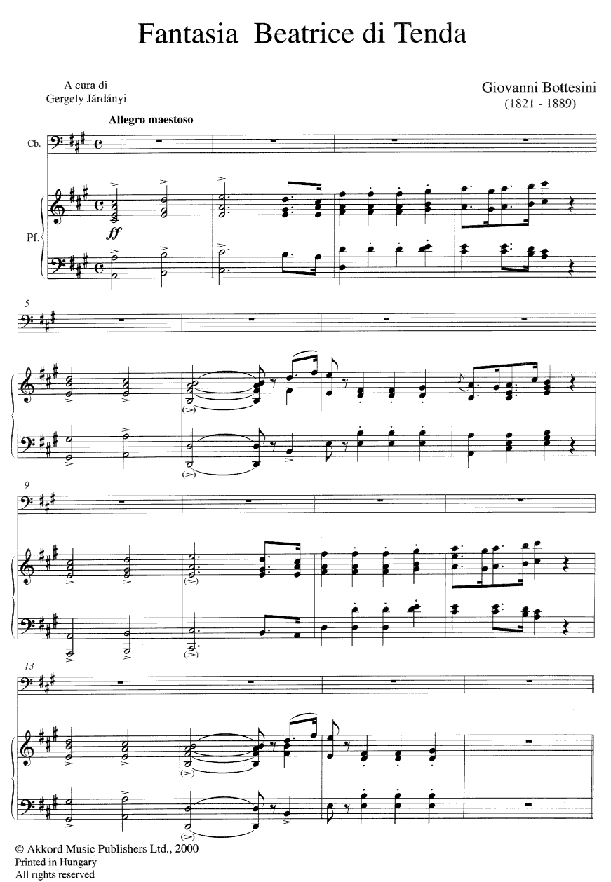
Score Sample – Accordmusic.com
General Note: This composition is preserved with both piano and string orchestra accompaniments. It appears that all extant copies are in the key of A major which should indicate only a Solo Tuning use.
–
Reference Recroding – YouTube [ Gergely Járdányi ] (with orchestra)
- Fantasia Lucia di Lammermoor, JGB 9.34, GB.93 ( )
LC Title Authority:Fantasia sulla “Lucia di Lammermoor” di G. Donizetti. LC Record
Alternative Titles:Fantasia Lucia
–Fantasia “Lucia di Lammermoor”
–Fantasia sulla “Lucia di Lammermoor”
Sources:
Fantasia per Contrabasso sopra motivi dell’Opera Lucia di Lamermour – orchestra parts in C major, I-PAc, Bott.55.b/I-XXXVIII [ Old Signatures: CB.II.3 and 47535 ] Cited as: JGB 9.34/d, Inzaghi BOT. 41 – Solo Tuning
Manuscript Data – RISM Record – SBN Record
Manuscript – Online View & Download – Internetculturale.sbn.it
Note: This source is easily identified by its bass part since the Violoncello e Basso title page has only one “m” and “o” in Lamermor instead of two of each as commonly written in Lammermoor. Also the second violin part bears inscription N° 9 / Fantasia Lucia which does not appear to be a designation for a part number but looks rather as a sequence number for entire Fantasia Lucia composition (scan page c. u1r ). Further research should address if indeed Fantasia Lucia may be the ninth piece Bottesini wrote.
–
General Note: This composition is preserved with both piano and orchestra accompaniments. In respect to dating neither Járdányi nor Street offer any time reference for this composition. However, the Parma I-PAc, Bott.55.b/I-XXXVIII source in the second violin part bears inscription N° 9 / Fantasia Lucia, and should N° 9 prove to be the sequence number for Fantasia Lucia, then this work may be dated as an early Bottesini composition, likely written in 1840s (see – Internetculturale.sbn.it scan page c. u1r )
–
Reference Recording – YouTube [ Gergely Járdányi ] (with orchestra)
- Fantasia Puritani, JGB 9.33, GB.89 (1858)
Sources:
Fantasia sopra motivi dell’Opera I Puritani – orchestra parts in A major, I-PAc, Bott.54/I-XLIV [ Old Signatures: No. 19, CB – II – 5 and 25690 ] Cited as: JGB 9.33/b, Inzaghi BOT. 40 – Solo Tuning
Manuscript Data – RISM Record – SBN Record
Manuscript – Online View & Download – Internetculturale.sbn.it
Note: Violino Principale (first part) bears a number designation: Parti No. 19 which at the first sight appears to indicate just the number of parts (page scan c. p1r). Yet, after counting all the parts, of which there are more then 19, even if considering only the string parts, it appears that this may also be the old signature, or the chronology number similar to the other No. designators located on the title pages of Bottesini manuscripts. Thus the signature may also be interpreted as “Parts for the composition No. 19.” Further research should address this marking as a possible indicator of composition chronology, while addressing a prospect that Fantasia Puritani may be the 19th piece Bottesini wrote.
–
General Note: This composition is preserved with both piano and orchestra accompaniments. Chris West dates this composition to 1858.
–
Reference Recording – YouTube [ Gergely Járdányi ] (with orchestra)
- Fantasia Sonnambula, JGB 9.35, GB.90 (1840)
LC Title Authority:Sonnambula. LC Record 1 – LC Record 2
Alternative Titles:Fantasia Sonnambula
–Fantasia La Sonnambula
–Fantasia sulla Sonnambula di Bellini
–Fantasie Sonambula [ one ‘n” ]
–Fantasie Sonnambula
Sources:
Fantasia per Contrabasso sopra motivi dell’Opera Sonnambula – orchestra parts in A major, I-PAc, Bott.56/I-XLI [ Old Signatures: 61357 (cit. Járdányi) and 148423 to 148462 ] Cited as: JGB 9.35/b, Inzaghi BOT. 39 – Solo Tuning
Manuscript Data – RISM Record – SBN Record
Manuscript – Online View & Download – Internetculturale.sbn.it
Note: Independent Solo Bass part is missing, yet the solo part music is included in Violino Principale part. Please see Internetculturale.sbn.it start page c. s1v.
–
Fantasia per contrabbasso e strumenti sull’opera «La Sonnambula» di Bellini – orchestra parts in A major, I-Mc, A. 30. 18. 9. Cited as: Inzaghi BOT. 39 – Solo Tuning
Manuscript Data – SBN Record
Manuscript – Online View & Download – Internetculturale.sbn.it
Note: This set of orchestra parts is located in Biblioteca del Conservatorio di Musica Giuseppe Verdi di Milano. This may be the second version of La Sonnambula according to Street, GB. 91.
–
General Note: This composition is preserved with both piano and orchestra accompaniments. Járdányi states that the first version of Fantasia Sonnambula was presented by Bottesini at the Trieste Opera concert in 1840. Street states that there are two versions of Fantasia Sonnambula that differ in the solo part (GB.90 and GB.91). Chris West dates the second version to 1862. In this listing however and for now Fantasia Sonnambula is cited as a single piece.
–
Reference Recording – YouTube [ Gergely Járdányi ] (with orchestra)
- Fantasia Straniera, JGB 9.31, BOT. 32, GB.92 (1836) or (late 1830s to early 1840s)
LC Title Authority:Fantasia sulla Straniera di Bellini. LC Record
Alternative Titles:Divertimento per Contrabbasso
–Fantasia sulla “Straniera” di V. Bellini
–Fantasia sulla “Straniera”
–Variazioni per Contro-Basso sopra un tema nell’opera «La straniera»
–Variazioni per Contro-Basso sopra un tema nella opera «La Straniera»
Sources:
Divertimento La Straniera – handwritten orchestral score and parts in A major, I-Mc, A-30 / 19-1, Cited as: JGB 9.31, Inzaghi BOT. 32 – Solo Tuning
Manuscripts Note: It appears that there may be two sources of La Straniera in the Milan Conservatory Library, the orchestra score and possibly set of orchestra parts. Furthermore, the Milan Conservatory Library should also have the copy of Malaric manuscript edition from 1938 in photocopy format. These items are not digitized, and neither their records exist in SBN. Lastly, the additional original Bottesini autograph of the orchestra score should be held in private ownership according to Street, see GB.92.
–
General Note: Járdányi classes this work with Bottesini’s Fantasias since it belongs to the genre that features theme and variations based on opera arias. However, he does not ascribe it the title of Fantasia, but simply calls it Divertimento Straniera. Gaspare Nello Vetro in his book Giovanni Bottesini, 1821-1889, Parma (1989), p. 191 cites this work as Variazioni per Contro-Basso sopra un tema nella opera «La Straniera» and states that this work belongs among the first three compositions Bottesini wrote during the time of his studies at Milan in 1836. That would be at the time when Bottesini was only about 15 years of age. Street cites this work more liberally as “Late 1830s to Early 1840s” and again as the work of young Bottesini. Lastly the Library of Congress classifies the title of this work as: Fantasia sulla Straniera di Bellini.
All this information leaves a question of how to present the title of this piece. Period sources apparently do not mention Fantasia in title inscriptions, while the composition itself still represents the form of theme and variations based on opera arias. The titles of the preserved manuscript sources mention this composition only as Divertimento La Straniera – and – Variazioni per C. … La Straniera. However, in common use among bassists, in published editions and recordings, and even in the official Library of Congress classification, this piece is known as Fantaisa sulla Straniera. Thus it was decided to class this composition together with Fantasias by following the spirit and form of the piece, rather than period source titles.
This composition is preserved only with orchestra accompaniment.
–
Reference Recroding – YouTube [ Gergely Járdányi ] (with orchestra)
- Grande Allegro di Concerto alla Mendelssohn, JGB 9.03, GB.65 (before 1857)
LC Title Authority:Grande allegro di concerto. LC Record
Alternative Titles:Allegro di concerto alla Mendelssohn
–Grand allegro de concert
–Grand allegro di concerto
–Grande allegro
Translated in Spirit:Great Allegro of a Concerto in the style of Mendelssohn.
Sources:
Grande Allegro di Concerto – string parts in E minor, I-PAc, Bott.61/I-V [ Old Signatures: No. 61, CB-II-7 and 47657 to 47660 ] Cited as: JGB 9.03/c, Inzaghi BOT. 76 – Solo Tuning
Original title: Allegro di concerto alla Mendelsohn
Manuscript Data – RISM Record – SBN Record
Manuscript – Online View & Download – Internetculturale.sbn.it
Note: Solo Bass part missing.
–
Note on Classification: This “concerto” was conceived as an Allegro movement-like piece inspired by the first movement of Mendelsohn’s famous violin concerto. There are no second or third movements to this composition, which brings a question of where to classify it? The options are to class it as a type of concerto since the title in translation reads Allegro of-from-in Concerto, so in a way affiliated with Concerto genre. If this approach is taken, then this would make it chronologically No. 3 Bottesini concerto. The other option was to include it with other general and character pieces. Járdányi in his thesis catalog considers it a type of concerto and assigns it classification number JGB 9.03 right after the Concerto in Si Minore JGB 9.02.
However, and in respect to professional cataloging, the Library of Congress within its LC Name/Title Authorities system does not classify this composition as a Concerto, yet as a separate piece. On how the official LC Name-Title Authority for Grande Allegro di Concerto looks please consult the official link – LC Title Authority Record
For now and for this listing it was thought prudent to follow the LC classification, yet if a good argument appears and general opinion prevails that Grande Allegro di Concerto is in fact a concerto, it may easily be (re)classified as a concerto too.
General Note: This composition is preserved with both piano and orchestra accompaniments. Chris West dates this composition to 1857 according to the first known performance of Allegro in Fa minore.
–
Reference Recording – YouTube [ Wies de Boevé ] (with orchestra)
- Introduzione e Gavotta, JGB 9.52, GB.76 (1887)
LC Title Authority:Introduzione e gavotta. LC Record
Alternative Titles:Emma Gavotte (later arrangement)
–Gavotta
–Gavotta per Contrabasso
–Queen Mary Gavotte (later arrangement)
Sources:
Introduzione e gavotta – orchestra parts in A major, I-PAc, Bott.48/I-V [ Old Signatures: No. 28 (or No. 48, illegible) CB.I.7 and 61353 ] Cited as: JGB 9.52/e, BOT. 120 – Solo Tuning
Manuscript Data – RISM Record – SBN Record
Manuscript – Online View & Download – Internetculturale.sbn.it
–
General Note: This composition is preserved with both piano and orchestra accompaniments. Chris West dates this composition to 1887.
–
Reference Recording – YouTube [ Gergely Járdányi ] (with orchestra)
- Nel cor più non mi sento, JGB 9.38, GB.95 (1885)
LC Title Authority:Nel cor più non mi sento – LC Record
Alternative Titles:Nel cor più non mi sento Variazioni
Title Translated:I do not feel it in my heart any longer
Sources:
Nel cor più non mi sento Variazioni per Contrabasso – orchestra score and parts in E major, I-PAc, Bott.58/I-XLIII [ Old Signatures: CB-II-3, 47540 (score), 47545-45582 (parts) ] Cited as: JGB 9.38/d (orchestra score) and JGB 9.38/e (orchestra parts), Inzaghi BOT. 52, BOT. 127 – Solo Tuning
Manuscript Data – RISM Record – SBN Record
Manuscript – Online View & Download – Internetculturale.sbn.it
Note: Solo bass part missing.
–
Nel cor piu non mi sento op. 23. – score type and key unknown, I-Mc, A. 30. 38. 8. Cited as: Inzaghi BOT. 127.
Note: This score should be held by Biblioteca del Conservatorio Statale di Musica Giuseppe Verdi in Milano. Inzaghi cites this Milano score at BOT. 127 signature along with several other Nel cor piu non mi sento manuscripts. This manuscript however could not be located in either RISM or SBN.
–
General Note: Nel cor più non mi sento is preserved with both piano and orchestra accompaniments. Street dates this composition to 1885 according to the date written on ms. Nel cor più non mi sento, Op. 23 – piano score in E major, I-PAc, Bott.83.
–
Reference Recording – YouTube [ Gergely Járdányi ] (with orchestra)
- Romanza Dramatica, JGB 9.58, GB.74, Op. 20 (1885)
LC Title Authority:Romanza drammatica. LC Record
Alternative Titles:Elegia No. 2
–Nuova Elegia
Sources:
Elegia N.2 – orchestra score and parts in E minor, I-PAc, Bott.45/I-XXXII [ Old Signatures: No. 41, CB-II-6, 25719 (score), 25720-25750 (parts) ] Cited as: JGB 9.58/d, Inzaghi BOT. 38 – Solo Tuning
Manuscript Data – RISM Record – SBN Record
Manuscript – Online View & Download – Internetculturale.sbn.it
–
General Note: Dedicated to Guido Papini. This composition is preserved with both piano and orchestra accompaniments. Dating is based on Romanza Drammatica I-PAc, Bott.64 score that shows date 1 January 1885.
–
Reference Recording – YouTube [ Gergely Járdányi ] (with orchestra)
- Tarantella, JGB 9.57, GB.73 (1851) – see also Elegia No. 1 (details in General Note)
LC Title Authority:Tarantellas, double bass, orchestra, A minor; arranged – LC Record
Alternative Titles:Elegia e Tarantella
Sources:
Elegia per Contrabasso (e Tarantella) – orchestra parts in D Major / A Minor (48 parts), I-PA-c , Bott.46/I-XLVIII [ Old Signatures: 61364 and 148043 to 148088 ] Cited as: JGB 9.57/d, Inzaghi BOT. 70 – Solo Tuning
Manuscript Data – RISM Record – SBN Record
Manuscript – Online View & Download – Internetculturale.sbn.it
Note: This set of parts contains Tarantella in A with an extended introduction of 16 bars before the fast 6/8 Tarantella commences. This version also bears inscription Tarantella No. 4 in Contrabasso part (check c. rr3r page in Internetculturale.sbn.it ) and this number may indicate that this particular version was written as a separate piece as No. 4 in sequence, before Tarantella became integrated with Elegia No. 1. As with other instances where sequential composition numbers are noted, this number should also be taken into consideration. As with all other sets of parts, this one also lacks the solo bass part.
–
Elegia e Tarantella – orchestra parts in E flat Major/ B flat Minor (24 parts), I-PA-c , Bott.47/I-XXIV [ Old Signatures: 61365 and 148304 to 148326 ] Cited as: JGB 9.57/e, Inzaghi BOT. 71 – Bottesini Tuning
Manuscript Data – RISM Record – SBN Record
Manuscript – Online View & Download – Internetculturale.sbn.it
Note: This set of parts contains Tarantella in B flat minor with 4 bar Andante bridge between Elegia and Trantella. In that respect this set of parts overlaps with Elegia N.1 (e Tarantella) piano score in E flat Major presented at Internetculturale.sbn.it .
–
General Note: Tarnatella is preserved with both piano and orchestra accompaniments in two keys and with two versions of introduction. When Tarantella is performed as a separate piece the Introduction is 14 measures long and titled Adagio after which the well known unaccompanied solo begins that leads into the fast 6/8 Tarantella. When Tarantella is performed as a joint piece with Elegia, then the bridge section between Elegia and Tarantella is a 4 measure long Andante section which at the end contains a cadenza that is the same as solo bass introduction of the independent Tarantella version.
In regard to the classification, Street considers Elegia e Tarnatella as a joint composition and classifies them both under GB.73 signature, while Járdányi classifies them as two separate pieces as Elegia JGB.9.56 and Tarantella JGB.9.57. In respect to dating, Tarantella as an independent composition was first noted as performed in 1851 London concert, while Elegia e Tarantella as a joint composition appears to have been first performed in 1857. Sources for dating were located in Street Catalog, and are likely referred by Chris West.
–
Reference Recording – YouTube [ Massimo Giorgi ] (with orchestra – Ellegia e Tarantella integral version)
Note: In this recording Giorgi presents integral version of Ellegia and Tarantella with a small bridging Andante that connects those two pieces. You can see this Andante at the end of Elegia orchestra score manuscript scan at Internetculturale.sbn.it , and also in piano version of Elegia e Taranatella at Internetculturale.sbn.it . This integral version represents how Bottesini often performed these two pieces and which in this instance may be considered a single composition titled Elegia e Taranatella. It may also be of interest to note that in this integral version the cadenza (solo bass section) which we commonly associate with the beginning of Tarantella, is in fact the cadenza for a small Andante, while the very Tarantella starts right at the fast 6/8 tempo.
–
Reference Recording – YouTube [ Massimo Giorgi ] (with string orchestra – Independent Tarnatella version)
Note: This performance was based likely on the set of parts cited in Elegia per Contrabasso (e Tarantella) in D major located in Parma Conservatory Bott.47/I-XXIV and scanned at Internetculturale.sbn.it . Although the orchestra score for this version is not preserved, if you go to Contrabbasso part at c. rr3r page, you will note that the music and score match, which is not the case with the Elegia e Tarantella version.
–
Reference Recording – YouTube [ Gergely Járdányi ] (with full symphony orchestra Independent Tarantella version)
–
–
Bourgeois, Derek (1941-2017)
- Concerto for Double Bass, Op. 62 (1979)
- Romance for Double Bass & Orchestra, Op. 64 (1979)
–
–
Bracht, Thomas (1970)
- Konzert für Kontrabass und Kammerorchester ( )
–
–
Brandl, Johann Evangelist (1760-1837)
- Concerto pour Contre Basso Principale (1797)
Manuscript Data – RISM Record
–
–
Brant, Henry (1913-2008)
- “Ghost Nets” Concerto for Double Bass (1988)
Reference Recording – YouTube [ Lewis Paer ]
–
–
Brero, Giulio Cesare (1908-1973)
- Dialoghi per Contrabbasso e Strumenti (1962)
Alternative Title: Tre Movimenti per Contrabbasso e Strumenti
Alternative Title: Concerto per Contrabasso e Orchestra
Full Title in Italian: Dialoghi per Contrabbasso Solista, Fiati, Ottoni, Pianoforte, Arpa, Fisarmonica e Batteria.
Full Title Translated: Dialogues for Solo Double Bass, Wind Instruments, Brass Instruments, Piano, Harp, Accordion and Drums.
Note: This unique piece has several titles and among them also a Concerto. Otherwise, SBN record dates this composition to “1. metà 20. sec.” (1st half of the 20th century) while its autogenerated-citation presents the year 1933 (?). On the other side, the Ricordi edition located in WorldCat cites it as from 1962. Further inquiry needed.
–
–
Bright, Colin (1949)
- Young Tree Green : A Song of The Republic : Concerto for Double Bass (1988, New Version 1992)
Reference Recording – YouTube [ Kees Boersma ]
Note: This video is part of the official Colin Bright YouTube page. By a deduction it appears that this is a recording of Kees Boersma with Sydney Symphony. A truly magnificent modern bass concerto.
–
–
Brochocka, Katarzyna (1982)
- Koncert Kontrabasowy (2007)
[ Double Bass Concerto ]
Reference Recording:
1. Andante moderato – SoundCloud [ Karol Kowal ]
2. Allegro energico – SoundCloud [ Karol Kowal ]
3. Adagio vivace – SoundCloud [ Karol Kowal ]
–
–
Brotons, Salvador (1959)
- Concerto for Double Bass and Band (2008)
Alternate Title: Concerto for Double Bass and Wind Orchestra (2008)
–
–
Brott, Alexander (1915-2005)
- Profundum Praedictum (1964)
Composition Page – Canadian Music Centre
Score Sample – Canadian Music Centre
Note: Dedicated to Gary Karr. For double bass and string orchestra.
Reference Recording – YouTube [ Gary Karr ]
–
–
Broughton, Bruce (1945)
- Amethyst with Chamber Orchestra ( )
- Changing with Chamber Orchestra ( )
- Concerto (1980)
- Hot Air on a G String with Chamber Orchestra ( )
- Howduz Disco? with Small Orchestra ( )
- Remembrances of Futures Past with Chamber Orchestra ( )
- Spanish Moods with Small Orchestra ( )
General Note: All presented compositions by Broughton have been located as cited in Grodner (2000) catalog. Yet, not a single of these compositions could be located independently at any source, whether online, in publishers’ catalogs or at WorldCat. Furthermore, all of these compositions, with exception of Concerto, have also been recorded by Arni Egilsson in his LP album Bassus erectus, although with piano accompaniment. In Grodner’s catalog however, these piano versions are not listed at all. Thus the provenance of these orchestra accompanied pieces is yet to be determined. Likewise, it would be of interest to find more information on the Concerto as well.
–
–
Bruns, Victor (1904-1996)
- Konzert für Kontrabaß und Streichorchester, Op. 73 (1982)
Manuscript Data – RISM Record
Manuscript Data (sketches) – RISM Record
–
–
Bruzdowicz, Joanna (1943-2021)
- Concerto for Double Bass and Orchestra (1982)
Note: Premiere presented by Fernando Grillo.
–
–
Bryars, Gavin (1943)
- By the Vaar (1987)
Full Title: By the Vaar for Solo Double Bass, Bass Clarinet, Percussion and Strings (1987)
Composition Page – GavinBryars.com IA
Composition Page – Brahms.iram.fr
Note: Dedicated to Charlie Haden.
Reference Recording:
1. Bar 1 – YouTube [ Charlie Haden ]
2. Bar 96 – YouTube [ Charlie Haden ]
3. Bar 197 Epilogue – YouTube [ Charlie Haden ]
Reference Recording – YouTube [ Gavin Bryars ]
–
- Double Bass Concerto: “Farewell to St. Petersburg” (2002)
Composition Page – GavinBryars.com IA
Note: Dedicated to Duncan McTier.
Reference Recording:
1. A – YouTube [ Duncan McTier ]
2. B – YouTube [ Duncan McTier ]
3. C – YouTube [ Duncan McTier ]
Reference Recording – YouTube [ Daniel Nix ] (piano reduction on screen)
Reference Recording – YouTube [ Božo Paradžik ]
–
–
Bucchi, Valentino (1916-1976)
- Concerto Grottesco per Contrabbasso e Archi (1967)
Note: Based on composer’s opera grotesque Il Contrabbasso (1954) – Opera Video YouTube
–
–
Bullerjahn, Rudolf (1856-1910)
- Etwas für die Alteste, Konzert-Polka für Contra-Bass oder Fagott mit Orchester Op.53 (1884)
–
–
Bumcke, Gustav (1876-1963)
- Der Spaziergang op. 22 (c. 1936)
Movement Ttitle: Stimme für Nr. 4 Kleines Intermezzo für Kontrabass
Note: It appears that Der Spaziergang op. 22 work may contain a movement Nr. 4 Kleines Intermezzo für Kontrabass that features solo bass, likely with accompaniment of orchestra. Further check neeed.
Note: In Manuscript.
–
–
Burdick, David ( )
- The Eclectic Heartland : Tone Poem for Symphony Orchestra and Double Bass Soloist (1994)
Note: Score presented as part of the DMA Thesis porject in 1994. WorldCat Thesis Record
–
–
Burkett, Bryan (1961)
- Hippopotamus for Solo Double Bass and Double Bass Quartet (1999)
Note: For cataloging purpose this composition fits well a description of a solo bass with ensemble, although the ensemble consists of four basses.
–
–
Busser, Henri (1872-1973)
- Canzone pour Contrebasse et Petit Orchestre par Henri Büsser, Op. 26 (1931)
Note: In Manuscript.
–
- Concertino Pour Contrebasse ou Violoncelle et Orchestre (1930)
Note: In Manuscript.
C
–
Cale, Bruce (1939)
- Concertino for Double Bass and Orchestra, Op. 33 (1979)
- Double Bass Concerto. Op. 75 (1994)
Score Sample – Australianmusiccentre.com.au
Note: Written in memory of Scott LaFaro.
–
–
Callison, Carter ( )
- “Laniakea” Concerto for Double Bass and Chamber Orchestra (2014-15)
–
–
Campbell, Karen (1954)
- Symbiosis for Solo Double Bass and String Orchestra (1980)
–
–
Capuzzi, Antonio (1755-1818)
- Concerto per Violone (18th c.)
Manuscript Data – BL Link ( Manuscript Number: Add MS 17834)
Composition History Paper – GreatBassViol.com (author Joëlle Morton)
Score Sample – ABP Repository (solo part)
Online View & Download – IMSLP
Note: IMSLP offers various free editions and a scan of the original manuscript located in British Library.
General Note: This concerto is widely known as simply a Capuzzi Double Bass Concerto although the manuscript indicates Concerto per Violone.
Reference Recording – YouTube [ Gerd Reinke ]
Reference Recording:
1. Allegro – YouTube [ Božo Paradžik ]
2-3. Andante Cantabile & Rondo – YouTube [ Božo Paradžik ]
–
–
Castillo, Jorge (1966)
- Double Bass Concerto (1990)
Note: Assumed for solo bass and ensemble. Further inquiry needed.
–
–
Cattini, Elena (1975)
- Omaggio a Geminiani for Double Bass and Orchestra (2018)
Score Sample – Stretta-music.com (solo part)
Note: This composition was a winner of the BASS2018Lucca conference Solo Composition Competition, which took place in Lucca, Italy during August of 2018.
Reference Recording – Reverbenation.com [ unknown ] (with orchestra)
Cervera-Bret, Josep (1883-1969)
Josep Cervera-Bret’s bass music legacy consists of some sixty solo pieces that are still in possession of Cervera family today. However out of these sixty pieces only six appear to have been written for solo bass with ensemble accompaniment. The listing of these pieces itslef is based on three catalogs that will respectively be acknowledged in each composition citation with its own unique alphanumeric designator.
The First Catalog of Josep Cervera-Bret works was assembled by his son Emili Cervera and the compositions from this catalog are featured in the EC PC form as the first designator after the title. This catalog was consulted courtesy of James Testi.
The Second Catalog of Josep Cervera-Bret is available online and hosted by Cervera family at en.josepcervera.net/composiciones. This catalog presents compositions in chronological order with each decade of works presented on its own page, along with two additional pages for Non-Dated and Incomplete works. Thus it was thought prudent to use this system to develop composition designators that follow the same pattern. The composition designator for this catalog you will find as the second one cited in the form of Cat A01-F02 abbreviation. The individual pages listed by decades and their composition designations are cited below.
En.josepcervera.net/1900-1909 – Compositions designated as Cat A01 to 05
En.josepcervera.net/1910-1919 – Compositions designated as Cat B01 to 09
En.josepcervera.net/1920-1929 – Compositions designated as Cat C01 to 09
En.josepcervera.net/1940-1949 – Compositions designated as Cat D01 to 05
En.josepcervera.net/1950-1959 – Compositions designated as Cat E01 to 09
En.josepcervera.net/1960-1969 – Compositions designated as Cat F01 to 02
En.josepcervera.net/sense-data– Non Dated Compositions designated as Cat ND01 to 15
En.josepcervera.net/sense-data– Incomplete Compositions designated as Cat ND-A16 to A20
–
The Third Catalog of Josep Cervera-Bret is based on the listing featured in the Joan Serinyà Gou 2015 Master thesis at pages 37-39. This thesis organizes Cervera-Bret works in three sections. The first section presents compositions chronologically by the year as noted on the manuscripts. There are 35 dated compositions and these are listed chronologically from number 1 to 35. The second section features works without a composition date and these are covered with numbers from 36 to 60. The third section features “The Other” works and these are presented with numbers from 61 to 62. Joan Serinyà Gou composition designator is cited as the third one in this composition citation in the JSG 1 form. Joan Serinyà Gou thesis is also available online at:
Serinyà Gou, Joan. De Pere Valls a Josep Cervera: El llegat català de Bottesini. M.M. Thesis, ESMUC Barcelona, 2015. Pdf Doc Link
–
Lastly, although there are already three catalogs of Josep Cervera-Bret works, some ambiguities in respect to the accompaniment type and completeness of listed compositions still remain, and these will be addressed here in the future.
Initial Post – January 3, 2026
Second Revision – February 7, 2026
–
- Al Pie del Altar, EC PC2, Cat B06, JSG 11 (1918)
Full Title: Plegaria / Al pie del altar / Melodia / para Contrabajo con acompto de Piano.
Cited in – En.josepcervera.net/1910-1919
Manuscript Front Page – En.josepcervera.net
Score Sample – Issuu ( solo bass part – ed. James Testi )
Note: Emili Cervera Catalog offers a written note by the Al Pie del Altar entry that states: (Plegaria) para Quinteto. Thus it appears that Al Pie del Altar – Plegaria exists also with an ensemble accompaniment.
–
- Chispas Eléctricas, EC PC14, Cat A02, JSG 2 (1907)
[ Electric Sparks ]
Full Title (ink): Chispas Eléctricas. / Variaciones para Contrabajo
Full Title (ink and pencil): Chispas Eléctricas. Relampagos y Trunenos / Variaciones para Contrabajo / compuestas / por el spiritu endemoniado / Jose Cervera y Bret.
Full Title Translated: Electric Sparks. Lightning and Thunder / Variations for Double Bass / composed / by the demonized spirit / Jose Cervera-Bret.
Cited in – En.josepcervera.net/1900-1909
Manuscript Front Page – En.josepcervera.net
Score Sample – Issuu ( solo bass part – ed. James Testi )
Note: Originally written for Catalan orchestrina or cobla ensemble accompaniment, this was one of the first solo bass pieces Cervera-Bret composed. James Testi in his article (citation below) says that “this piece has notable role and virtuosic character for the soloist but a very simple and sparse accompaniment for the other instruments. It was an instant hit and was played various times in the orchestrina concerts.” Chispas Eléctricas exists also in a version with piano accompaniment.
Testi in his article also mentions that Cervera-Bret’s cobla ensemble toured outside of Catalonia, apparently reaching along the prime theatre venues in Paris and London as well. So, it would be of interest to see if there are preserved records of Cervera-Bret’s solo performances in those venues as well.
Article Citation:
Testi, James. “Catalonian Virtuoso Josep Cervera Bret.” Bass World : The Journal of International Society of Bassists. Vol. 37, No. 1, June – September 2013, p. 14.
–
- El Brujo del Contrabajo, EC PC8, Cat C01, JSG 14 (1920)
[ The Double Bass Wizard ]
Full Title: El Brujo del Contrabajo. / Concierto de Contrabajo
Cited in – En.josepcervera.net/1920-1929
Manuscript Front Page – En.josepcervera.net
Note: In a personal correspondence James Testi points that this composition exists with both piano and orchestrina ensemble accompaniment. Also, the full title as presented on the front page reads El brujo del contrabajo / Concierto del Contrabajo, and it would be of interest to discover whether this composition corresponds in any way to the standard concerto form, since the Concierto inscription is present in the title.
In respect to the composition character the cervera.us (in Spanish) describes this piece as a “comic-musical piece, playing in different positions: lying on the floor, with the bow upside down, or making sounds with his mouth” (Google translation). These gestures certainly spark an interest and make us wonder how this piece may sound or appear on the stage?
–
- El Carnaval de Venecia, EC PC28, Cat ND05, JSG 43 ( )
Full Title: El Carnaval de Venecia / para / Contrabajo / con acompanamiento / de Piano.
Cited in – En.josepcervera.net/sense-data (compositions without a date)
Manuscript Front Page – En.josepcervera.net
Score Sample – ABP Repository ( Variacion 15 – solo bass part )
Note: In a personal correpondence James Testi points that this composition exists with both piano and orchestrina ensemble accompaniment. It is possible that the Emili Cervera and Joan Serinyà Gou title citations are from the ensemble source since they differ from the piano score title.
Reference Recording – Cervera.us – Audio IA [ Josep Quer ]
–
- Fantasia con Variaciones, EC PC21, Cat B01, JSG 5 (1912)
Full Title: Fantasia con Variaciones
Cited in – En.josepcervera.net/1910-1919
Manuscript Front Page – En.josepcervera.net
Note: In a personal correspondence James Testi points that this composition exists with both piano and orchestrina ensemble accompaniment.
–
- Flor Magnetica, EC PC24, Cat ND04, JSG 61 ( )
[ Magnetic Flower ]
Full Title: Flor Magnetica. / Americana de Contrabajo
Cited in – En.josepcervera.net/sense-data (compositions without a date)
Note: Flor Magnetica in translation says Magnetic Flower and when combined with Americana de Contrabajo one may wonder what the actual inspiration for this piece was? It appears that this piece has not been edited or performed yet, so it would be of interest to discover what may the Flor Magnetica offer us today?
Joan Serinyà Gou cites this piece under separate heading with note “Contrabaix i orquestra” which should mean that the piece is written (extant) in a version with ensemble accompaniment.
–
–
Chardon, Yves (1902-2000)
- Basso Concerto: À Monsieur Serge Koussevitzky (1929)
Score Sample – OJBR IA ( manuscript reproduction )
Score Sample – ABP Repository ( score, courtesy of Andrew Kohn)
Score Sample – ABP Repository ( reduction for two pianos, courtesy of Andrew Kohn )
Note: This concerto was composed for Serge Koussevitzky in 1929, yet he never had a chance to perform it. The concerto itself was written for accompaniment of a wind octet, and the modern day premiere with accompaniment of two pianos was presented by Andrew Kohn in 2017 in the US. The additional European premiere with two pianos was presented by Andrew Kohn in 2018 during the Bass2018 Lucca Congress in Italy.
–
–
Charles, Kebra-Seyoun ( )
- Chorale and Ciaconna (2022)
Composition Page – kscharles.com
Reference Recording – YouTube [ Kebra-Seyoun Charles ]
–
- Nightlife: Concerto for Bass (2024)
Composition Page – kscharles.com
Reference Recording – YouTube [ Kebra-Seyoun Charles ]
–
–
Chihara, Paul (1938)
- Dances and Reveries (2013)
Note: Dedicated to Christine Hoock. Premiere presented by Christine Hoock in 2013.
Reference Recording – YouTube [ Christine Hoock ]
–
- “Grass”: For Amplified Double Bass and Orchestra (1972)
Composition Info – Googleusercontent.com
Note: Featured is the back cover of Grass. Ceremony I. Ceremony III, 1974, LP with details on composition, composer and soloist.
Note: Premiere presented by Bertram Turetzky in 1972.
Reference Recording – Audio [ Buel Neidlinger ]
–
–
Chernoivanenko, Pavel Efremovich (1913-1989)
- Концерт для Контрабаса (1972)
[ Concerto for Double Bass ]
Note: The year of composition was deduced from the piano edition although the concerto may have been written even earlier. The edition also indicates that piano reduction was made from the orchestra score, which implies that concerto may have been written originally with orchestra accompaniment.
–
–
Cimador, Giovanni Battista (1761-1805)
- Concerto per il Contrabasso a Tre Corde (18th c.)
Manuscript Data – BL Link ( Manuscript Number: Add MS 17834)
Online view & Download – IMSLP
Note: IMSLP offers a modern score edition along with a scan of the original manuscript located in The British Library.
Reference Recording – YouTube [ Gerd Reinke ] (with orchestra)
Reference Recording – YouTube [ G. Amadio ] (with orchestra)
–
–
Clementi, Aldo (1925-2011)
- Concerto per Contrabbasso, Strumenti e Carillons (1976)
Score Sample – Babelscores.com
–
–
Cohen, Shimon (1937)
- Concerto for Doublebass or Bass-Trombone and Orchestra (1990)
–
–
Cole, Andrew Seager (1980)
- “Naya Jeevan” Concerto for Double Bass and Wind Ensemble (2012)
Composition Info – Twocomposers.org (click on “Naya Jeevan” )
General Note: Naya Jeevan means New Life in Hindi. This concerto was written as a part of the D.M.A. thesis project at University of Missouri – Kansas City and the full score of this composition is presented in the thesis document.
Online View & Download:
Cole, Andrew Seager. Naya Jeevan, Concerto for Double Bass and Wind Ensemble. D.M.A. Thesis, University of Missouri-Kansas City, 2014. Download Page
Note on Premiere: It is not common that two separate movements of the same composition get to be premiered by two different performers with two different ensembles on two different concerts and while the second movement gets to be premiered two years before the first one. Yet, it appears that exactly such a combination has enabled the presentation of this piece. The following paragraph is cited directly from Andrew Seager Cole’s Naya Jeevan page and it explains in detail who has premiered which movement and when:
“Naya Jeevan was commissioned by Jeremy Baguyos and the University of Nebraska Music Department. Mvt. 1 was premiered by Lawrence University Wind Ensemble on January 20th 2014, with Mark Urness on double bass and Andy Mast conducting. Mvt. 2 was premiered by The University of Nebraska at Omaha Symphonic Winds on December 7 2012, with Jeremy Baguyos on double Bass and James Saker conducting.
Reference Recording:
Movement 1 – Soundcloud [ Mark Urness ? ]
Movement 2 – Soundcloud [ Jeremy Baguyos ]
–
–
Coleman, Todd (1970)
- “Shiva Shakti” Double Bass Concerto ( )
Note: Premiere presented by James Vandemark.
–
–
Comitas, Alexander (1957)
[ also known as Eduard de Boer ]
- Concerto, voor Contrabas en Harmonieorkest, Op. 54 (2007)
[ Concerto for Contrabass and Wind Orchestra ]
Reference Recording – YouTube [ Peter Leerdam ]
–
- Concerto for Contrabass and Orchestra (2019)
Note: The 2007 Concerto with wind orchestra accompaniment was revised in 2019 in a version with full orchestra accompaniment.
–
–
Consoli, Marc-Antonio (1941)
- Concerto per Contrabasso ( )
- Dialogues ( )
–
–
Conti, Antonio (1832-1913)
- Concertino per Contrabasso e Orchestra ( )
Note: In manuscript. Located in Malaric Collection in Mozarteum, Salzburg.
–
–
Conti, Sebastian (1925-1962)
- String Bass Concerto with Orchestra and/or Piano Accomp. (1951)
Note: Premiere presented by Oscar Zimmerman. This concerto was composed as a part of Master of Music thesis project at Eastman School of Music, University of Rochester. Thesis Data – Sibley Music Library Record
–
–
Conyngham, Barry (1944)
- “Kangaroo Island” Concerto for Double Bass and Orchestra (2009)
Composition Page – AMC
Composition Info – Gardner of Time CD – booklet pdf
Note: Please check the story that stands behind this concerto on pages 6-7 of the CD booklet.
Score Sample – AMC
Note: Commissioned for Robert Nairn.
Reference Recording:
1. Coastline – Seals – Visitors – YouTube [ Robert Nairn ]
2. Flatland – Kangaroos – Roadkill – YouTube [ Robert Nairn ]
3. Caves – Bats – Wonders – YouTube [ Robert Nairn ]
4. Treeline – Koalas – Survival – YouTube [ Robert Nairn ]
5. Skyline – Bees – Captives – YouTube [ Robert Nairn ]
–
- “Shadows of Noh” Concerto for Double Bass (1979)
Composition Page – AMC
Score Sample – AMC
Note: Dedicated to Bertram Turetzky.
–
–
Cordeiro, João Rodrigues (1826-1881)
- Fantasia para Contrabaixo e Quarteto de Cordas (1864)
Manuscript Data – Online View & Download – Biblioteca Nacional de Portugal – Purl.pt
Score Sample – Editions.ava.com
Reference Recording – YouTube [ Slawomir Marzec ] (with ensemble)
Note: You can observe Final – Tempo di Polacca in Manuscript starting with page 12 (quintet score – solo bass part at the bottom staff). This recording however is a creative type of an arrangement based on Final – Polacca section which incorporates some of the other sections of the original Fantasia, but certainly does not present the composition in its original form.
Note: The compositions was enlarged in 1869 with wind parts (presented pp. 23-28 of the manuscript scan).
–
–
Coro, Salvatore (19th century)
- Fantasia per Contrabbasso sul Rigoletto di Verdi (1863)
Online View & Download – Intenetculturale.it
Note: In manuscript. Starting with page 10 v of the manuscript scan you may note the famous La donna è mobile aria from Rigoletto. This time however intended for solo bass in high register, and played with harmonics.
–
–
Crayford, Jonathan (1964)
- Adagio for Solo Bass, Viola, Violoncello and Bass ( )
Note: Located in Gary Karr Collection. Johnatan Crayford (1964) is indeed a jazz and classical pianist and a versatile composer, however this particular Adagio for Solo Bass could not be located independently in any other database or online source.
–
–
Creutzfeldt, H. ( )
- Introduction und Variationen für Contrabass mit Orchester (1898)
–
–
Cunningham, Arthur (1928-1997)
- The Walton Statement : For Double Bass and Orchestra (1971)
Note: Dedicated to Oritz Walton. Premiere presented by Fred Tinsley in 1980.
–
–
Cwojdziński, Andrzej (1928-2022)
- Koncert na Kontrabas i Orkiestrę Symfoniczną, Op. 10 (1959)
[ Concerto for Double-Bass and Orchestra ]
Reference Recording:
1st Movement – YouTube [ Boguslaw Furtok ] (with orchestra)
2nd Movement – YouTube [ Boguslaw Furtok ] (with orchestra)
3rd Movement – YouTube [ Boguslaw Furtok ] (with orchestra)
–
–
Czarnecki, Sławomir (1949)
- Concerto per Contrabasso e Archi, Op. 28 (1991)
Classification Criteria & Organization
All the compositions featured here should be written for a solo (single) double bass with accompaniment of an ensemble of any size and profile. Some bass bibliographies used to define this section of solo bass literature as written for an accompaniment of “An Orchestra.” Yet, such a definition was found too narrow for the variety of encountered pieces, since there are solo bass compositions that require indeed quite a small ensemble for accompaniment, and those were often classed with general chamber music listings in the past. For example F. A. Hoffmeister Solo Quartets, which are unequivocally composed for solo bass with accompaniment of a string trio, and as such are indeed accompanied with an ensemble, a very small one admittedly. Nevertheless, these quartets certainly are not quartets with bass in a sense that we understand chamber music repertoire where bass play mostly accompaniment role, or may play even soloistic sections, but equal to the solo demands of the other quartet members. Therefore the designation ensemble accompaniment was found more useful than the orchestra accompaniment.
Another example where an “Ensemble Accompaniment” descriptor may prove useful, are the solo bass pieces which involve accompaniment of a variety of instrumentalists that may not be called an orchestra. The same case may be applied even to a choir accompaniment of a solo bass composition, and these do exist as well. In those instances the designator ensemble is also more fitting than the orchestra. Now, it certainly would be of interest to have an option to select and choose between different types of ensembles, whether those may consist of only few instrumentalists, a “Vivaldi” string orchestra of up to 12 players, a small symphony orchestra or a large symphony orchestra. However at this stage of development this database can not offer such a distinction, and for such a level of service this catalog will have to wait for the time when it can be transferred at the proprietary cataloging software that allows all the search functions of the modern library catalog.
This section will also feature solo bass compositions with orchestra accompaniments made from a piano score (a reverse orchestration). Such scores may admittedly be considered arrangements, yet their profile fits this section to the letter. Therefore those arranged orchestra scores, and when such information is available, will be mentioned in the Notes filed. The very issue of when is something arranged or not arranged, may be tricky on occasion, as there are solo bass pieces that have initially been composed for piano accompaniment and then arranged by composers themselves for orchestra as well. In those instances it is the same composition with two accompaniment types. There are solo compositions originally written with piano accompaniment that were orchestrated later (centuries later) and these may be considered a non-composer made orchestra accompaniments. Finally, there are solo concerti from classical period (mostly by Sperger and Keeper, likely also by Dragonetti) that still exist only in unedited original manuscript variant for solo bass and orchestra (ensemble) accompaniment, and have no piano reduction of any type.
Therefore it is strongly recommended that for all pieces that one expects to find in a Solo with Piano section, and are not listed there, one also looks for here in Solo with Ensemble page, as this section may offer a boarder listing.
In that respect, one may consider that a unified database that may list all solo bass compositions including Solo Unaccompanied, Solo with Piano, and Solo with Ensemble in one long and complete listing would be of good idea. Yet, such an option is not envisioned for this catalog in this stage of development. However, it may be possible to offer such a complete and unified listing in future when these listing are transferred to proprietary cataloging software. Then, your access options to all the records featured here will in essence be the same as with any other professional library cataloging system, and you could have an option to unify all classes of solo compositions in one long list.
Otherwise, this catalog is organized alphabetically by the last name of composer and follows a custom design described in the Record Format and Record Format Map sections. Therefore, it begins with composers whose last name starts with A and will continue to expand with composers with last name starting on B (Bourgeois), C (Cage), D (Dragonetti) and so on. All the letters in various languages that differ from Latin script but approximate standard Latin letters, such as Å for A ; Č and Ć for C, will be indexed within the alphabetical order of existing Latin letters and not be grouped separately. This rule applies also to German Ü and Ö that will be catalogued within standard U and O listings in continuity with other composers’ names. Within the title citations that starts with an article (The, A, An) the first letter of the article actually determines the alphabetical sequence. This practice may not be in accordance with some professional cataloging rules, yet was considered more intuitive for common user then to offer an explanation on “how to ignore articles” while looking at the alphabetical order of compositions.
An issue of determining the last name with some Latin American and Hispanic composers, whose actual full names may contain up to five names, has brought a question of which one is actually the last name according to which the author is to be classified? In those (multi name) instances a wider search over the net and extant catalogs was used, and commonly a professional citation in some catalog or academic listing located. However, in some instances some mistakes may be possible and will certainly be resolved if discovered.
Lastly, it may be of interest to know what sources were used in making of this catalog, as there certainly are a lot of them available both in historical prints and the present online offering. All these sources will be cited in future Bibliography section, yet only when the catalog is completed and all the cataloging issues resolved in full.
Record Format
The Record Format for individual compositions was established in order to present uniformly the composer’s name, the compositions title and the year composition was written. In addition, some other supplementary data of relevance for the composition may be featured in separate entries that follow the title. However, you may find that these records do not mimic the traditional online library records, since the purpose of the record is simply to indicate the existence of a particular composition (with some extra data) and not to offer the full source citation in the way library records do. The records in this catalog are also designed to incorporate only the free and non-commercial content.
The additional areas of interest that pertain to composition origin, its history, and particularly the editions, performances and recordings are not featured here, but are in plans for future. The extra work needed to incorporate just the editions for all featured compositions at the present Beta-Phase development, would simply delay the completion of this project to some uncertain time in the future. Thus and for now, only the basic data are offered.
The typical composition entry that you will encounter here will consist of the fields presented in the Record Format Map (below), although the offering of fields may vary considerably from one entry to the other. Thus with some entries even the dates for composer and compositions may lack, while with some other you may find the composition very well documented.
Record Format Map
This map presents and explains all the fields that may be encountered in a typical record. In practice however, most records will be much smaller, and some may offer only the author and composition title entries. At the end of each entry field you will find a numbered link that will lead to a description of that particular field, with entry example, description, and the purpose described. As mentioned in Solo Compositions page introduction, this bibliography at this stage of development does not present printed editions, so none will be featured here either.
–
Doe, John (1901-1982) 1
Composer’s Bass Opus Introduction. This introductory paragraph will appear only with composers whose bass opus is not completely researched, and when the research and cataloging status of a particular opus require further clarification. Commonly and with most composers this introduction will be missing. 2
Double Bass Concerto, No.2, Op. 111 (1950) 3
[ Translated Title in English (if title citation is in Foreign Language) ] 4
Title in Foreign Language: Foreign Language Title 5
Manuscript Data – Source Record or RISM Record 6
Composition Page – SourcePage.com 7
Composition Info – SourcePage.com 8
Composition History Page – SourcePage.com 9
Featured Pieces: 10
Yellow duster
Rhode Island red
A flutter on the grey
Comfy green settee
Floral blue frock
Pinks with African violets
Black cherry
Score Sample – SourcePage.com 11
Modern Day Premiere Report – SourcePage.com 12
Note or Notes: 13 ( Notes entries will commonly cover any inconsistencies, particularities or unknowns that the source records may reveal about the featured composition. For example: Dedicated to Joe Doe. Commissioned by Joe Doe. Written originally for Double Bass and Orchestra (or) Unknown if an orchestra version exists. Assumed with piano accompaniment. Some data unknown, further inquiry needed. )
Online View & Download – SourcePage.com or IMSLP 14
Reference Recording – YouTube [ Joe Doe ] 15
Or, with multiple movements featured in separate video or audio streams:
Reference Recording:
1. Allegro – YouTube [ Jane Doe ]
2. Largo – YouTube [ Jane Doe ]
3. Menuetto – YouTube [ Jane Doe ]
4. Rondo – YouTube [ Jane Doe ]
–
Record Format Map Index – Individual Fields
Example: Doe, John (1901-1982)
Form: Composers’ names are cited in traditional Last name, First name format which is followed by composer’s life years, or just the birth year for those that are still among us. If the name consists of several names, then the Library of Congress Name Authority record is used to form the proper name entry. In some instances however and when the Library of Congress Authority Name record is missing, a VIAF Name Authority is used. In the case when both the Library of Congress and VIAF name authorities do not exist, a common and most acceptable name form used on internet is used instead.
–
–
Introduction to Composer’s Bass Opus
Example:
The complete double bass opus of J. J. Abert will need additional research in order to be fully systematized. Some of the listed pieces may represent later arrangements by Abert himself, or possibly arrangements by other musicians. In addition, some of the pieces may feature separate movements from Abert’s own compositions.
(From the introduction to Abert, Johann Joseph listing)
Purpose and Content: During the work on this bibliography it was discovered that some solo bass legacies present challenging issues that make them very difficult to properly define and index. Therefore it was thought prudent to offer a small introduction chapter where these issues are addressed along with explanation on how the listing was formed and what possible steps should be taken in future, in order for the listing to become more complete and accurate. Commonly these issues relate to dating, the composition identification, the relevance or incompleteness of sources, or the divergence between various sources that need to be fully researched in order to be accurately represented.
Example: Double Bass Concerto, No. 2, Op. 111 (1950)
Form: Composition Title, Number, Opus Number (Year of writing or Year of Print) [ Lost ] or [ Incomplete ]
Rules: The composition title is commonly cited in Italics with all the noun words capitalized and the non-noun ones (articles, adjectives, adverbs etc.) non capitalized. The title is then followed by composition number and opus number, if those are available or known. The citation ends with the year of composition in brackets. If the year of composition could not be located, the year of publication is used instead. It is assumed that the year of publication in most cases will be sufficiently close to the year of composition in order to offer a relevant time reference. If neither the year of composition nor any printed edition date could be located, the year bracket is left empty.
The title of composition is always cited in Italics and in the original language. This rule will almost always be applied if the composition is coming from the traditions of larger European countries with languages such as German, Italian, French, or Spanish. However in instances when the title is already well established in its English variant, the English title is used instead, and the original title featured in the Composition Title in Foreign Language field. This practice may appear puzzling, but was caused by sometime a bewildering amount of differing citations encountered during the cataloging work. In practice however, all composition citations within a record will always offer sufficient data for composition identification in both English and the original language.
Furthermore, the titles of those compositions that come from countries that do not use Latin scripts will be cited in English translation and then accompanied with Composition Title in Foreign Language entry right after the title field. This pertains particularly to compositions with original titles written in non-common alphabets, such as Greek, Armenian and other Non-Western scripts.
The very form of the citation will also depend on the on the citation source, and in that respect the title may, or may not offer information on the accompaniment type, such as “with orchestra” or “with piano.” In most instances this will depend on the profile of title that the composer have written on the manuscript, or if such is inaccessible, on the full title from the available editions. Thus in some instances you may find only the simple one-word title, and in some other also a complete citations of the accompaniment type and even some other details that are mentioned in the title.
At the end of the title citation there may also be a descriptor for the lost or incomplete compositions in square brackets such as: [ Lost ] or [ Incomplete ]. Unfortunately with some bass compositions, we do have references that these pieces have existed, yet these (and for the time being) could not be located any longer and thus are assumed lost. Likewise, there are some compositions which the authors have not been able to complete in a lifetime, and a descriptor for these will also be located at the end.
–
–
Title Translation in English
Example: [ Translated Title in English ] (if the title citation is in foreign Language) ]
Form: Square Bracket, translated Title in English with capitalized Nouns, Square Bracket.
Purpose: Since the composition titles are commonly cited in their original language, this field is designed to offer the title translation in English for the sake of convenience. This field if offered in cases where the translation may offer a better insight into the meaning of the piece.
–
–
Composition Title in Foreign Language
Example: Title in Greek: Τρία κομμάτια, για κοντραμπάσο (1962)
Form: “Title in” followed by original Language Name, Colon, Full Title in Foreign Language.
Purpose: There are some instances when the foreign composition title is either already established in English, or the title may be too difficult to discern in the native langue. Thus it was thought prudent to cite the title translated in English in the main Composition Title Entry field. However, in those cases, and in order to make searches easier in any registry or database, the original title will also be presented here in its native language.
Example: Manuscript Data – Source Record or RISM Record
Form: As presented in the example above with online page link that feature the manuscript data or a dedicated RISM page that covers a particular composition.
Purpose: For all historical research projects of compositions, the manuscript data are commonly the starting point. Therefore this field entry will be available for all bass compositions’ manuscripts records, which by chances have bee produced by independent libraries that house these artifacts or by RISM itself. In most cases these records will inform about the manuscript title, the size and length of document, while RISM may also offer musical incipits for each movement. For this bibliography however, the Manuscript Data may also be featured by an independent or a non-institution-affiliated pages, where data and wider information on the manuscript for a particular piece can be located. The manuscript as stated in this field actually implies both a handwritten score by a copyist or a composer’s autograph written by composer’s own hand. The distinction between those two types is not made at this stage of indexing, but may be offered in future development.
Example: Composition Page – SourcePage.com
Form: As presented in the example above with a direct link to a particular composition page.
Purpose: With some compositions an online page or pages dedicated to a particular bass composition exist, and in those cases these pages are cited here with a direct link. These pages may come from the composers’ sites or independent sites that may offer pertinent information.
Example: Composition Info – SourcePage.com
Form: As presented in the example above with a direct link to a particular page that may feature any kind of information of relevance for the featured composition.
Purpose: This field offers a link to the compositions’ page very similar, but not identical to the Composition Page data. The difference is in content coverage since Composition Info pages may contain data that feature several other compositions, or be related to subjects not directly related to the composition and yet with information that is pertinent to the composition.
Example: Composition History Page – SourcePage.com
Form: As presented in the example above with a direct link to a page that addresses the history of the featured composition.
Purpose: With some compositions an online pages that present the history of the featured bass composition actually exist. In those cases these pages are cited here with a direct link. These citations by all means do constitute the full bibliography on the particular composition, but may be found of use in further research or as historical overviews that offer basic data.
Example:
Khroma Zones (2001)
Featured Pieces:
Yellow duster
Rhode Island red
A flutter on the grey
Comfy green settee
Floral blue frock
Pinks with African violets
Black cherry
–
Form: As presented in the example above with independent citations of all featured pieces within a composition title. An example taken from John Alexander’s bass with piano opus. However, the same citing principle would apply for a bass composition with ensemble accompaniment that features independent titles for its constituent pieces.
Purpose: Certain compositions may be conceived in a form of a little suite (figuratively speaking) that consists of several independent (or dependent) pieces with separate titles. In cases where these individual titles are available they are cited right after the Composition Title Entry field. These pieces may or may not be considered as movements of the featured composition, as that designation in most cases depends on the composer’s own intent. In some instances these pieces may even be performed independently.
Example: Score Sample – SourcePage.com
Form: As presented in the example above with a direct link to a page or a document (commonly pdf) that features the score sample.
Purpose: During the process of making this bibliography it was discovered that some pages offer score samples of cited compositions, whether in manuscript or a printed form. Thus it was decided to include those as well. Commonly these will come from the composer’s own pages, but may also come from a variety other page profiles including social network sites. In most cases these sample will be exactly that, a sample and not the complete composition. Yet, even as a sample, and when considered in addition to possible Reference Recording , these may offer good reference on what to expect from a composition.
–
–
Modern Day Premiere Report
Example: Modern Day Premiere Report – SourcePage.com
Form: As presented in the example above with a direct link to a page that presents information or an overview of a modern premiere.
Purpose: During the process of making this bibliography it was discovered that details on the premieres of many contemporary compositions may be located in online sources of various profiles. Therefore in every instance where a relevant data on the premiere, performers and circumstances of initial performance were discovered, a source page was offered in this field.
–
–
Note or Notes (pending on what is available)
Example: Note: Dedicated to Joe Doe.
Form: Text with content of relevance to the composition.
Purpose: The Note field was created almost as soon as the work on the the bass compositions bibliography has started, as it was discovered that many library records offer extra information that should be of wider interest. The most common content may relate to a dedicatee or a commissioner of a particular piece, but may also relate to the item form (manuscript, autograph or print), or may address the ambiguities that the source record presents.
Example: Online View & Download – SourcePage.com or IMSLP
Form: As presented in the example above with a direct link to a page that offers either the online view or the download page for the cited composition.
Purpose: During the work on this bibliography it was discovered that many compositions are actually available for either online view or download. Mostly and as expected, these pages offer the older pieces that are out of copyright status, however some apparently may be located that go beyond this rule as well. In that respect the ABP does not pretend to be a judge on a copyright status, but will present a link if the source appears to be a legal and legitimate and the reason for posting may serve the education and non profit purpose. Most bassist should be familiar with IMSLP as a unique source of the free bass music, and every time when a composition was discovered in IMSLP, it was cited in this field as well.
Examples:Reference Recording – YouTube [ Joe Doe ]
Or
Reference Recording:
1. Allegro – YouTube [ Jane Doe ]
2. Largo – YouTube [ Jane Doe ]
3. Menuetto – YouTube [ Jane Doe ]
4. Rondo – YouTube [ Jane Doe ]
–
Form: As presented in two examples above. Within this field you will always find a direct link to the streaming files of the featured composition, whether in Video or Audio format, and with the name of the performer cited in square brackets at the end of citation. You may note that there are two ways to cite the reference recording. The first is cited in one line and features the integral interpretation of the composition. The second way cites each individual movement with the title of the movement, direct link to the streaming file and the name of performer in square brackets. The type of offered citation will depend on the available files and their organization.
Purpose: During the work on this bibliography it was discovered that many compositions are actually available as online streams in video or audio formats. Thus it was thought prudent to offer quality performances as a reference recording in addition to possible links to manuscript data, history of composition and/or the online view and download options. The reference recording, and where available, actually rounds the collection of online data on a particular piece and offers thus a full access and evaluation of the bass piece in a way that no printed publication can match. Likewise, this catalog is probably the first world’s first of its kind in respect to bass music cataloging that can offer such a complete assessment of bass compositions.
As the very name Reference Recording implies, the recording was to serve as a general reference on how the piece should sound and be interpreted. The rules for selecting the Reference Recording are few and simple.
1. The recording should present a very high artistic standard and likewise present high recording standard. If either of two may lack, it will not be considered for inclusion. Thus all the recordings with an excellent performance but also unnecessary echoes, high ambient noise and other obstructing frequencies were disqualified. In general the cell phone on-the-spot recordings were not considered.
2. The recording should be complete. There are many recordings, and particularly videos, that offer fantastic glimpses of solo bass pieces, yet they feature a performer playing only a section of a composition. All these videos were disqualified.
3. The recording should be free. Unfortunately and in respect of those that may not have access to specialized streaming databases, only free recordings were considered here. This choice by default may imply that there are some excellent reference recordings out there that may not be featured here. Yet, the social aspect of this project was put above the commercial and particularly in respect to the educational function that this site espouses. The goal of this site is to be available to the global community of users, some of which may barely have an access to the internet alone.
4. The video aspect of a recording is not relevant as long as the performance and acoustic qualities offer a solid representation of the composition.
5. In instances where more than one recording would fit all the criteria, all of the recordings were cited. The vertical hierarchy of citations does not imply that the top one should necessary be the best, so the users are encouraged to explore all of the cited ones and make their own judgment.
Now, with all of the above stated it should be pointed that in some instances it was still very difficult to make a clear cut decision on what to post and what not to post. So, in that respect you may find that some recordings are on a border of rules offered above, particularly if a recording aspect was on a lower side and a performance side was impressive and due a high credit for an interpretation.
Lastly, and in order to enjoy recordings as comfortably as possible, one strong recommendation is suggested. Please use the advertisement blocker browser if by any way you can while browsing this and the other ABP Compositions’ pages. I would strongly suggest the Brave browser in Incognito Mode as with this setup all the annoying popups and pre-advertisements will be eliminated with YouTube videos. With this browser all the featured links will lead you directly to the composition performance. Likewise and due to wide variety of sonic levels offered, it is recommended that you keep your volume at the lower middle, and thus avoid any sudden volume spikes while switching from one recording to the other
Page Development Assistance
–
ABP is grateful on any information that may widen the scope of this listing. Should you know of any other composition that is not listed within the posted sections, please contact ABP and your effort will be credited here.
–
-
ABP would like to offer sincere gratitude to Professor Andrew Kohn on presenting information and score samples for Allan Blank Concerto for Contrabass and String Orchestra (1995). – November 22, 2025
–
–
–
–
–
–
–
–
–
–
–
–
–
–
–
–
–
–
–
–
–
–
–
–
–
–
–
–
–
–
–
–
–
–
–
–
–
–
–
Created by Igor Pecevski
–
–
Last Update:
Last Update: March 13, 2026
Posted: August 29, 2025
 Academic Bass Portal