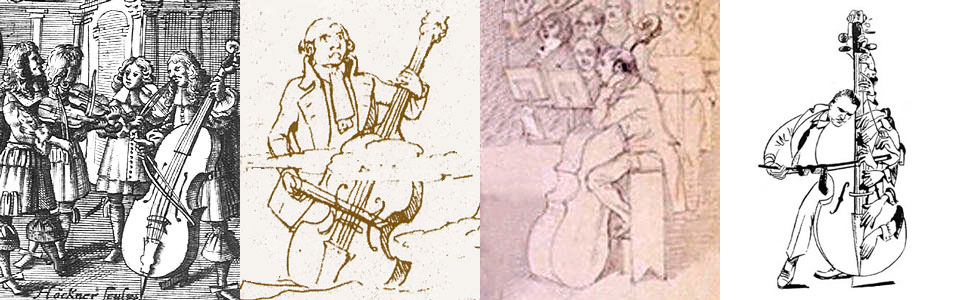
Welcome to the Solo Bass catalog section, an online bibliography designed to present all original solo bass composition written for a single unaccompanied bass instrument. In historical terms these compositions, as designated with Contrabasso or Double Bass in title, start to emerge in Classical period with solo pieces of Domenico Dragonetti. The future research however, may allow us to consider even some solo compositions from Baroque period written for Violone, and should these pieces be scholarly confirmed as written for a period 16 foot Violone instrument that was equal in function to the modern double bass.
The catalog is organized alphabetically by the last name of composer and follows a custom design described in the Record Format and Record Format Map sections. The entry format itself was designed with goal to offer basic information on the author and composition, and yet also afford the presentation of any other free data or media of relevance to the cited works. Thus you will find here also links to manuscript data, free scores and along the Reference Recording online streams. The cataloging standards and procedures are likewise explained in the Classification Criteria & Organization section.
This catalog is designed to expand in stages by following the alphabet sequence.
–
–
A
–
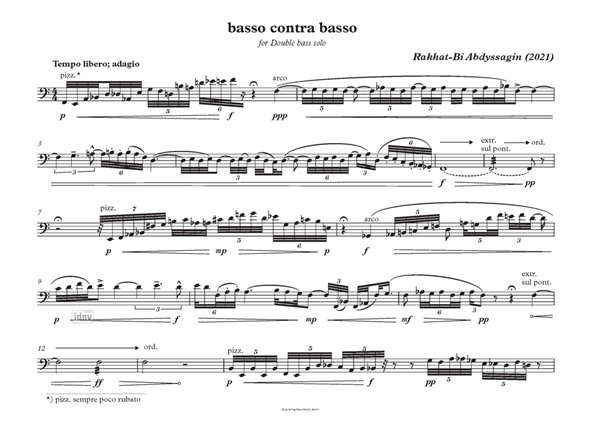
Abdyssagin, Rakhat-Bi (1999)
- Basso Contra Basso for Double Bass Solo (2021)
Score Sample – Amaverlag.com
–
–
Acker, Dieter (1940-2006)
- Orakel für Kontrabass Solo (1974)
–
–
Ackermann, Michel ( )
- A Riot Song of Colour of Love’s (1990)
Note: Dedicated to Gary Karr
–
–
Aeschlimann-Roth, Esther (1953)
- Crisalida (1996)
–
–
Adkins, Cecil (1932-2015)
- XIII Variations for String Bass (1962)
–
–
Adler, Samuel (1928)
- Canto VI: For Double Bass Solo (1971)
- Canto VI a: A Scherzo for Solo Double Bass, with Apologies to Many Composers, Especially Beethoven (2000)
Manuscript Data – Samuel Adler Papers – Eastman School of Music
Note: Also known as Canto XVII
Note: Dedicated to James Vandemark.
Reference Recording – YouTube [ Kurt Muroki ]
–
–
Agazzi, Dario (1986)
- Joseph (2012)
- Klaus (2012)
Note: Dedicated to Lukasz Klusek. The title refers to the composer Klaus Hashagen (1924-1998), and the music makes reference to three of his works.
–
–
Agoshian, Ardashes (1977)
- “The Book of Phoenix” for Viennese Bass Solo, Op. 49 (2017)
- Three Meditations for Viennese Bass (2019)
Reference Recording – YouTube [ Ardashes Agoshian ]
–
–
Aho, Kalevi (1949)
- Solo VI : Double Bass (1999)
Reference Recording – YouTube [ Pierre Dekker ]
–
–
Aitken, Hugh (1924-2012)
- Suite for Solo Bass (1963)
Reference Recording – YouTube [ Katrina Michelle Roman ]
–
–
Albright, Valerie Ann (1959)
- Ondas = Waves (2004)
–
–
Alexander, John (1942)
- Abalone (1999)
- Break Ng Up (2001)
- Edifice (2013)
Note: Dedicated to Claus Freudenstein
–
- Four Aspects of Prague (2019)
- The Intelligent Hand (2011)
- Kith (2014)
Composition Info – FB Heyes Post (middle of the page)
Note: Dedicated to David Heyes
Reference Recording – YouTube [ David Heyes ]
–
- Not One, But Half of Two (2004)
- Roseaux Dans Anches (2018)
Note: Dedicated to Dritan Gani
Reference Recording – YouTube [ Dritan Gani ]
Reference Recording – YouTube [ Dritan Gani ]
–
- Tractway (2017)
–
–
Alexandra, Liana (1947-2011)
- Elegy pentra Contrabass Solo (2006)
[ Elegy for Contrabass Solo ]
Online View & Download – IMSLP
–
–
Alkema, Henk (1944-2011)
- Solo voor Contrabas (1973)
[ Solo for Contrabass ]
Score Sample – Donemus
–
–
Allman, Edward ( )
- Short Suite for Solo Bass (2003)
–
–
Alton, Ed ( )
- Piece for Solo Bass (1977)
Note: Located in Gary Karr Library
–
–
Åm, Magnar (1952)
- Svevande Djupner (1986)
[ Hovering Depths ]
Score Sample – National Library of Norway Link
Reference Recording – YouTube [ Bjørn Ianke ]
–
–
Amato, Salvador (1928-1994)
- Estudio Capriccio (1983)
- Estudio Concierto (1983)
–
–
Ameller, André (1912-1990)
- 4 Études pour Contrebasse Seule, Op. 364 (1985)
Note: This collection consists of four etudes, yet whether these are strictly didactic or may be suitable for concert performance as well, is open to further inquiry.
–
- Dix Études Progressives pour Contrebasse, Op. 366 (1985)
[ Ten Progressive Etudes for Double Bass ]
Note: This collection consists of ten etudes, yet whether these are strictly didactic or may be suitable for concert performance as well, is open to further inquiry.
Score Sample – Ameller.org
–
- XII Pièces pour Contrebasse, Op. 280 (1981)
Note: Out of twelve, one of these pieces is a duet for two double basses.
–
–
Ammon, Ludwig G. ( 20th c.)
Not much is known on Ludwig Ammon except that he is mentioned in various pamphlets as a solo bassist and orchestra musicians active in Bern, Switzerland.
The opus of Ludwig G. Amman consists of some eight compositions, located at the present within the Malaric collection in Salzburg. The titles of these compositions are presented in alphabetical order, although they appear to be numbered in sequence from Fourth to Eighth (in German). Therefore possibly the first three pieces may be represented by Drei Romantische Vortragsstucke, followed by the Viertes, Funftes, Sextes and Achtes Vortragusstuck. One would also expect the seventh to be named as well, but it is missing from the inventory. Instead, we find Ein Kontrabass-Solo and two sources for Moderato Assai und Scherzo. However, whether any of these sources may represent the Seventh or Siebtes piece, is yet to be determined.
–
- Achtes Romantisches Vortragsstuck für Kontrabaß-Solo ( )
- Drei Romantische Vortragsstucke für Kontrabass-Solo ( )
- Ein Kontrabass-Solo ( )
- Funftes romantisches Vortragsstuck für Kontrabass-Solo “Eile mit Weile” ( )
- Moderato Assai e Scherzo für Kontrabass-Solo ; [ Ein Vortragsstück ] (1975)
Note: This Moderato Assai e Scherzo is labeled as Ein Vortragsstück and dated 1975, while there is also Moderato Assai und Scherzo from 1979 (below). Further inquiry should clarify if these two compositions are the same?
–
- Moderato Assai und Scherzo : Für Kontrabass-Solo (1979)
Note: Dedicated by Ludwig Ammon to his wife Rosmari (Ammon).
–
- Sechstes Romantisches Vortragsstück für Kontrabass-Solo : [Andante Cantabile] (c. 1983?)
- Viertes Vortragsstück für Kontrabass-Solo mit Einleitung (1975)
–
–
Anderson, Beth (1950)
- May Swale (1995)
–
–
Anderson, David (1962)
- Cappricio No. 2 for Solo Double Bass (1996)
Reference Recording – YouTube [ Diego Zecharies ] (score on screen)
Reference Recording – YouTube [ Diego Zecharies ]
Reference Recording – YouTube [ Villafranca del Bierzo ]
–
- Four Short Pieces (1994)
Reference Recording – YouTube [ Hanah Novak ]
–
–
Anderson, Tommy Joe (1947)
- Petite Suite, Op. 13a (1972)
–
–
Andre, Mark (1964)
- iv 18 : (“Sie Fürchteten Sich Nämlich”) für Kontrabass (2021)
Note: Title comes from Mark 16:8, printed in German.
–
–
Annunziata, Mauricio (1971)
- Bajos Fondos, Op. 126 ( )
Reference Recording – YouTube [ Alessandro Vicard ]
–
–
Antoniou, Theodore (1935-2018)
- Two Likes for Contrabrass (1976)
Composition Page – Hellenicmusicarchive.gr
Note: Composed for Bertram Turetzky.
–
–
Arnestad, Finn (1915-1994)
- Sonate for Contrabass Solo (1980)
Score Sample – National Library of Norway (some staves made unreadable on purpose)
Reference Recording:
1. Marcato et Energico – YouTube [ Sjur Bjærke ]
2. Adagio – YouTube [ Sjur Bjærke ]
3. Tempo Vivo et Agitato – YouTube [ Sjur Bjærke ]
–
–
Arnič-Lemež, Blaženka (1947)
- Tri Basni za Kontrabas Solo (2014)
[ Three Fables for Double Bass Solo ]
–
–
Arseneault, Raynald (1945)
- Monodies Rituelles pour Contrebasse Solo (1980)
Composition Page – Canadian Music Centre
–
–
Artemov, Viacheslav (1940)
- Sonata “Zimnie Grëzy” (1981)
–
–
Ashkenazy, Benjamin (1940)
- Psalm 130, A Song of Ascents, for Contrabass (2023)
–
–
Askim, Peter (1971)
- Edge for Solo Double Bass (2003)
Composition Page – Peteraskim.com
Score Sample – Peteraskim.com
Reference Recording – Audio – YouTube [ Peter Askim ]
Reference Recording – YouTube [ Jeremy Kurtz-Harris ]
–
- Vital Signs for Solo Double Bass (1998)
–
–
Assaf, Oded (1947)
- I am writing my Nocturn, for Double Bass Solo (2006)
Composition Page – Israelcomposers.org
Score Sample – Israelcomposers.org
Note: Dedicated to Ron Merhavi.
Reference Recording – YouTube [ Ron Merhavi ]
Note: Introduction by composer from 00:00 to ca. 6:55. Piece starts ca. 7:00.
–
–
Atehortúa, Blas Emilio (1933-2020)
- Diferencias para Contrabajo Solo, Op.79 (1978)
–
–
Aubert, Pauline (1884-1979)
- Two Melodies (1912)
–
–
Auerbach, Lera (1973)
- Contemplation for Double Bass Solo (2015)
- Memory of a Tango for Double Bass Solo, Op. 64 (2002)
Reference Recording – YouTube [ Dan Styffe ]
Reference Recording – YouTube [ Joel Braun ]
–
- Monologue for Double Bass Solo, Op. 34 (1996)
Reference Recording – YouTube [ Joel Braun ]
–
- Trout No More for Double Bass Solo (2019)
–
–
Auriol, Hubert d’ (1913-1980)
- Sonatine dans le Style Romantique (1974)
–
–
Avram, David (1930-2004)
- Soliloquy for Contrabass Solo, Op. 48 (1968/1975)
Note: Dedicated to William Rhein
–
–
Axelrod, Lawrence (1960)
- Mandala No. 3 (1996)
–
–
Azarchin, Rodion (1931-2007)
- Theme with Variations ( )
Full Title in Russian: Тема с Вариациями для Контрабаса Соло Ми Минор “Памяти С. Кусевицкого”
Full Title in Translation: Theme with Variations for Double Bass Solo in E minor “In memory of S. Koussevitzky”
Note: Written in memory of Serge Koussevitzky.
Reference Recording – YouTube [ Rodion Azarkhin ] (score on screen)
B
–
Badinski, Nikolai (1937)
- “Lateo“ per Contrabasso Solo (1973)
- “5 – 1 Eufonie“ per Contrabasso Solo (1974)
–
–
Baines, Francis Athelstone (1917-1999)
- Grounds for Solo Double Bass (1969)
–
–
Ballif, Claude (1924-2004)
- Solfeggietto pour Contrebasse, No. 18, Op. 36 (1998)
–
–
Barnes, Larry (1950)
- Dreams of the Anti-City ( )
Note: Located in Garry Karr Collection. Recorded by Bertram Turetzky.
–
–
Barnes, Milton (1931-2001)
- Anerca I for Solo String Bass (1979)
Reference Recording – YouTube [ Cameron Breiter ]
–
–
Barrell, Bernard (1919-2005)
- A Pocket of Pieces for Solo Double Bass or Double Bass Duo, Op. 70 (1986)
Note: As the title indicates, this piece may be perfomed by a solo bass or by two basses.
–
–
Barrett, Richard (1959)
- Splinter (2022)
Composition Page – Polyphonicpictures.com
Composition Article (online) – OJBR.com
Online View & Download – Richardbarrettmusic.com
Note: Dedicated to Kathryn Schulmeister.
Reference Recording – YouTube [ Kathryn Schulmeister ]
–
–
Basseto, Bruno (1971)
- Cativeiro (1999)
- Música para o Filme de Edson Mito ( )
–
–
Bassingthwaighte, Sarah (1967)
- Missing for Solo Bass (2011)
Reference Recording – SoundCloud [ Todd Gowers ]
–
–
Bauer, Gunter (1953-2018)
- …immerzu… ( )
–
–
Baur, John (1947)
- Four for the Road for Solo Double Bass ( )
–
–
Becerra-Schmidt, Gustavo (1925-2010)
- Partita para Contrabajo Solo, Op. 69 (1962)
Reference Recording – YouTube [ Mauricio Romero ]
–
- Trozo para Contrabajo Solo, Op. 60 (1956)
–
–
Bechert, Ernst (1958)
- Frost (1988)
–
–
Belcher, Jason (1987)
- 5 Chilcot (2013)
Composition Info – ACA
Score Sample – ACA
–
–
Bellisario, Angelo (1932)
- Preludio per Contrabbasso Solo (1979)
–
–
Ben Ezra, Adam (1982)
- Flamenco (2015)
Note: Flamenco is originally conceived and performed on the five stringed bass (see video below), but it is also available in a version and edition for a standard four string instrument.
Reference Recording – YouTube [ Adam Ben Ezra ] (5 string bass in High Solo Tuning )
Reference Recording – YouTube [ Adam Ben Ezra ] (4 string bass)
–
–
Benton, Daniel (1945)
- Grounds (1978)
–
–
Bentzon, Niels Viggo (1919-2000)
- Studie for Kontrabas-Solo, Op. 34 (1945)
[ Study for Double Bass Solo ]
–
–
Berio, Luciano (1925-2003)
- Psy per Contrabbasso Solo (1989)
Score Sample – Universal Edition
Note: Please be aware that Reference Recordings list does not imply any ranking hierarchy, as mentioned in the Record Map – Reference Recording (No. 5). The Psy itself appears to have caught interest of may capable bassists, which certainly testifies to the artistic quality of this piece.
Reference Recording – YouTube [ Luis Fonseca ]
Reference Recording – YouTube [ Michael Cameron ]
Reference Recording – YouTube [ Ron Merhavi ]
Reference Recording – YouTube [ Dan Styffe ]
Reference Recording – YouTube [ Bjørn Ianke ]
Reference Recording – YouTube [ Edicson Ruiz ] (score on screen)
Reference Recording – YouTube [ Edicson Ruiz ] (live performance)
Reference Recording – YouTube [ James Oesi ]
–
–
Bertola, Edouardo (1939-1996)
- Lucipherez (1994)
Composition Analysis – [ Borem ] Opus Brazil
Note: Dedicated to Fausto Borem.
–
–
Bertomeu, Agustín (1929)
- Divertimento para Contrabajo (1988)
Note: Written for Stefano Scodanibbio.
–
–
Bialosky, Marshall (1923-2016)
- Sauntering This Way : For Contrabass Alone (1988)
Note: Dedicated to Daniel Gwin. Premiere presented by Daniel Gwin in 1990. Starting ca. 5:17 in video there is a recitation of a poem that may be part of a performance, although the author of the poem and its relation to the composition are unknown.
Reference Recording – YouTube [ Daniel Gwin ]
–
–
Bibalo, Antonio (1922-2008)
- Invenzione Evolutiva per Contrabasso Solo (1990)
Reference Recording – YouTube [ Bjørn Ianke ]
–
–
Bielawa, Lisa (1968)
- Synopsis #4 : I’m Not That Kind of Lawyer (2009)
Note: Dedicated to Tony D’Amico. Synopsis #4 is a part of the collection of fifteen short solo pieces composed for individual members of the Boston Modern Orchestra Project. More on each piece including the Synopsis #4 at Synopses-Notes pdf.
Reference Recording – YouTube [ Tony D’Amico ]
–
–
Bille, Isaia (1874-1961)
- Organalis for Double Bass Alone ( )
- Sei Studii Caratteristici per Contrabbasso a Quattro Corde (1926)
[ Six Character Studies for a Four-String Double Bass ]
Featured Pieces:
N. 1 Giuochi d’Eco
N. 2 Scherzo
N. 3 Contr’arco
N. 4 Alla Burlesca
N. 5 Quasi Valzer
N. 6 Danza Satanica
Note: Although the cover title indicates Studies, the featured pieces imply an individual character for each, and which is not common in etudes’ editions. So, it is likely that these Character Studies were intended for concert performance, and are thus listed here among the solo unaccompanied compositions. Furthermore, Danza Satanica exists also in a version with piano accompaniment, which points further to the concert heritage of this collection.
–
–
Bitsch, Marcel (1921-2011)
- Suite pour Contrebasse Seule (1958)
Reference Recording – YouTube [ Daniel Gwin ] (score on screen)
Reference Recording – YouTube [ Daniel Gwin ]
–
–
Blank, Allan (1925-2013)
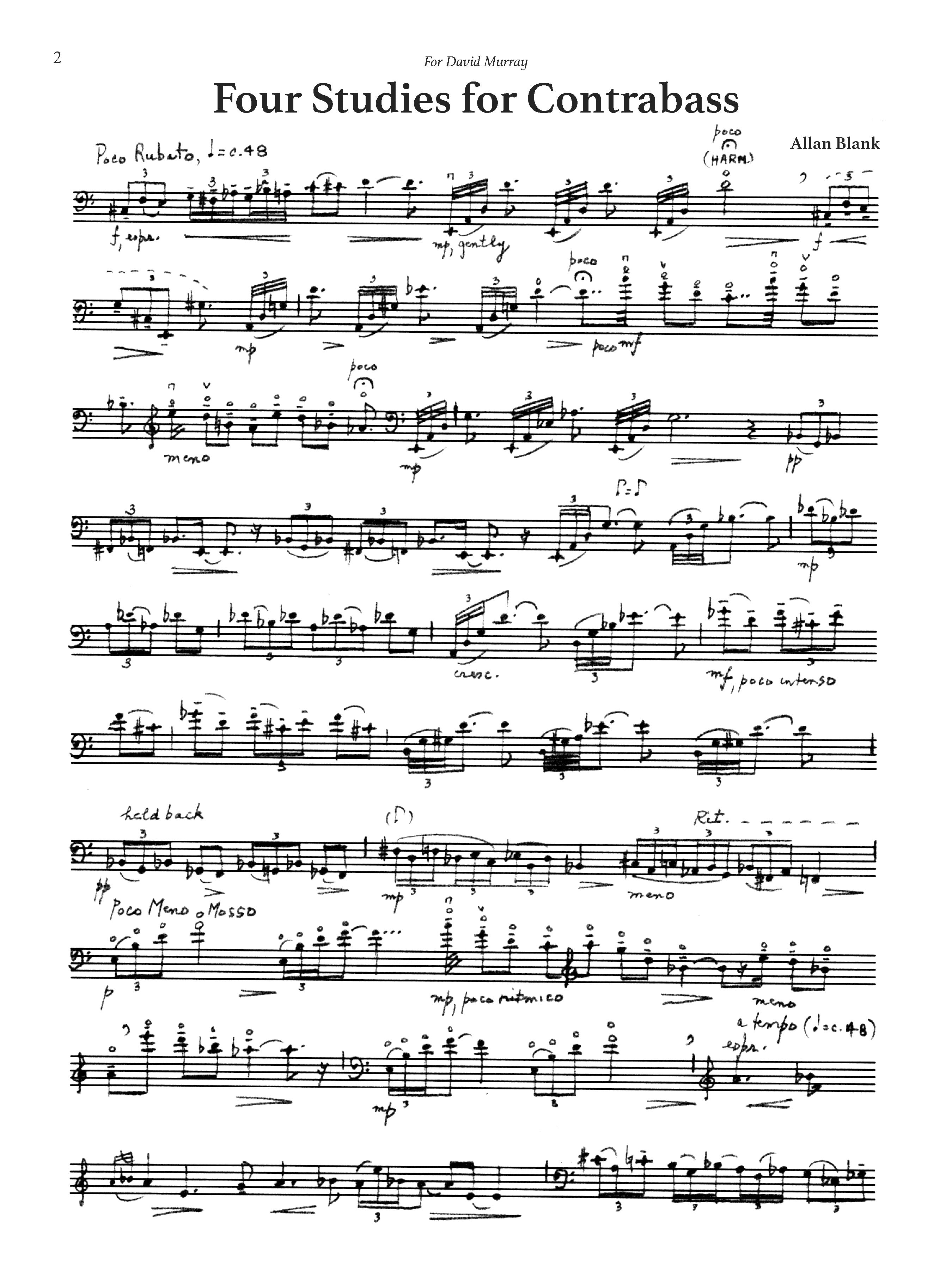
- Four Studies for Contrabass (1992)
Score Sample – Composers.com
Note: Dedicated to David Murray
Reference Recording – YouTube [ Hervé Rémond ]
Reference Recording:
1. Poco Rubato – YouTube [ Andrew Kohn ]
2. Dotted Half = C. 66 – YouTube [ Andrew Kohn ]
3. Drammatico – De Profundis – YouTube [ Andrew Kohn ]
4. Quarter = 88+ – YouTube [ Andrew Kohn ]
–
–
Blaustein, Susan (1953)
- Intermezzo (1978)
–
–
Block, Robert Paul (1942-2001)
- Fantasy for Double Bass Solo (1973)
Note: Written for Eldon Obrecht.
Reference Recording – YouTube [ Hervé Rémond ] (score on screen)
Reference Recording – YouTube [ Hervé Rémond ]
–
–
Blumenthaler, Volker (1951)
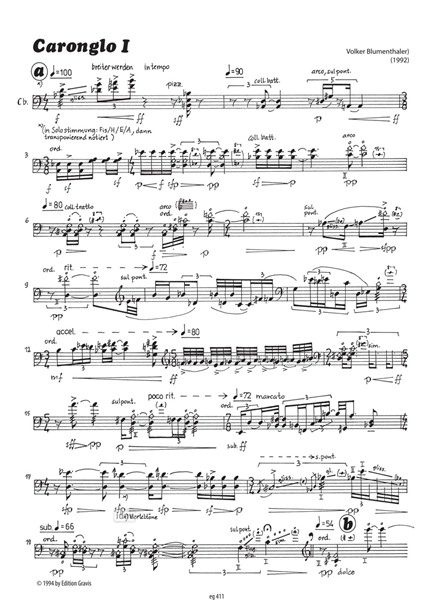
- Caronglo I für Kontrabass Solo (1992)
Score Sample – Amaverlag.com
–
–
Boivin, Philippe (1954)
- Cinq Algorithmes (1990)
- Zab ou la Passion selon Saint-Nectaire pour Contrebasse Seule (1981)
[ Zab or the Passion according to Saint-Nectaire for Solo Double Bass ]
Note: Dedicated to Jean-Pierre Robert.
Reference Recording:
Part 1 – YouTube [ Jean-Pierre Robert ]
Part 2 – YouTube [ Jean-Pierre Robert ]
Part 3 – YouTube [ Jean-Pierre Robert ]
Note: The score of this composition is incredibly poignant in visual descriptions, and since the score if offered on screen together with audio, the video offers a unique experience of how the piece looks and how it sounds.
Reference Recording – YouTube [ Masashi Yamamoto ]
–
–
Borém, Fausto (1960)
- Wave Variations for Double Bass Alone (2008)
Composition Page – Superpartituras.com.br
Reference Recording – YouTube [ Fausto Borém ]
–
–
Bortkun-Szpotańska, Katarzyna (1952)
- Cael per Contrabbasso (1982)
–
–
Borzelli, Silvia (1978)
- Drao (2003)
- Own Pace ( Amnesia 3b) (2011)
Composition Page – Silviaborzelli.com
Note: Dedicated to Stefano Scodanibbio.
–
–
Bosco, Gilberto (1946)
- The Improvvisi per Contrabbasso Solo (1984)
–
–
Bost-Sandberg, Lisa (1982)
- Chroma: From Wordlessness: Contrabass (2018)
Composition Page – Lisabost.com
Composition Story – Video [ Bass Solo From Wordlessness: Contrabass ca. 12:30 ]
Note: This piece for solo bass is actually the 7th movement of the Chroma composition, which has eight movements and where each is written for a different set of instruments. Such a conception certainly brings a question of how to perceive this movement and where to catalog it? For now, it was decided to feature it here among the solo bass compositions as a separate composition. Please see the Compositions Story video for further details on this piece.
–
–
Bottelier, Ina (1943-2022)
- Raga, “Sunrise” for Double Bass Solo (1985)
Title in Dutch: Raga Voor Contrabas : ‘Zonsopgang’
–
–
Bourgeois, Derek (1941-2017)
- Fantasy Pieces for Double Bass, Op. 133d (1993)
Note: This collection consists of nine pieces.
–
–
Bowen, Robert ( contemporary )
- Neopolitan (1999)
–
–
Boyadjian, Hayg (1938)
- Cantum Eclectis (1983)
Note: Dedicated to the Martyrs of April 24, 1915
Score Sample – Scoreexchange.com
–
–
Brackett, David (1958)
- Another Boring Day in Grungeland (1998)
–
–
Brass, Nikolaus (1949)
- Epilog (Zum Songlines-Zyklus) für Kontrabass Solo (2006/07)
Note: Dedicated to Frank Reinecke.
Reference Recording – YouTube [ Frank Reinecke ]
–
- Flucht : Drei Sätze für Kontrabass (2009)
–
–
Braun, Joel (contemporary)
- Awake (2022)
Reference Recording – YouTube [ Joel Braun ]
–
–
Bright, Colin (1949)
- Many Heads – Katatjuta, for Solo Bass (2008)
Note: Dedicated to Pat Dodson and Michael Mansell.
Score Sample – Australianmusiccentre.com.au
Video of the Composition – YouTube
Note: The notes for this video offer excellent background on this composition. It appears that this is a violoncello version, yet still very much worth perusing for an insight on what the piece has to offer.
Audio Sample – Australianmusiccentre.com.au [ sample performed on Violoncello ]
–
–
Brings, Allen (1934)
- Descant for Solo Double Bass (1972)
Composition Page – Newmusicusa.org
Online View & Download – Newmusicusa.org
Note: A download option for this composition was located at Newmusicusa.org page, and which appears to be a part of a legitimate and legal web site. Thus it is assumed that this piece is also legal for viewing and download, although its Copyright date indicates year 1975.
–
- Two Badineries for Solo Double Bass (1996)
Composition Page – Newmusicusa.org
Online View & Download – Newmusicusa.org
Note 1: A download option for this composition was located at Newmusicusa.org page, and which appears to be a part of a legitimate and legal web site. Thus it is assumed that this piece is also legal for viewing and download, although its Copyright date indicates year 1996.
Note 2. The Composition page at Newmusicusa.org link offers also the recording of this piece with two MP3 files which appear to require an outdated Adobe Flash function in order to be functional.
–
–
Brisman, Heskel (1923-2001)
- Chaconne and Allegro for Double Bass Solo ( )
Note: In manuscript, undated.
–
–
Brizani, Imer Traja (1958)
- Rrom-do (2014)
–
–
Brochocka, Katarzyna (1982)
- Pas de Basse: Suite for Solo Double Bass (2012)
Title in Polish: Pas de Basse, Suita na Kontrabas Solo
Reference Recording:
1. Port de Bras – YouTube [ Karol Kowal ]
2. Deboules – YouTube [ Karol Kowal ]
3. Arabesque – YouTube [ Karol Kowal ]
4. Ballotte – YouTube [ Karol Kowal ]
5. Degage – YouTube [ Karol Kowal ]
6. Chasse – YouTube [ Karol Kowal ]
–
- Soliloquia for Double Bass (2022)
Reference Recording – YouTube [ Karol Kowal ]
–
–
Brozen, Michael (1934)
- Baroque Dances for Double Bass (1988)
–
–
Brün, Herbert (1918-2000)
- Per Contra: Serenata Bassa, Op. 47 (1977)
Note: ISB composition award 1977
Reference Recording – YouTube [ Samuel Bradshaw ]
Reference Recording – Spinelessbooks.bandcamp.com [ Mark Sullivan ]
–
- Yet with a Heart of Gold: Solo for Double Bass (1997)
–
–
Burhans, Caleb (1980)
- Glimpses of Mars (2003)
Score Sample – Calebburhans.com [ 1st movement ]
Reference Recording:
1. On the Verge of Wandering – YouTube [ Joel Braun ]
2. Forlorn – YouTube [ Joel Braun ]
3. Chill – YouTube [ Joel Braun ]
4. Wandering, Distant – YouTube [ Joel Braun ]
5. Delicate but Wrong – YouTube [ Joel Braun ]
–
–
Bussotti, Sylvano (1931-2021)
- Rara (Eco Sierologico) (1964, rev. 1967)
Note: The edition notes state: “For guitar, violin, viola, violoncello and double bass (individually or in any combination), thus indicating that Rara can be perfomed as a solo bass piece too. No online recordings of this compositions were located at the posting of this record.
–
- Sensitivo per Arco Solo, Sette Folgi 7 (1959)
[ Sensitivo for Bowed Instrument Solo, Seven Sheets (No.) 7 ]
Full Title: Sensitivo per Arco Solo from Sette Fogli: Una Collezione Occulta 1963
Full Title Translated: Sensitive for Bow(ed) Solo from Seven Sheets: An Occult Collection 1963
About Composition – Brahms.irham.fr [ Please see The Sign chapter, third paragraph ]
Composition Page – Sensitivo Brahms-old.irham.fr (as part of the collection Sette Fogli Brahms-old.ircam.fr )
Composition Page – MOMA New York [ presents the facsimile of the score as an art object ]
MOMA Page Note:
Please observe that MOMA page indicates “Research in progress; information about this work may be incomplete.”
Composition Details – Sylvanobussotti.org Archived ( middle of the page )
Note: The title of this unique aleatoric composition Sensitivo per Arco Solo implies that it may be perfomed by any bowed instrument, but the IRHAM record actually cites it as intended for double bass. See Sensitivo, Sette Folgi 7 (1959) Brahms-old.irham.fr (cit. No. 7 for Double bass solo). This page also states that the piece was premiered on bass in 1970 by Fernando Grillo, which is some eleven years after its writing in 1959.
Reference Recording – YouTube [ Michael Cameron ]
–
- Naked Angel Face (1982)
Composition Page – Brahms-old.ircam.fr
Composition Details – Sylvanobussotti.org Archived ( middle of the page )
Note: This composition may also be performed by two basses, which also allows it to be classified as a duo.
Reference Recording – YouTube [ Joëlle Leandre ]
–
–
Bynes, Mason
- The WRECKoning (2020)
Note: Commisioned by Bass Players for Black Composers.
Reference Recording – YouTube [ Maggie Cox ]
Note: Video starts with Mason Bynes’ presentation on the background of the composition, while the performance starts ca. 1:01.
Reference Recording – YouTube [ Daniel Murray ]
Reference Recording – YouTube [ Austin Lewellen ]
Note: Video page presents also information on the composer and composition.
C
–
Cage, John (1912-1992)
- 26’1.1499″ for a Solo String Player (1955)
[ 26 minutes 1.1499 seconds ]
Composition Page – Data-JohnCage.org
Reference Recording – YouTube [ Bertram Turetzky ]
–
- 57 ½ Seconds for a String Player (1953) [ Incomplete ]
Manuscript Data (Facsimile) – WorldCat Record
Note: The composition was eventually revised and incorporated into 26’1.1499″ for a String Player.
–
- 59 ½ For String Player (1953)
Composition Page – Data-JohnCage.org
Reference Recording – YouTube [ Joëlle Léandre ]
–
- Ryoanji (1983-1985)
Composition Page – Data-JohnCage.org
Note: Composition page states: For any solo from or combination of voice, flute, oboe, trombone, double bass ad libitum with tape, and obbligato percussionist or any 20 instruments. Thus, among other combinations, a solo bass performance is also envisioned for this piece. Furthermore, there is a record of a manuscript by Paul Sadowski in WorldCat that describes notes for performance of Ryoanji in a version for double bass – source WorldCat Record .
Reference Recording – YouTube [ Jean-Pierre Robert ]
Reference Recording – YouTube [ Joëlle Léandre ]
Reference Recording – YouTube [ Stefano Scodanibbio ]
–
–
Cale, Bruce (1939)
- Freedom, Op. 54 (1984)
Composition Info – Classikon.com [ see chapter Kaatomba, second paragraph ]
Score Sample – Australianmusiccentre.com.au
–
–
Callison, Carter ( )
- Apparitions – for Five String Solo Double Bass (2013)
–
–
Caltabiano, Ronald (1959)
- Ellington Sonata for Solo Double Bass (1983)
Note: Commissioned by Bertram Turetzky.
–
–
Cameron, Pedro Bueno (1948)
- 3 Peças para Contrabaixo Solo (1979)
Note: Dedicated to Ana Valéria Poles.
Reference Recording:
1. Reinvenção – YouTube [ Ana Valéria Poles ]
2. Solóquio – YouTube [ Ana Valéria Poles ]
3. Conciliação – YouTube [ Ana Valéria Poles ]
–
–
Campbell, Karen (1954)
- Only One (1974)
Composition Page – NYPL American Music Center of Published Scores
–
–
Canat de Chizy, Edith (1950)
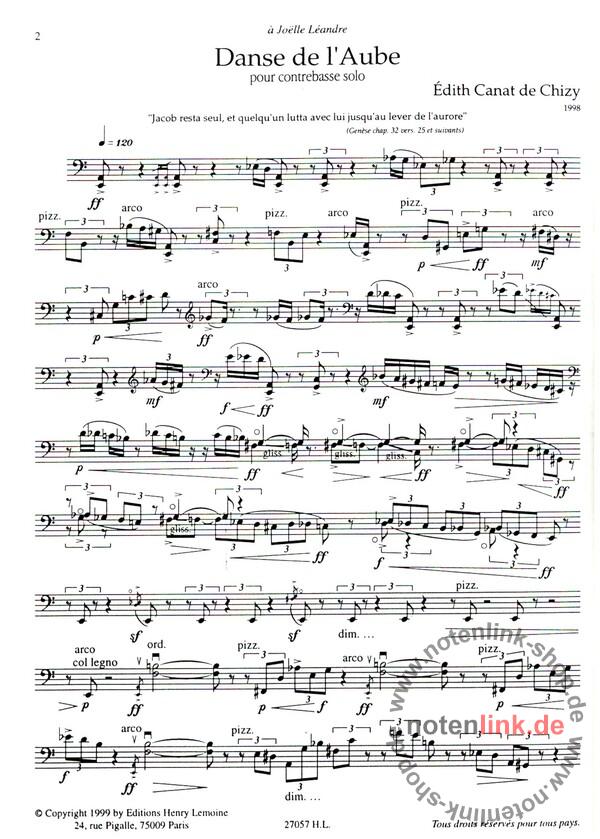
- Danse de L’Aube (1998)
[ Dance of Dawn ]
Composition Page – Edithcanatdechizy.fr (In French with audio sample likely played by Joëlle Léandre)
Score Sample – Notelink.de
Note: Dedicated to Joëlle Léandre. This piece exists also in a version with choreography.
Reference Recording – YouTube [ Charlotte Testu ] (alive)
Reference Recording – YouTube [ Marc Siffert ]
Reference Recording – YouTube [ Irina-Kalina Goudeva ]
Reference Recording – YouTube [ Alexis Scharff ]
–
–
Cannonieri, Arturo (1849-1926)
- 12 Studi di Concerto per Contrabasso
Alternative Title: Duodici Studi di Concerto
Note: These studies are intended to be performed as concert etudes, thus listed here under solo repertoire. Originally conceived for a three stringed bass.
–
–
Capdeville, Constança (1937-1992)
- Amen para uma Ausência (1986)
Composition Page – Mic.pt
Composition Info – Tandfonline.com
Note: Dedicated to Alejandro Erlich-Oliva.
Reference Recording – YouTube [ Alejandro Erlich-Oliva ] (alive)
Reference Recording – Audio Mic.pt [ Pedro Wallenstein ]
–
–
Carcas, Gillian (1963)
- Indigo Dreams (2001)
Note: This composition was inspired by Australian didgeridoo sound.
Reference Recording – YouTube [ Danny Felsteiner ]
Carter, Elliott (1908-2012)
- Figment III for Contrabass (2007)
Manuscript Data:
According to the Elliottcarter.com/resources/manuscripts/ page, the Paul Sacher Foundation in Basel, Switzerland now owns the majority of the Carter materials pertaining to his career from 1988 until his death in 2012. When followed on this, the The Paul Sacher Stiftung in Basel indeed does have the Elliott Carter page, and if the data match, the Figment III manuscript should be held at their collection as well. Please see Elliott Carter – Paul-sacher-stiftung.ch .
–
Composition Page – Elliottcarter.com
–
Composition History and Analysis:
Link, John. Elliott Carter’s Late Music. Cambridge University Press, 2022. pp. 378-379 ABP Repository (courtesy of Donald Palma)
–
Composition Performance Review:
Kozinn, Allan. “Veterans and Newcomers in Elliott Carter’s Labyrinth.” The New York Times. 18 June 2008, p. E3 – New York Times IA
Note: Figment III featured in 5th paragraph.
–
Composition Theses:
Song, Nahee. Analysis and Performance Guide for Figment III by Elliott Carter. D.M.A. Thesis, University of Georgia, 2020. Download Page
Wentworth, Rion. Twenty-first Century Works for the Solo Double Bass by Elliott Carter and Mario Davidovsky: Analyses of Figment III and Synchronisms No. 11 and a Brief History of the Development of the Double Bass Since 1960. D.M.A. Thesis, The Juilliard School, 2011. Juilliard Record
–
Score Sample – ABP Repository
–
General Note: Dedicated to Donald Palma. Premiere presented by Donald Palma on January 18, 2008 in Merkin Concert Hall, New York.
–
Reference Recording – YouTube [ Donald Palma ]
Reference Recording – YouTube [ Edicons Ruiz ]
Reference Recording – YouTube [ Edicson Ruiz ] (documentary video)
Note: This video presents Ruiz’ Figment III performance during the consultation with Elliot Carter in 2012, likely in Carter’s New York apartment. At that time Carter was already 103 years of age, and his vitality and congeniality during this event are simply astonishing to witness.
Reference Recording – YouTube [ Megan McDevitt ]
Reference Recording – YouTube [ Jordan Sand ]
Reference Recording – YouTube [ Eric Chappell ]
Note: Recorded at the Maison Symphonique de Montréal. Octobass visible in the background.
Reference Recording – YouTube [ Anton Jaro Jr. ]
Reference Recording – YouTube [ Austin Lewellen ]
Note: This video presents a small analysis of the piece, both as text on the video and within the video page notes. Commendable.
Reference Recording – YouTube [ James Oesi ]
–
–
Cassidy, Aaron (1976)
- The Wreck of Former Boundaries for Solo Contrabass (2014-15)
Score Sample – Aaroncassidy.com
Note: This composition exists in both solo bass and ensemble with bass versions. The solo bass version is excerpted from the ensemble version.
Reference Recording – YouTube [ Kathryn Schulmeister ] (solo version – in studio)
Reference Recording – YouTube [ Kathryn Schulmeister ] (solo version – CD track)
–
–
Castro-Robinson, Eve de (1956)
Please see: De Castro-Robinson, Eve (1956)
–
–
Cecconi, Raffaele (1947)
- Pentàculum per Contrabbasso Solo (1979)
–
–
Cecconi-Botella, Monic (1936)
- Solitaires, Pièce Humoristique pour Trombone (ou Contrebasse) et Régisseur (1974)
[ Humorous Piece for Trombone (or Double Bass) and Stage Manager ]
Note: Pending on the point of view this composition may be perceived as a solo piece or a duo. Further inquiry may decide on final classification.
–
–
Cervera-Bret, Josep (1883-1969)
Josep Cervera-Bret’s bass music legacy consists of some sixty solo pieces that are still in possession of Cervera family today. Out of those sixty pieces only one, Capricho appears to be written for solo unaccompanied bass. For the complete listing of Cervera-Bret compositions please visit the Cervera-Bret, Josep in Solo with Piano listing.
–
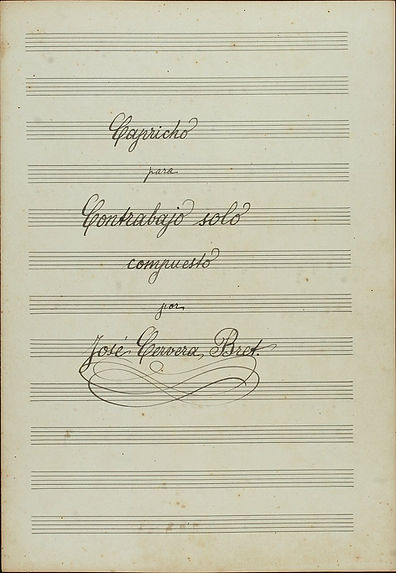
- Capricho, EC PC9, C09, JSG 37 ( )
Full Title: Capricho / para / Contrabajo Solo
Cited in – En.josepcervera.net/1920-1929
Manuscript Front Page – En.josepcervera.net
Note: Capricho is dated to the April 24, 1924 by the jospecervera.net, however neither Emili Cervera nor Joan Serinyà Gou offer date for this composition. The title pages indicates Contrabajo Solo and James Testi confirms that this is the only solo unaccompanied bass composition that Cervera-Bret has left.
–
–
Charles, Kebra-Seyoun ( )
- Figuration No. 1 (2025)
Composition Page – kscharles.com
–
- I Know the Lord Laid His Hands On Me (2024)
Composition Page – kscharles.com
Reference Recording – YouTube [ Kebra-Seyoun Charles ]
–
- This the Day (2021)
Composition Page – kscharles.com
–
–
Chen, Chin-Chin (1964)
- No Strings Attached for Solo Double Bass (1996)
Note: A copy of this piece was located with Michael Cameron Music and Papers collection at University of Illinois Urbana-Champaign Library. It is likely that this piece was composed for or affiliated in some way with Michael Cameron.
–
–
Chihara, Paul (1938)
- Logs (1966)
Notes: According to the notes on the official Paul Chihara site, this composition is cited as Logs Contrabass Solo, yet in brackets right afterwards it stands “(may be played by 2 or more players).” See Paulchihara.com IA. Thus the number of players may wary. In addition there is a separate composition Logs XVI for String Bass and Tape (1970).
Composition Info – ABP Repository (Tree Music LP, back cover with composition info)
Reference Recording – YouTube [ Bertram Turetzky ] (solo bass unaccompanied)
–
–
Childs, Barney (1926-2000)
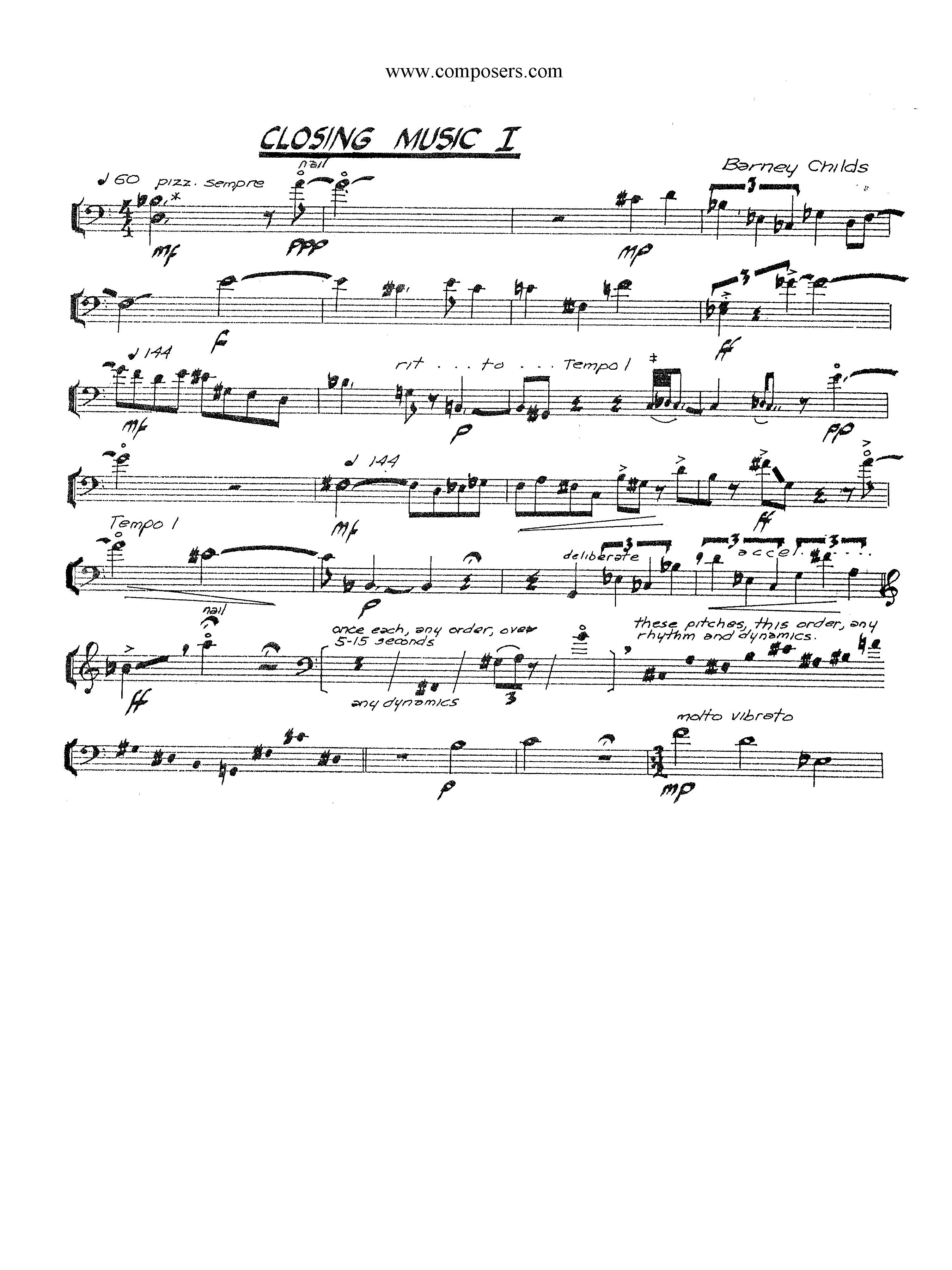
- Closing Music I (1964)
Score Sample – ACA
–
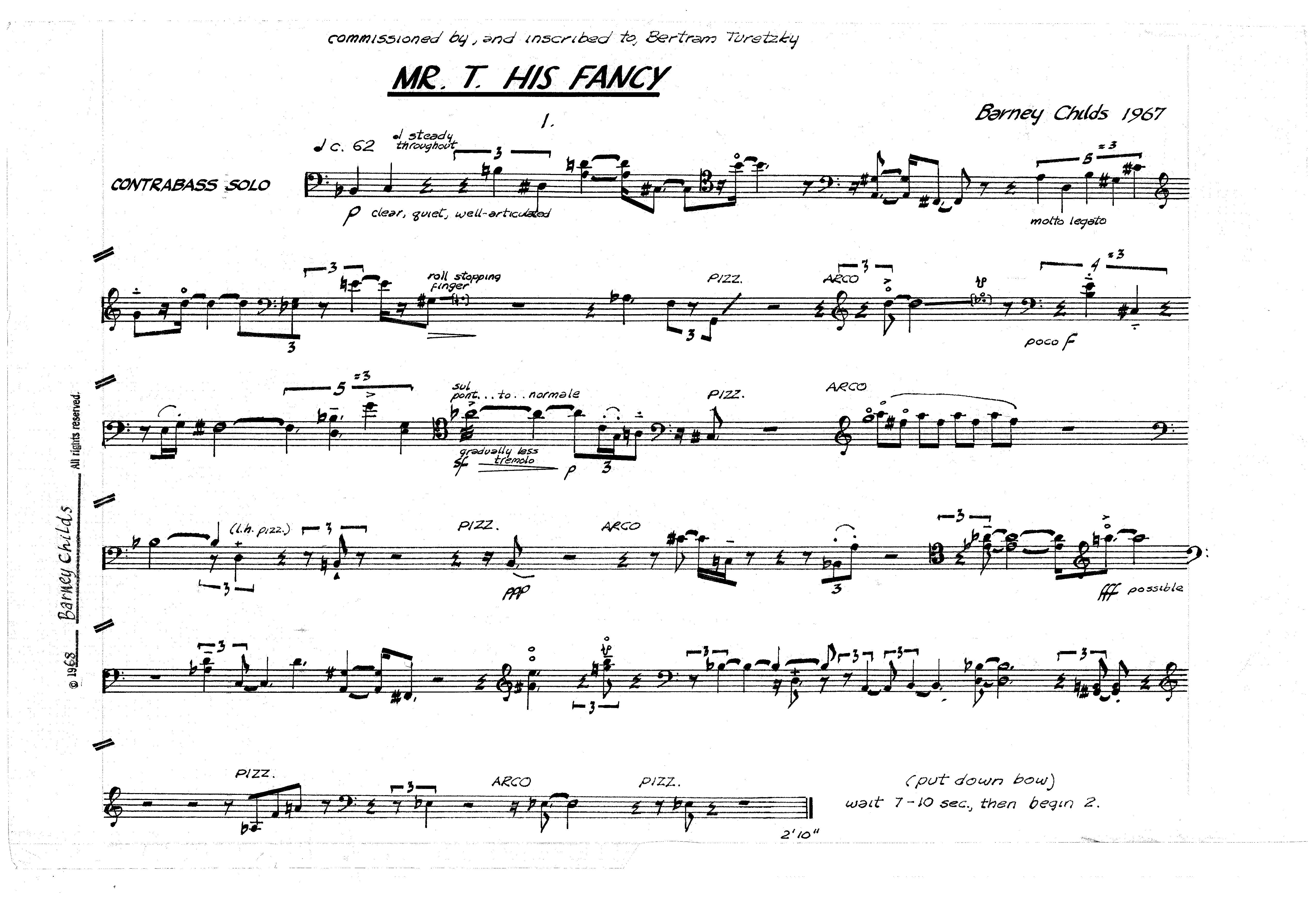
- Mr. T His Fancy (1967)
Score Sample – ACA
Note: Dedicated to Bertram Turetzky.
Reference Recording – YouTube [ Bertram Turetzky ] (score on screen)
Reference Recording – YouTube [ Hervé Rémond ]
–
- Music for One Player (1967)
Note: This score is offered with charts for Mandolin, or Flute, Viola, Cello, Double Bass, Clarinet or Bass Clarinet. Thus considered a piece for solo double bass as well.
–
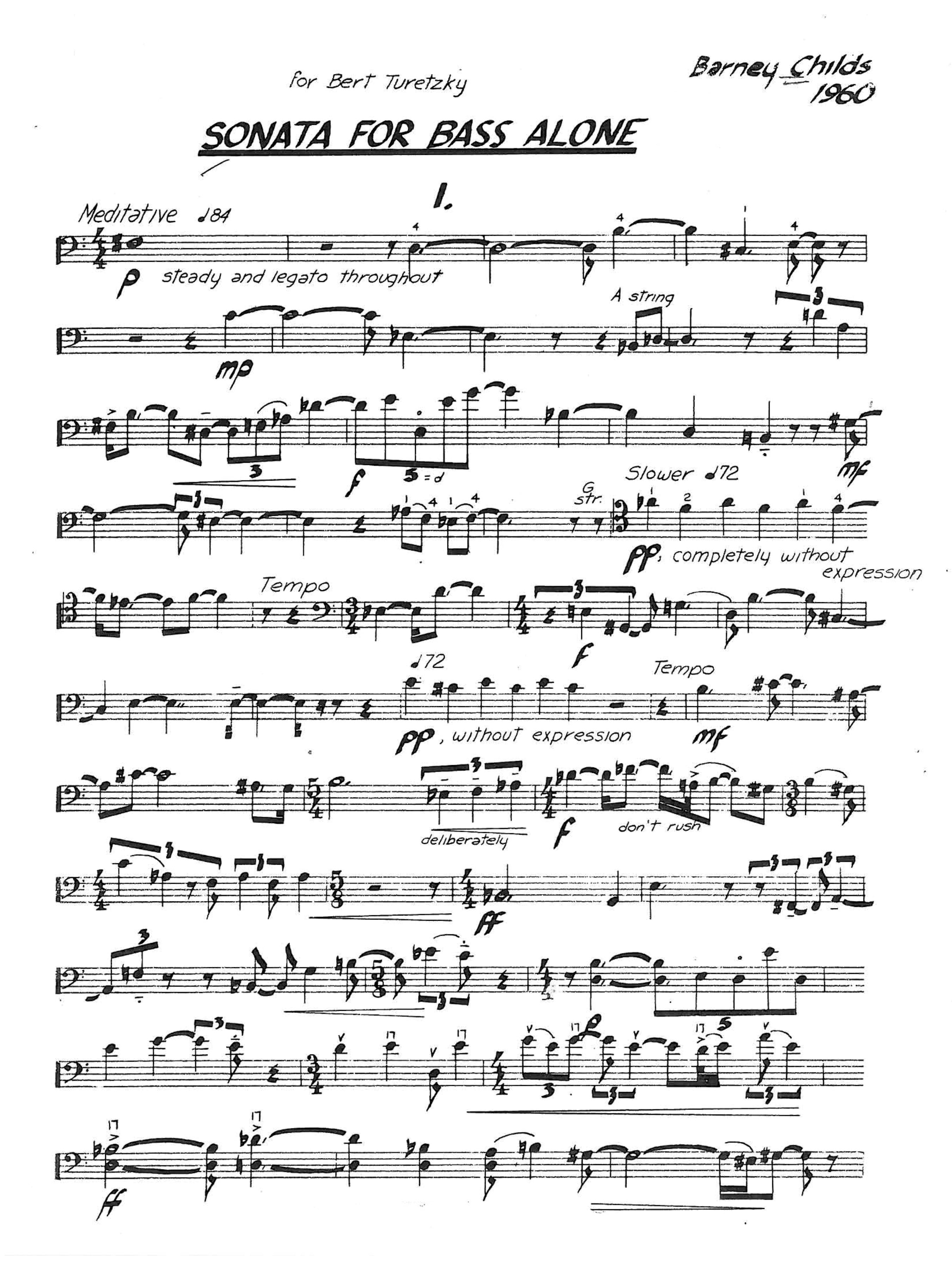
- Sonata for Bass Alone (1960)
Score Sample – ACA
Note: Dedicated to Bertram Turetzky.
Reference Recording – YouTube [ Hervé Rémond ]
–
- Therteen Classic Studies (1984)
Note: Also known as Contemporary Etudes for Contrabass or Thirteen Classic Etudes.
–
- Welcome to Contrabass Land (1981)
Note: This composition is featured on the LP A Different View and cited on the back cover as written by Barney Childs. It is also cited at Sandiegotroubadour.com as a “collaboration with music by Barney Childs and lyrics by Turetzky.”
Reference Recording – YouTube [ Bertram Turetzky ]
–
–
Childs, Mary Ellen (1957)
- Unfettered ( )
–
–
Chizy, Edith Canat de (1950)
Please see: Canat de Chizy, Edith (1950) – listed above
–
–
Clarke, Rosemary (1920-2005)
- Fantasy for Double Bass (1985)
Composition Page – NYPL American Music Center of Published Scores
–
- Lysippus’ Apoxyomenos for Solo Double Bass (1988)
Composition Page – NYPL American Music Center of Published Scores
–
–
Claudino, Valdir ( )
- Estudo No. 1 (1996)
–
–
Cleary, David (1954)
- Ret-rak (1975)
Composition Page – NYPL American Music Center of Published Scores
–
–
Coates, Carroll (1929-2023)
- Suite for Doublebass ( )
Note: This piece was located in Gary Karr Collection under author cited as “Carroll, C.” The search for the author however did not reveal any composer whose last name was Carroll with C initial, while the closest match was Carroll Coates (Coates being the last name), who was a songwriter and a movie composer. Further overview of Coates’ opus unfortunately did not reveal any solo instrumental compositions and neither the cited Suite for Doublebass. Thus it appears that the Suite may be a unique piece that Coates composed only for Gary Karr, although this is still a conjecture that will need to be corroborated.
–
–
Cohen, Patric ( )
- Fill-in-the-blues (1997)
Note: This composition could not be located independently in print or as a manuscript, yet it exists on a recording (see below). Otherwise, the Michael Cameron Music and Papers collection at University of Illinois at Urbana-Champaign indicates that within the Box 15, Item 18 there is a Bass Piece by Patric Cohen, which may or may not be Fill-in-the-blues featured here. Further inquiry needed.
Reference Recording – YouTube [ Michael Cameron ]
–
–
Cohn, Arthur (1910-1998)
- Declamation and Toccata (1946)
Reference Recording – YouTube [ Mark Bergman ]
–
–
Cope, David (1941-2025)
- Alternatives for Solo Bass (1968)
–
–
Corcoran, Frank (1940)
- Hernia (1977)
Note: Premiere presented by Wolfgang Güttler in 1981.
–
- Quasi Un Basso (2005)
Composition Page – Britishmusiccollection.org.uk
Note: Dedicated to Allan von Schenkel.
–
–
Cordero, Roque (1917-2008)
- Soliloquios No. 5 for Contrabass (1981)
Notes: Dedicated to Arthur Corra. Premiere presented by Arthur Corra.
Reference Recording – YouTube [ Roberto Flórez ]
–
–
Cornelissen, Ruud (1948)
- The Anniversary Song for Doublebass Solo (1976)
- Double-Bass Dexterity : Contrabass (1977)
- Musical Magazine for Unaccompanied Double-Bass (1977)
- Short Therapy for a Double Bass Player (1981)
–
–
Cornicello, Anthony (1964)
- Static Walking for Solo Bass (1997)
Note: Premiere presented by Robert Black.
–
- Le Città Invisibili IV : Le Gouffre : For Reciting Bassist or Two Performers (1993-94)
–
–
Cõrtes, Edmundo Villani (1930)
Please see: Villani-Côrtes, Edmundo (1930)
–
–
Cruft, Adrian Francis (1921-1987)
- Homage to J.S. Bach : A Little Suite, Op. 1 (1950)
Manuscript Data – Located in Royal Conservatory of Music, London under Ms. No. 6071
Note: This composition presents a little mystery since the full title of this piece indicates “for unaccompanied violoncello,” yet the WorldCat subject record states “Suites (Double Bass), Arranged” (?) Thus one may wonder if possibly this may be one of Bach’s Violoncello Suites in arrangement for double bass, or even some other cello related Bach’s composition that was arranged? The title of the piece also sets a question of whether Homage to J.S. Bach and A Little Suite, Op. 1 may indicate the original work of a kind that took Bach’s music only as an inspiration for an independent work. Edition sources WorldCat Record 1 – WorldCat Record 2 .
–
–
Cunningham, Arthur (1928-1997)
- Eclatette for Double Bass (1979)
–
–
Custer, Calvin (1939-1998)
- Caprice (after Rossini) ( )
Note: Located in Gary Karr Collection.
D
–
Dallapiccola, Luigi (1904-1975)
- Two Sketches (post 1975)
Composition Page – Opera-vieusseux.nexusit.it
Note: This composition is preserved in a form of manuscript photocopy within Luigi Dallapiccola estate and contains two pieces: Air per Contrabasso-Solo and Flying Thought per Contrabasso-Solo. By chance and since these pieces were located in Dallapiccola estate, they were mistakenly attributed to Dallapicaola and then recorded by Biørn Ianke as written by Dallapiccola. That attribution has proven to be a mistake, so the subsequent issues of Biørn Janke CD have corrected the authorship and show now the Anonymous as the author.
Nevertheless and with hope that the real author of these pieces may be discovered one day, these pieces are cited here under Dallapiccola for further reference.
Reference Recording
1. Air per Contrabasso-Solo – YouTube [ Biørn Ianke ]
2. Flying Thought per Contrabasso-Solo – YouTube [ Biørn Ianke ]
–
–
Damase, Jean-Michel (1928-2013)
- Pièces pour 1, 2 et 3 contrebasses (1989)
[ Pieces for 1, 2, or 3 double basses ]
Featured Pieces:
Chant d’espoir
Rituel
Intrada
Note: This composition apparently features three pieces that may be played by one, two or three basses. However, the answer to which movement requires what number of basses, or whether all three movements may be played in any of three combinations, was not clear from the available records.
–
–
Daniels, Ben ( )
- Slab (2017)
Reference Recording – YouTube [ Cody Takacs ]
–
–
D’Angelo, James (1939)
- Fool and Angel Entering a City (1995)
Note: Inspired by a painting by the British artist Cecil Collins (1908-1990)
Reference Recording – Jamesdangelomusic.com [ unknown ]
–
–
D’Auriol, Hubert (1913-1980)
Please see: Auriol, Hubert d’ (1913-1980)
–
–
Davidson, Lyle (1938-2021)
- And a Certain Gurgling Melodiousness for Doublebass Alone (1973)
Alternative Title: A Certain Gurgling Melodiousness for Doublebass Alone.
Note: Premiere presented by Richard Fletcher in 1973.
–
–
Davies, Peter Maxwell (1934-2016)
- Lux in Tenebris for Solo Double Bass, Op. 218 (2001)
Score Sample – Paganino.com
Note: Premiere presented by Duncan McTier in 2001.
–
–
De Castro-Robinson, Eve (1956)
- Panorama (1987)
Manuscript Data – National Library of New Zealand Record
Note: Dedicated to Barry Johnstone.
–
–
Deak, Jon (1943)
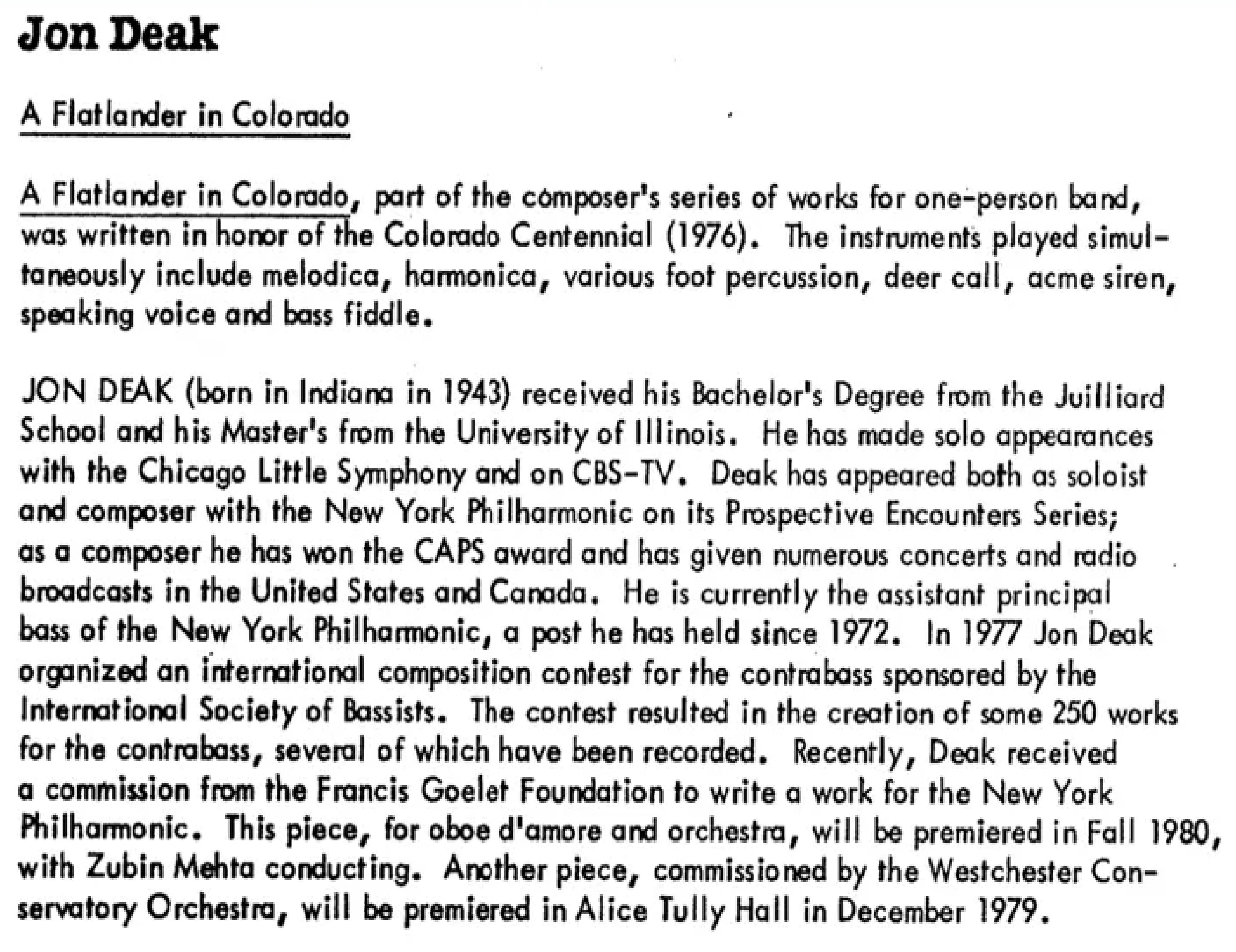
- A Flatlander in Colorado (1976)
Composition Info – Georgesdupuis.substack.com
Score Sample – Ebayimg IA
Note: This piece requires a performer to play simultaneously melodica, harmonica, various foot percussion, deer call, acme siren, to speak and certainly to play bass as well.
Reference Recording – YouTube [ Cody Takas ]
–
- Audition : Orchestral Instrument, Solo : Contrabass Version (1972)
–
- B.B. Wolf (Apologia) (1982)
Note: The text for this popular piece has been written by Richard Hartshorne.
Reference Recording – YouTube [ Jon Deak ]
Reference Recording – YouTube [ Jeff Bradetich ]
–
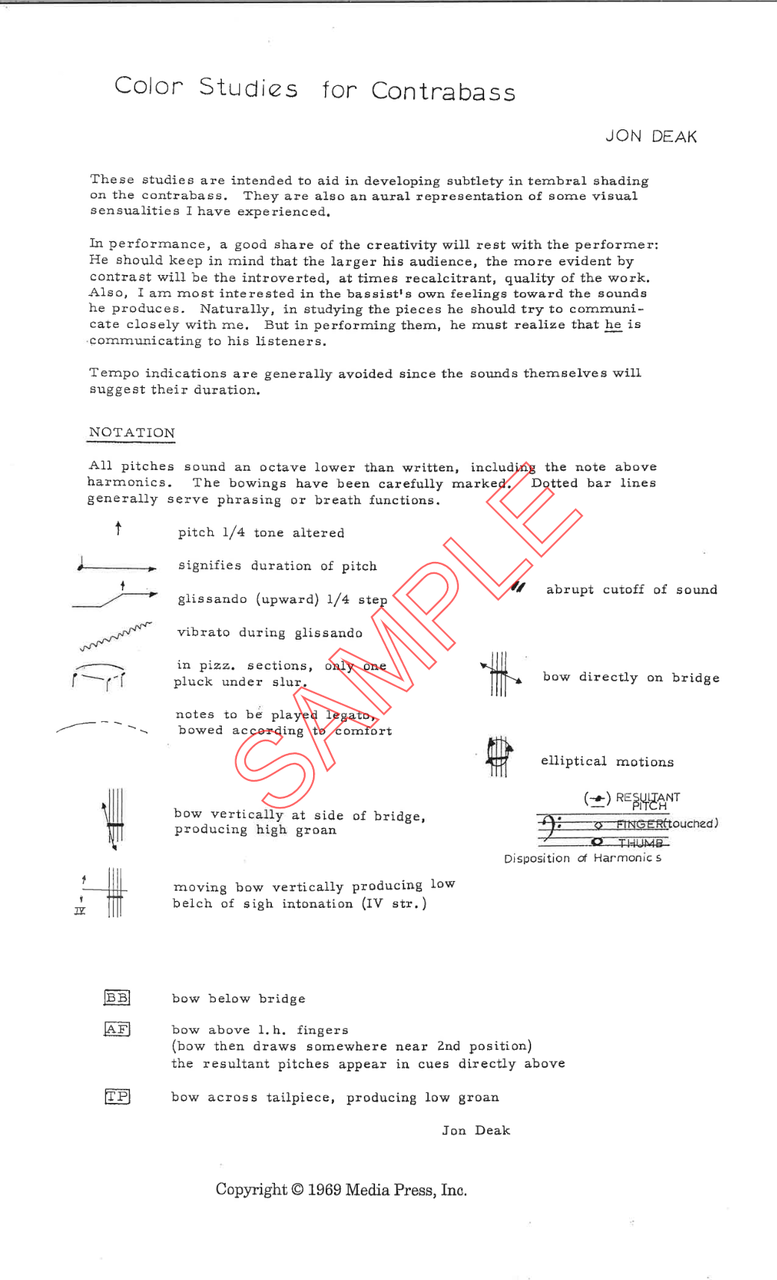
- Color Studies for Contrabass (1969)
Score Sample – Mediapressmusic.com
–
- Moody Melody (1995)
Note: This piece is based on the required solo bass piece for the International Society of Bassists 1995 Competition.
–
- Readings from Steppenwolf or the Private Life of Harry Haller (1975, rev. 1982)
–
- Sad Waltz from Street Music (1977)
Note: This composition is written for the same performer setup as A Flatlander in Colorado (1976). Both pieces are published in the same edition while it appears that Sad Waltz from Street Music was written in 1977 while A Flatlander in Colorado in 1976.
–
- Sherlock Holmes in “The Speckled Band.” (2010 – 11)
Note: This is the sequel piece to The Adventures of Sherlock Holmes, The Hound of the Baskervilles (1984). The piece was commissioned by Tod Leavitt.
–
- Surrealist Studies (1970)
Score Sample – Ebayimg IA
–
- The Adventures of Sherlock Holmes. The Hound of the Baskervilles (1984)
Composition Thesis:
Ibemere, Gracie. Interactions between Text and Music in Three Pieces by Jon Deak, Frank Proto, and Tom Johnson, University of Houston, 2018. Download Page
Note: A portion of Ibemere thesis is dedicated to Deak’s The Adventures of Sherlock Holmes: The Hound of the Baskervilles where she examines the composition, its style and peculiarities in several chapters pp. 4-15. Highly recommended reading for anyone who may consider a performance of this piece.
Reference Recording:
1. Part 1 – YouTube [ Richard Fredrickson ]
2. Part 2 – YouTube [ Richard Fredrickson ]
–
- The Hound of the Baskervilles (1984)
Please see: The Adventures of Sherlock Holmes, The Hound of the Baskervilles (1984) – cited above.
–
- The Wonderful World of Language : For Contrabass / Narrator (1980)
Note: Dedicated to Mary-Ellan Jarbine.
–
–
De Lucca, Silvia (1960)
Please see: Lucca, Silvia de (1960)
–
–
Delapeyronnie, Isabelle ( )
- Dialogue avec la Contrebasse (2023)
[ Dialogue with the Double Bass ]
Full Title: Dialogue avec la Contrebasse Des Histoires d’Oiseaux pour Contrebasse Seule sur des Textes de Jules Renard.
Full Title Translated: Dialogue with the Double Bass: Bird Stories for Solo Double Bass, based on texts by Jules Renard.
Note: This composition consists of some fourteen illustrated pieces depicting various birds and among them a bat as well. The publisher offers also the media images that can be presented during particular movements, while the text may either be narrated or played in a recorded form.
Reference Recordings:
La chauve-souris
[ The Bat ]
Reference Recording – YouTube [ Isabelle Delapeyronnie ]
La Bergeronnette
[ The Wagtail ]
Reference Recording – YouTube [ Isabelle Delapeyronnie ]
Le Martin Pêcheur
[ The Kingfisher ]
Reference Recording – YouTube [ Isabelle Delapeyronnie ]
La Bécasse
[ The Woodcock ]
Reference Recording – YouTube [ Isabelle Delapeyronnie ]
–
–
Delor, Thibault ( )
- Paris sera toujours Paris (2019)
[ Paris will always be Paris ]
Composition Info – Paris sera toujours Paris – wiki en
Note: Although this composition presents a timeless Parisian song with a known author, this arrangement for a solo bassist as both a vocalist and performer offers a sufficient amount of original contribution to be considered the original work. Thus listed here.
Reference Recording – YouTube [ Thibault Delor ] (alive)
Reference Recording – YouTube [ Thibault Delor ] (studio version)
Original Song Recording – YouTube [ Maurice Chevalier 1939 ]
Note: This is the American re-edition of French matrix from November of 1939 in the original interpretation with ensemble. The video page also features the full history of this song, it explains how it originated and presents the heroic life story its author Kazimierz (“Casimir”) Oberfeld. A text well worth reading.
–
- Volubile ( pre 2006 )
Alternate Title: Farewell – Volubile
Note: This composition presents the vocalization of Fernando Pessoa’s poem I Have Wished so oft This Mockery Might End with its stanzas performed respectively in English and Portuguese to the accompaniment of solo bass that matches in intensity and mood the poem’s text. In the opinion of the author of this site this composition is simply a masterwork.
Bibliography:
Fernando Pessoa (1888-1935) – Wiki en
Fernando Pessoa – Poem I Have Wished so oft This Mockery Might End – Escritas.org
Reference Recording – YouTube [ Thibault Delor ]
–
–
Dempsey, Lydia (1993)
- At Will (2017)
Note: Dedicated to Will Yager. Premiere presented by Will Yager in 2017.
–
–
Denhoff, Michael (1955)
- Meine Kleine Hafner-Serenade für Kontrabaß Solo, Op. 20 (1978)
Composition Info – Denhoff.de
Note: Dedicated to Christian Sutter who lived in Hafner-Hütte hamlet near Luzern at the time the composition was written. So the Hafner in the title bears no reference to Haffner Serenade by Mozart.
–
–
Denis, Didier (1947)
- Deux Pieces pour Contrebasse Seule (1974)
Featured Pieces:
La Graine
La Branche
–
–
Diamond, Arline (1928-1985)
- Bass Solo (1965)
Composition Page – AMC Collection – New York Public Library Record
Note: The NYPL record appears to indicate a photocopy of a manuscript score with the title For string bass : bass solo. The other citation of this piece is located in WorldCat where the title indicates simply Bass Solo. See WorldCat Record
–
–
Diesendruck, Tamar (1946)
- Stroll (2011)
Score Sample – ABP Repository (courtesy of Adrew Kohn)
Note: Dedicated to Andrew Kohn. Premiere presented by Andrew Kohn in 2011.
Reference Recording – ABP Audio Stream [ Andrew Kohn ] (courtesy of Andrew Kohn)
–
- The Orchestra (1993)
Score Sample – ABP Repository (courtesy of Adrew Kohn)
Note: Dedicated to Andrew Kohn.
Reference Recording – ABP Audio Stream [ Andrew Kohn ] (courtesy of Andrew Kohn)
–
–
Diethelm, Caspar (1926-1997)
- Fantasie für Kontrabass Solo, Op. 136 (1975)
Score Sample – Paganino.com
–
- Sonate Nr. 1 für Kontrabass Solo, Op 132 (1975)
Score Sample – Paganino.com
–
- Sonate Nr. 2 für Kontrabass Solo, Op 133 (1975)
–
–
Dinescu, Violeta (1953)
- Abendandacht (1985)
[ Evening Prayer ]
Score Sample – ABP Repository (courtesy of Andrew Kohn)
Note: This piece was originally composed for trumpet with option to be played by any other melodic instrument. So, it exists in versions for solo violoncello and solo double bass as well. There is even a version for block flute with organ accompaniment.
Reference Recording – ABP Audio Stream [ Andrew Kohn ] (courtesy of Andrew Kohn)
–
- Lytaniae I, Variante für Kontrabass (2010)
Score Sample – ABP Repository (courtesy of Andrew Kohn)
–
- “Nekyiomantia” für Kontrabass (1996)
Note: Premiere was likely presented by Michael Cameron in 1997, although that information still needs to be verified.
–
- Satya III (1981)
Score Sample – ABP Repository (courtesy of Andrew Kohn)
Reference Recording – YouTube [ Ernst Weissensteiner ]
–
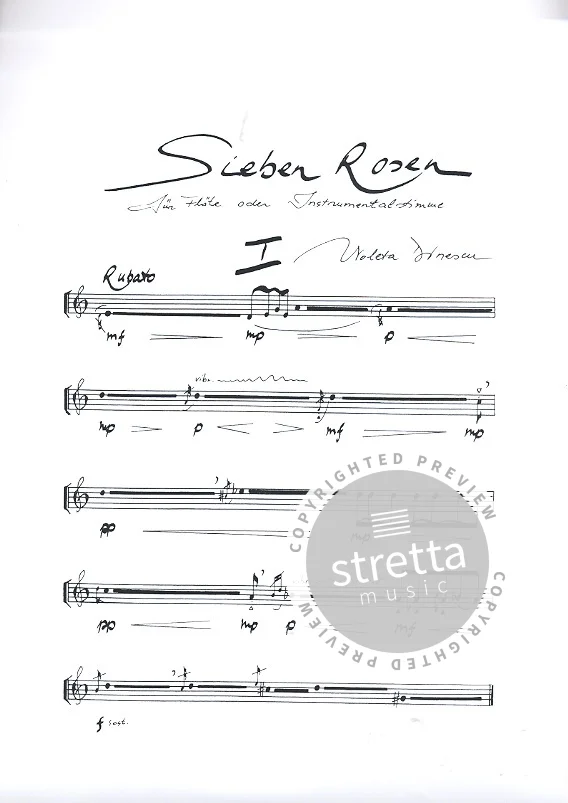
- Sieben Rosen für Flöte Oder Instrumentalstimme (2012)
Score Sample – Stretta-Music.com
Note: This composition is conceived for flute or any other “Instrument voice,” which should imply the double bass as well. However, no bass performance or recording of this composition has been noted at the time of posting, which opens a possibility for someone to premiere this piece in a bass version as well.
–
–
Diokno Schnitzlein, Bethel ( )
Alternate Name: Diokno, Bethel D.
- Emotionale (1977)
Score Sample – ABP Repository
Note: Recorded by Jon Deak in 1977. Reviewed in Deak, Jon. “ISB Composition Contest.” ISB Journal. Vol. 4, No. 2, 1977, p. 382.
–
–
Donatoni, Franco (1927-2000)
- Lem, Due Pezzi per Contrabbasso (1982)
Composition Page – Ricordi.com
Composition Thesis:
Cho, Han Han. Double Bass: Transcribed and Contemporary Repertoire. D.M.A. Thesis, University of California, San Diego, 2010. Download Page
Note: This thesis presents also an overview of Franco Donatoni’s Lem pp. 16-47. Covered are the composition technique, history of the piece, related Donatoni opus, detailed music analysis of Lem (pp. 21-39) and even practice suggestions for this piece (pp. 46-47).
Note: Dedicated to Franco Petracchi. Premiere presented by Stefano Scodanibbio in 1984. Lem consist of two pieces (Pezzi) that appear to function as two movements of this composition.
Reference Recording – YouTube [ Michael Cameron ] (score on screen)
Reference Recording:
1. Pezzo 1 – YouTube [ Michael Cameron ]
2. Pezzo 2 – YouTube [ Michael Cameron ]
Reference Recording – YouTube [ Anton Jaro Jr. ]
Reference Recording:
1. Pezzo 1 – YouTube [ Pierre Dekker ]
2. Pezzo 2 – YouTube [ Pierre Dekker ]
Reference Recording – YouTube [ Federico Passaro ] ( Part I only )
Reference Recording – YouTube [ Daniele Roccato ]
Reference Recording:
1. Pezzo 1 – YouTube [ Han Han Cho ]
2. Pezzo 2 – YouTube [ Han Han Cho ]
–
–
Downey John W. (1927-2004)
- Silhouette for Double Bass (1980)
–
–
Dragonetti, Domenico (1763-1846)
The complete solo bass legacy of Domenico Dragonetti has unfortunately not been fully researched and catalogued to this day. Therefore the author of this site has to relate with apology that the index of unaccompanied solo bass works presented here is also bound to be partial and incomplete.
The known Dragonetti music oeuvre that contains both bass and non bass compositions is held today within at least six major libraries on both European and American continents. The majority of Dragonetti solo bass works however still reside in The British Library within the Vincent Novello bound volumes that have been assembled from the scores Dragonetti bequeathed to Vincent Novello. These volumes are cited online in The British Library catalog, but only under manuscript numbers, while their basic content is described only in the simplest terms. Please see – BL Dragonetti Search – Cumulative Records Link
The task of presenting a scholarly catalogue of all Dragonetti’s bass works has been attempted in the past by several authors, yet none of those catalogs are available in the public today and it appears that all such attempts have ended as half completed projects, likely due to the magnitude of the task. Within the Dragonetti bound volumes in The British Library one will find innumerable sketches and likewise incomplete pieces that require time to analyze and catalogue properly within the scholarly standards. Another problem with indexing Dragonetti’s solo bass music lies in the fact that many of Dragonetti’s solo pieces have never been completed by the maestro himself, as these exist only as solo parts or even incomplete solo parts. Dragonetti has hoped that the piano accompaniments for these incomplete pieces will be completed by someone else, likely Novello to whom he bequeathed his solo bass estate. Altogether, the author of this site estimates that the cumulative number of Dragonetti compositions, or the movements of compositions, whether completed, partially completed, in sketch state, with or without piano, or ensemble accompaniment – may exceed two hundred pieces (if not more).
Therefore it is the opinion of the author of this site that a cumulative Dragonetti cataloging project would be a worthwhile endeavor to the bass profession. Such a project, and considering the profiles of desired expertise and required work, would likely need to be organized as a coordinated international effort with a team of dedicated experts, consisting of musicologists, librarians, archivists and certainly bass players.
In respect to unaccompanied solo bass works, and as stated in the opening paragraph, the following listing can not claim to be complete at this point. However, what has been ascertained is that the authentic solo bass pieces known to be by Dragonetti are his solo bass collections of waltzes. There are two of them (so far), the first one located in British Library MS: Add. 17830, F. 15b. volume, edited by Anthony Scelba in 1988, and the second one located in British Library MS: Add. 17831 volume. The second one, known as Twelve Waltzes, has been discovered during the 60’ and 70’ of the last century, and has become quite popular ever since. At the present it is available in modern editions and likewise featured on several recordings by accomplished artists.
–
- Twelve Waltzes (est. 19th century)
Manuscript Data – BL Record ( Manuscript Number: Add MS 17831)
Composition Info – Henle Verlag Edition (Edition Preface pdf)
Composition Info – Henle Verlag Edition (Edition Comments, Ms Info & Errata pdf)
Note: It is not common to feature a direct edition notes within the Composition Info field, however Henle has done such a good job in both editing and describing the Waltzes that these notes suite the purpose well.
–
General Note: As the Henle edition presents, these Waltzes were likely composed toward the later part of Dragonetti’s career in London and for his own use. However, Waltzes may also be considered as the first samples of solo unaccompanied double bass literature that are extant and intended for the modern double bass setup. The issue of the first solo bass pieces written for period G Violoni may still need to be addressed, but until that issue is settled, the Dragonetti Waltzes may bear the honor of being the first pieces written for solo bass that were conceived as such.
–
Online View & Download – IMSLP
Note: IMSLP features the scan of The British Library source manuscript of Twelve Waltzes, however it appears that it is incomplete.
–
Reference Recordings:
Please note that Dragonetti’s Twelve Waltzes have already been known to the wider bass community and have thus been recorded in high quality by many accomplished bassists. Nevertheless, only few artists have dared to record all twelve waltzes as it was more common to note only few performances of waltzes by a particular artist. Therefore the waltzes are all indexed separately in numerical order where each features available reference recordings and their affiliated artists.
–
Waltz No. 1 Vivace
Reference Recording – YouTube [ Giuseppe Ettorre ]
Note: Performed on Dragonetti’s own cherished Gasparo da Salò bass in the original gut three string setup.
Reference Recording – YouTube [ Odon Racz ]
Reference Recording – YouTube [ Phoebe Russell ]
Reference Recording – YouTube [ Dritan Gani ] (score on screen)
Reference Recording – YouTube [ Jeremy McCoy ]
Score Sample – Musescore
–
Waltz No. 2 Presto
Reference Recording – YouTube [ Giuseppe Ettorre ] ( Dragonetti type bow)
Reference Recording – YouTube [ Giuseppe Ettorre ] ( overhand type bow )
Note: Performed on Dragonetti’s own cherished Gasparo da Salò bass in the original gut three string setup. For this presentation it appears that Maestro Ettorre has decided to present two excellent interpretations of this waltz and with two different types of bows.
Reference Recording – YouTube [ Dritan Gani ] (score on screen)
Reference Recording – YouTube [ Phoebe Russell ]
–
Waltz No. 3 Vivace
Reference Recording – YouTube [ Tobias Glöckler ]
Reference Recording – YouTube [ Odon Racz ]
Reference Recording – Northwestern University Production [ Andrew Raciti ] ( located at NU Dragonetti )
Reference Recording – YouTube [ Laura Asensio ]
Note: This video presents some talk but the interpretation is quite spirited and definitely worth hearing.
Reference Recording – YouTube [ Dritan Gani ] (score on screen)
–
Waltz No. 4 Allegro
Reference Recording – YouTube [ Jeremy McCoy ]
Reference Recording – YouTube [ Dritan Gani ] (score on screen)
–
Waltz No. 5 Vivace
Reference Recording – YouTube [ Odon Racz ]
Reference Recording – YouTube [ Julian Medina ]
Reference Recording – YouTube [ Dritan Gani ] (score on screen)
–
Waltz No. 6 Vivace
Reference Recording – YouTube [ Odon Racz ]
Reference Recording – YouTube [ Dritan Gani ] (score on screen)
–
Waltz No. 7 Vivace
Reference Recording – YouTube [ Odon Racz ]
Reference Recording – Northwestern University Production [ Andrew Raciti ] ( located at NU Dragonetti )
Reference Recording – YouTube [ Jeremy McCoy ]
Reference Recording – YouTube [ Robert Oppelt ]
Reference Recording – YouTube [ Indi Stivin ]
Reference Recording – YouTube [ Dritan Gani ] (score on screen)
–
Waltz No. 8 Vivace
Reference Recording – YouTube [ Tobias Glöckler ]
Reference Recording – YouTube [ Dritan Gani ] (score on screen)
–
Waltz No. 9 Vivace
Reference Recording – YouTube [ Jeremy McCoy ]
Reference Recording – YouTube [ Dritan Gani ] (score on screen)
–
Waltz No. 10 Allegretto
Reference Recording – YouTube [ Dritan Gani ] (score on screen)
–
Waltz No. 11 Vivace
Reference Recording – YouTube [ Odon Racz ]
Reference Recording – YouTube [ Dritan Gani ] (score on screen)
–
Waltz No. 12 Presto
Reference Recording – YouTube [ Jeremy McCoy ]
Reference Recording – YouTube [ Ubaldo Fioravanti ]
Reference Recording – YouTube [ Dritan Gani ] (score on screen)
–
–
Drew, Lucas (1935)
- Little Suite of Shaker Songs and Dances for Solo Double Bass (or Solo Violoncello) (2011)
Featured Pieces:
I. Dance
II. Passion of Sorrow
III. Indian Song
IV. Pinch’d up
V. Simple Gifts and Coda
Note: The Little Suite of Shaker Songs may appear to be arrangement of popular Shaker songs, but it is also possible that it represents the original work based on Shaker songs. Therefore listed here among the original compositions.
–
- Four 20th Century Miniatures for Unaccompanied Double Bass (2015)
Featured Pieces:
I. Soliloquies
II. Sound Study
III. Scherzo
IV. Pisces
–
- Prayer for Bass Clef Instruments (2002)
Note: The edition states that the composition is written for any of the following instruments: Violoncello, Double Bass, Electric Bass, Guitar, Bassoon, and Lower Brass. The edition title also indicates “with optional chordal accompaniment,” so the composition may be suitable for piano or guitar accompaniment as well. Further check needed.
–
- Zodiac Suite (1987)
Featured Pieces:
Aries
Taurus
Gemini
Cancer
Leo
Virgo
Libra
Scorpio
Sagittarius
Capricon
Aquarius
Pisces
Note: Zodiac Suite was initially composed for viola and double bass ensemble, while the solo bass version appears to have come after the duo. Furthermore, the edition notes for both the duo and solo bass versions indicate suggestions for background lighting, so apparently there is also a visual component in the performance of this composition.
–
–
Drogoz, Philippe (1937-2023)
- Rue de Madrid pour Contrebasse (1971)
Note: Written for Concours du Conservatoire National Supérieur de Musique.
–
–
Druckman, Jacob (1928-1996)
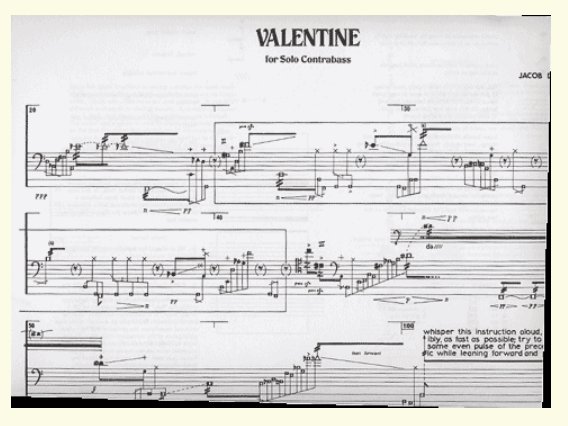
- Valentine (1969)
Manuscript Data – Located at New York Public Library – Jacob Druckman Papers
Note: Jacob Druckman Papers at NYPL hold several manuscript sketches along with the work and final proof manuscripts of Valentine. In addition, the collection holds numerous correspondences of Druckman that pertain to Valentine and which point to a high interest in this piece and literally from the time it was created in 1969.
–
Composition Info – Bruceduffie.com [ an Interview with Bruce Dyrfle ]
Note: The circumstance of Valentine’s origin have been well described in Jacob Druckman interview with Bruce Dyrfle that took place in a form of an informal dialogue. The Valentine itself is mentioned in the middle of the interview, where we find that the piece apparently originated on the request of Bertram Turetzky, while composed at the time Druckman lived in Monmarte neighborhood of Paris. The very writing process of this piece apparently commenced one day when Druckman decided to rent a bass in order to explore the instrument’s possibilities for Valentine.
–
Composition Articles:
Baguyos, Jeremy Castro. “Synapse>Valentine: Reuniting Acoustic And Electronic” International Computer Music Association. Vol. 2005. Online View and Download – Quod.lib.umich.edu
Deak, John. “Valentine for Solo Contrabass.” International Society of Bassists Magazine. Vol. 2, No. 1, Fall 1975, p. 117.
–
Composition Performance Reviews:
Kisselgoff, Anna. “The Dance: ‘Valentine.’” The New York Times March 11, 1971, p. 35 – Article Link
Note: A review of choreographed Valentine version premiere for two dancers and solo bassist performed by the City Center Joffrey Ballet. For the performance video check “Reference Video – Choreographed Version, Joffrey Ballet,” listed below at the end of Reference Recordings section.
–
Don McDonagh. “‘Valentine’ Makes Its Joffrey Debut.” The New York Times November 4, 1971, p. 57 – Article Link
Note: A new season review of choreographed Valentine version for two dancers and a solo bassist performed by the City Center Joffrey Ballet.
–
Composition Theses:
Cesare-Bartnicki, T N. Gender-specific Texts in Contemporary Double Bass Compositions: Jacob Druckman’s Valentine and Joëlle Léandre’s Taxi. (B.M. ?) Thesis, Oberlin College, 1999. Record Link
Isham, Timothy J. A Comparison of Extended Technique Use in Three Works for the Double Bass. M.M. Thesis, Bowling Green State University, 1996. Record Link
Note: This thesis presents an analysis of Druckman’s “Valentine.”
–
Score Sample – Bruceduffie.com
–
Reference Recording – YouTube [ Joseph Kaufman ] (score on screen)
Note: Although Valentine was written as a theatrical piece with this video it is possible to follow the score on screen and relate directly what is written to how it is interpreted.
–
Reference Recording – YouTube [ Alvin Brehm ]
Note: This is the famous first LP 1971 recording of Valentine with Alvin Brehm and where the purely electronic Synapse, precedes the acoustic Valentine. The video features both pieces, but the timing is adjusted to start right on Valentine at 9:55. The video cover image is however not from the original LP.
–
Reference Recording – YouTube [ Lawrence Wolfe ]
Note: This Valentine interpretation by Lawrence Wolfe was released in 1999 album with recording dated to 1978. However, there are records of Lawrence Wolf performing Valentine already in 1972 in Jordan Hall, Boston, and the program is very similar to the one presented on this CD.
–
Reference Recording – YouTube [ Joëlle Leandre ]
Note: This is recording of Valentine by Joëlle Leandre was likely and originally recorded in 1987, yet here it is presented in 2019 reissue of her Joëlle Leandre Contrebasse et Voix, ADDA, 1987, LP. This recording is also mentioned in Druckman interview with Bruce Dyrfle (cited above).
–
Reference Recording – YouTube [ Pierre Dekker ]
–
Reference Recording – YouTube [ Paul Cannon ] (alive)
–
Reference Recording – YouTube 1 [ Lisa Dowling ] (alive)
Reference Recording – YouTube 2 [ Lisa Dowling ] (alive)
Note: Lisa Dowling presents actually two performances of Valentine online, so you can choose which one you like better.
–
Reference Recording – YouTube [ Robert Black ]
Reference Video – Choreographed Version for Solo Bass and Two Dancers – Video segment – Facebook Video Post
Valentine. The Joffrey Ballet. Choreography: Gerald Arpino, Music: Jacob Druckman, Performed by dancers Rebecca Wright and Christian Holder. Assumed Alvin Brehm on bass.
–
Reference Video – Choreographed Version for Solo Bass and Two Dancers – Video segment – Facebook Video Post
Valentine. Choreography: Gerald Arpino, Music: Jacob Druckman, Performed by dancers Julianne Spratlin and Fabrice Calmels and Joseph Guastafeste (Chicago Symphony Orchestra) on bass.
Note: This is likely the Chicago performance of choreographed Valentine, with different dancers but still supervised by Gerald Arpino and based on the original New York choreography. The solo bass in this performance is Joseph Guastafeste, the Principal Bass of the Chicago Symphony Orchestra at the time.
–
General Note: It appears that Valentine has caught the imagination of bass players quite early and literally since the time it was composed and premiered in 1969. Valentine was originally written for a bassist narrator as a second piece in the double composition Synapse – Valentine. However, it is commonly performed as a separate piece without the electronic Synapse, and it has also caught the public imagination in a stage choreography variant with two dancers, a production that by chance has been reviewed twice by the New York Times. The number of relatively recent performances and online recordings proves that the piece still inspires and intrigues bass players in 21st century. The full and final history of this composition however, seems to still await the complete research, and particularly given that much of Druckman correspondence with performers is preserved in the archives of the New York Public Library.
–
–
Dubois, Pierre Max (1930-1995)
- Cornemuse : Pour Tuba ut ou Trombone Basse ou Saxhorn Basse Si ♭ ou Contrebasse à Cordes et Piano (1961)
–
- Histoires de Contrebasse pour Contrebasse Accompagnée de Piano (1988)
Featured Pieces:
1. Chanson Pieuse
2. Troïka
3. Berceuse à Boby
4. Danse du Teckel Noir
Reference Recording – YouTube [ Mark Bergman ]
–
- Le Gai Cascadeur; Variations Très Faciles pour Contrebasse et Piano (1973)
–
–
Dubrovay, László (1943)
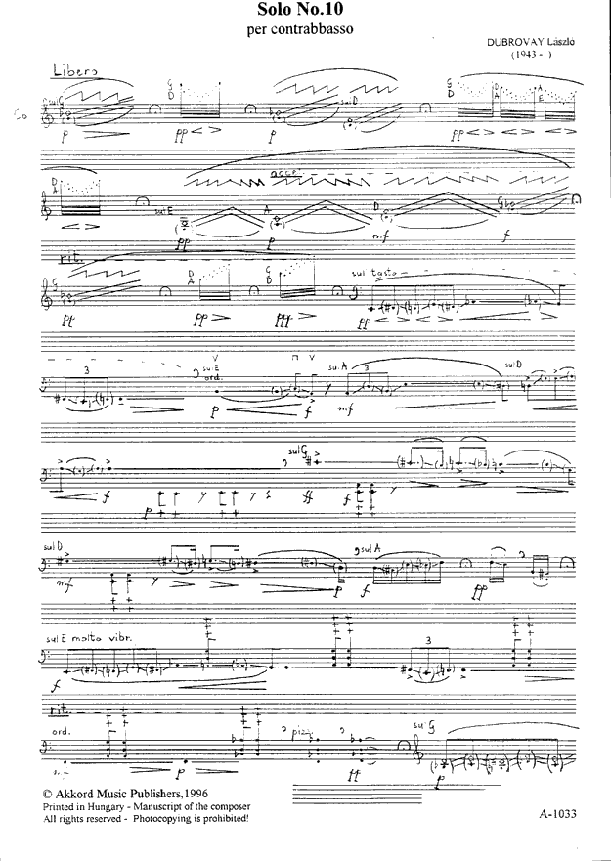
- Solo No. 10. per Contrabasso (1991)
Score Sample – Akkordmusic.com
Reference Recording – YouTube [ Iván Sztankov ] (live recording)
Reference Recording – YouTube [ Iván Sztankov ] (studio recording)
–
–
Dubugnon, Richard (1968)
- Disco Iræ, for Double Bass and Loop Pedal, Op. ? (2020)
Note: Composed for Béjart Ballet, Lausanne, 2020.
Reference Recording – YouTube [ Richard Dubugnon ]
–
- Trois Évocations Finlandaises, Op. 6 (1991)
[ Three Finish Recollections ]
Alternative Title: 3 Pièces Pour Contrebasse Seule : Evocations Finlandaises [ 3 Pieces for Double-Bass Solo : Finnish Recollections ]
Featured Pieces:
Menuet Carelien
Dithyrambe
Hämärä
Reference Recording – YouTube [ Richard Dubugnon ] (score on screen)
Reference Recording – YouTube [ Théotime Voisin ] (score on screen)
Reference Recording – YouTube [ Théotime Voisin ]
Reference Recording:
1. Menuet Carelien – YouTube [ Richard Dubugnon ]
2. Dithyrambe – YouTube [ Richard Dubugnon ]
3. Hämärä – YouTube [ Richard Dubugnon ]
Note: Hämärä substitle reads Le coucou chante dans le crepuscule, translated “The cuckoo sings in the twilight.”
–
–
Dusapin, Pascal (1955)
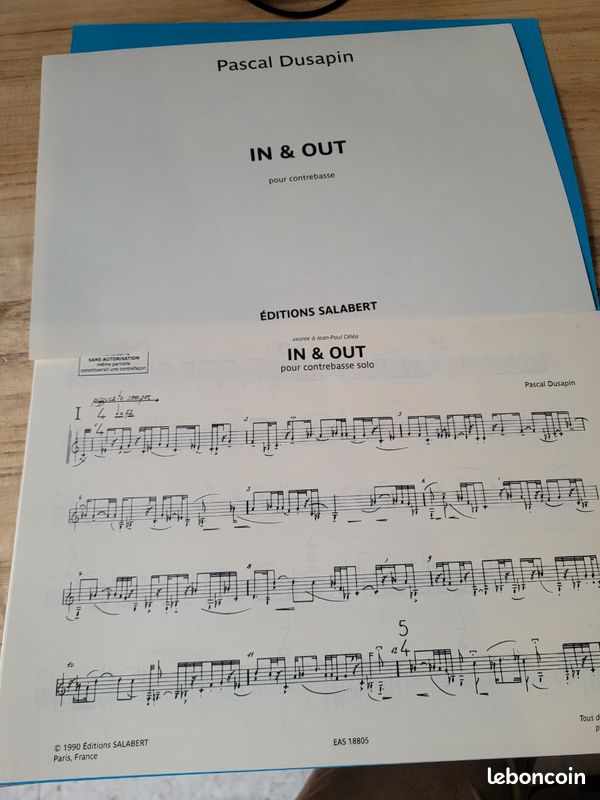
- In & Out pour Contrebasse (1989)
Alternate Ttile: In & Out, Deux Pièces pour Contrebasse
Composition Info – Brahms.ircam.fr
Score Sample – Leboncoin.fr
Note: Dedicated to Jean-Paul Céléa.
Reference Recording – YouTube [ Alvaro Rosso ]
Note: Recording text presents additional information on the piece. The “Out” piece (bowed) starts ca. 5:33.
–
–
Dyndahl, Petter (1957)
- Kneial 1 – Monolog for Kontrabass (1993)
Composition Info – Nva.sikt.no
Score Sample – Nb.no
Classification Criteria & Organization
As mentioned in the page introduction, this listing is designed to present all original compositions for unaccompanied solo bass. Therefore you will not find here any Baroque pieces that were almost by default adopted and arranged from the literature written for other instruments, such as Bach’s solo violoncello suites. These pieces will be featured in the Arrangements & Transcriptions section once the cataloging process for original bass repertoire is completed.
The majority of compositions cited here will date from the mid to late 20th century along with pieces from the 21st century. Some of them may be written in neoclassical or neobaroque style, yet some of them that belong to the more contemporary repertoire, may also require extra techniques and even vocalizations or recitation. Those extra tasks will bear no influence on classification of a piece as written for a single performer. However, as long as any element of performance may be assigned to a second performer, then by a default this piece would be considered suitable for another category, whether as chamber music piece in a duo classification, or yet in another class if there are more performers involved.
This catalog is organized alphabetically by the last name of composer and follows a custom design described in the Record Format and Record Format Map sections. Therefore, it begins with composers whose last name starts with A and will continue to expand with composers with last name starting on B (Bourgeois), C (Cage), D (Dragonetti) and so on. All the letters in various languages that differ from Latin script but approximate standard Latin letters, such as Å for A ; Č and Ć for C – will be indexed within the alphabetical order of existing Latin letters and not be grouped separately. This rule applies also to German Ü and Ö that will be catalogued within standard U and O listings in continuity with other composers’ names. Within the title citations that starts with an article (The, A, An) the first letter of the article actually determines the alphabetical sequence. This practice may not be in accordance with some professional cataloging rules, yet was considered more intuitive for common user than to offer an explanation on “how to ignore articles” while looking at the alphabetical order of compositions.
An issue of determining the last name with some Latin American and Hispanic composers, whose actual full names may contain up to five names, has brought a question of which one is actually the last and according to which one is the author to be classified? In those (multi name) instances a wider search over the net and extant catalogs was used, and commonly a professional citation in some catalog or academic listing located. However, in some instances some mistakes may be possible and will certainly be resolved if discovered.
A unified database that may list all solo bass compositions including Solo Unaccompanied, Solo with Piano, and Solo with Ensemble in one listing is not envisioned for this catalog in this stage of development. However, it may be possible to offer such a unified listing in future when these separate listings are transferred to a proprietary cataloging software. When that occurs, your access options to all the records featured here will in essence be the same as with any other professional library cataloging system.
Lastly, it may be of interest to know what sources were used in making of this catalog, as there certainly are a lot of them available both in historical prints and the present online offering. All these sources will be cited in future Bibliography section, yet only when the catalog is completed and all the cataloging issues resolved in full.
Record Format
The Record Format for individual compositions was established in order to present uniformly the composer’s name, the compositions title and the year composition was written. In addition, some other supplementary data of relevance for the composition may be featured in separate entries that follow the title. However, you may find that these records do not mimic the traditional online library records, since the purpose of the record is simply to indicate the existence of a particular composition (with some extra data) and not to offer the full source citation in the way library records do. The records in this catalog are also designed to incorporate only the free and non-commercial content.
The additional areas of interest that pertain to composition origin, its history, and particularly the editions, performances and recordings are not featured here, but are in plans for future. The extra work needed to incorporate just the editions for all featured compositions at the present Beta-Phase development, would simply delay the completion of this project to some uncertain time in the future. Thus and for now, only the basic data are offered.
The typical composition entry that you will encounter here will consist of the fields presented in the Record Format Map (below), although the offering of fields may vary considerably from one entry to the other. Thus with some entries even the dates for composer and compositions may lack, while with some other you may find the composition very well documented.
Record Format Map
This map presents and explains all the fields that may be encountered in a typical record. In practice however, most records will be much smaller, and some may offer only the author and composition title entries. At the end of each entry field you will find a numbered link that will lead to a description of that particular field, with entry example, description, and the purpose described. As mentioned in Solo Compositions page introduction, this bibliography at this stage of development does not present printed editions, so none will be featured here either.
–
Doe, John (1901-1982) 1
Composer’s Bass Opus Introduction. This introductory paragraph will appear only with composers whose bass opus is not completely researched, and when the research and cataloging status of a particular opus require further clarification. Commonly and with most composers this introduction will be missing. 2
Double Bass Concerto, No.2, Op. 111 (1950) 3
[ Translated Title in English (if title citation is in Foreign Language) ] 4
Title in Foreign Language: Foreign Language Title 5
Manuscript Data – Source Record or RISM Record 6
Composition Page – SourcePage.com 7
Composition Info – SourcePage.com 8
Composition History Page – SourcePage.com 9
Featured Pieces: 10
Yellow duster
Rhode Island red
A flutter on the grey
Comfy green settee
Floral blue frock
Pinks with African violets
Black cherry
Score Sample – SourcePage.com 11
Modern Day Premiere Report – SourcePage.com 12
Note or Notes: 13 ( Notes entries will commonly cover any inconsistencies, particularities or unknowns that the source records may reveal about the featured composition. For example: Dedicated to Joe Doe. Commissioned by Joe Doe. Written originally for Double Bass and Orchestra (or) Unknown if an orchestra version exists. Assumed with piano accompaniment. Some data unknown, further inquiry needed. )
Online View & Download – SourcePage.com or IMSLP 14
Reference Recording – YouTube [ Joe Doe ] 15
Or, with multiple movements featured in separate video or audio streams:
Reference Recording:
1. Allegro – YouTube [ Jane Doe ]
2. Largo – YouTube [ Jane Doe ]
3. Menuetto – YouTube [ Jane Doe ]
4. Rondo – YouTube [ Jane Doe ]
–
Record Format Map Index – Individual Fields
Example: Doe, John (1901-1982)
Form: Composers’ names are cited in traditional Last name, First name format which is followed by composer’s life years, or just the birth year for those that are still among us. If the name consists of several names, then the Library of Congress Name Authority record is used to form the proper name entry. In some instances however and when the Library of Congress Authority Name record is missing, a VIAF Name Authority is used. In the case when both the Library of Congress and VIAF name authorities do not exist, a common and most acceptable name form used on internet is used instead.
–
–
Introduction to Composer’s Bass Opus
Example:
The opus of Ludwig G. Amman consists of some eight compositions, located at the present within the Malaric collection in Salzburg. The titles of these compositions are presented in alphabetical order, although they appear to be numbered in sequence from Fourth to Eighth (in German). Therefore possibly the first three pieces may be represented by Drei Romantische Vortragsstucke, followed by the Viertes, Funftes, Sextes and Achtes Vortragusstuck. One would also expect the seventh to be named as well, but it is missing from the inventory. Instead, we find Ein Kontrabass-Solo and two sources for Moderato Assai und Scherzo. However, whether any of these sources may represent the Seventh or Siebtes piece, is yet to be determined.
(From the introduction to Ammon, Ludwig G. ( 20th c.) listing)
Purpose and Content: During the work on this bibliography it was discovered that some solo bass legacies present challenging issues that make them very difficult to properly define and index. Therefore it was thought prudent to offer a small introduction chapter where these issues are addressed along with explanation on how the listing was formed and what possible steps should be taken in future, in order for the listing to become more complete and accurate. Commonly these issues relate to dating, the composition identification, the relevance or incompleteness of sources, or the divergence between various sources that need to be fully researched in order to be accurately represented.
Example: Double Bass Impression, No. 2, Op. 111 (1950)
Form: Composition Title, Number, Opus Number (Year of writing or Year of Print) [ Lost ] or [ Incomplete ]
Rules: The composition title is commonly cited in Italics with all the noun words capitalized and the non-noun ones (articles, adjectives, adverbs etc.) non capitalized. The title is then followed by composition number and opus number, if those are available or known. The citation ends with the year of composition in brackets. If the year of composition could not be located, the year of publication is used instead. It is assumed that the year of publication in most cases will be sufficiently close to the year of composition in order to offer a relevant time reference. If neither the year of composition nor any printed edition date could be located, the year bracket is left empty.
The title of composition is always cited in Italics and in the original language. This rule will almost always be applied if the composition is coming from the traditions of larger European countries with languages such as German, Italian, French, or Spanish. However in instances when the title is already well established in its English variant, the English title is used instead, and the original title featured in the Composition Title in Foreign Language field. This practice may appear puzzling, but was caused by sometime a bewildering amount of differing citations encountered during the cataloging work. In practice however, all composition citations within a record will always offer sufficient data for composition identification in both English and the original language.
Furthermore, the titles of those compositions that come from countries that do not use Latin scripts will be cited in English translation and then accompanied with Composition Title in Foreign Language entry right after the title field. This pertains particularly to compositions with original titles written in non-common alphabets, such as Greek, Armenian and other Non-Western scripts.
The very form of the citation will also depend on the on the citation source, and in that respect the title may, or may not offer information on the accompaniment type, such as “with orchestra” or “with piano.” In most instances this will depend on the profile of title that the composer have written on the manuscript, or if such is inaccessible, on the full title from the available editions. Thus in some instances you may find only the simple one-word title, and in some other also a complete citations of the accompaniment type and even some other details that are mentioned in the title.
At the end of the title citation there may also be a descriptor for the lost or incomplete compositions in square brackets such as: [ Lost ] or [ Incomplete ]. Unfortunately with some bass compositions, we do have references that these pieces have existed, yet these (and for the time being) could not be located any longer and thus are assumed lost. Likewise, there are some compositions which the authors have not been able to complete in a lifetime, and a descriptor for these will also be located at the end.
–
–
Title Translation in English
Example: [ Translated Title in English ] (if the title citation is in foreign Language) ]
Form: Square Bracket, translated Title in English with capitalized Nouns, Square Bracket.
Purpose: Since the composition titles are commonly cited in their original language, this field is designed to offer the title translation in English for the sake of convenience. This field if offered in cases where the translation may offer a better insight into the meaning of the piece.
–
–
Composition Title in Foreign Language
Example: Title in Greek: Τρία κομμάτια, για κοντραμπάσο (1962)
Form: “Title in” followed by original Language Name, Colon, Full Title in Foreign Language.
Purpose: There are some instances when the foreign composition title is either already established in English, or the title may be too difficult to discern in the native langue. Thus it was thought prudent to cite the title translated in English in the main Composition Title Entry field. However, in those cases, and in order to make searches easier in any registry or database, the original title will also be presented here in its native language.
Example: Manuscript Data – Source Record or RISM Record
Form: As presented in the example above with online page link that feature the manuscript data or a dedicated RISM page that covers a particular composition.
Purpose: For all historical research projects of compositions, the manuscript data are commonly the starting point. Therefore this field entry will be available for all bass compositions’ manuscripts records, which by chances have bee produced by independent libraries that house these artifacts or by RISM itself. In most cases these records will inform about the manuscript title, the size and length of document, while RISM may also offer musical incipits for each movement. For this bibliography however, the Manuscript Data may also be featured by an independent or a non-institution-affiliated pages, where data and wider information on the manuscript for a particular piece can be located. The manuscript as stated in this field actually implies both a handwritten score by a copyist or a composer’s autograph written by composer’s own hand. The distinction between those two types is not made at this stage of indexing, but may be offered in future development.
Example: Composition Page – SourcePage.com
Form: As presented in the example above with a direct link to a particular composition page.
Purpose: With some compositions an online page or pages dedicated to a particular bass composition exist, and in those cases these pages are cited here with a direct link. These pages may come from the composers’ sites or independent sites that may offer pertinent information.
Example: Composition Info – SourcePage.com
Form: As presented in the example above with a direct link to a particular page that may feature any kind of information of relevance for the featured composition.
Purpose: This field offers a link to the compositions’ page very similar, but not identical to the Composition Page data. The difference is in content coverage since Composition Info pages may contain data that feature several other compositions, or be related to subjects not directly related to the composition and yet with information that is pertinent to the composition.
Example: Composition History Page – SourcePage.com
Form: As presented in the example above with a direct link to a page that addresses the history of the featured composition.
Purpose: With some compositions an online pages that present the history of the featured bass composition actually exist. In those cases these pages are cited here with a direct link. These citations by all means do constitute the full bibliography on the particular composition, but may be found of use in further research or as historical overviews that offer basic data.
Example:
Daytime Passes (2001)
Featured Pieces:
Morning
Noon time
Sunset comes
–
Form: As presented in the example above with independent citations of all featured pieces within a composition title. An example taken from John Alexander’s bass with piano opus.
Purpose: Certain compositions may be conceived in a form of a little suite (figuratively speaking) that consists of several independent (or dependent) pieces with separate titles. In cases where these individual titles are available they are cited right after the Composition Title Entry field. These pieces may or may not be considered as movements of the featured composition, as that designation in most cases depends on the composer’s own intent. In some instances these pieces may even be performed independently.
Example: Score Sample – SourcePage.com
Form: As presented in the example above with a direct link to a page or a document (commonly pdf) that features the score sample.
Purpose: During the process of making this bibliography it was discovered that some pages offer score samples of cited compositions, whether in manuscript or a printed form. Thus it was decided to include those as well. Commonly these will come from the composer’s own pages, but may also come from a variety other page profiles including social network sites. In most cases these sample will be exactly that, a sample and not the complete composition. Yet, even as a sample, and when considered in addition to possible Reference Recording , these may offer good reference on what to expect from a composition.
–
–
Modern Day Premiere Report
Example: Modern Day Premiere Report – SourcePage.com
Form: As presented in the example above with a direct link to a page that presents information or an overview of a modern premiere.
Purpose: During the process of making this bibliography it was discovered that details on the premieres of many contemporary compositions may be located in online sources of various profiles. Therefore in every instance where a relevant data on the premiere, performers and circumstances of initial performance were discovered, a source page was offered in this field.
–
–
Note or Notes (pending on what is available)
Example: Note: Dedicated to Joe Doe.
Form: Text with content of relevance to the composition.
Purpose: The Note field was created almost as soon as the work on the the bass compositions bibliography has started, as it was discovered that many library records offer extra information that should be of wider interest. The most common content may relate to a dedicatee or a commissioner of a particular piece, but may also relate to the item form (manuscript, autograph or print), or may address the ambiguities that the source record presents.
Example: Online View & Download – SourcePage.com or IMSLP
Form: As presented in the example above with a direct link to a page that offers either the online view or the download page for the cited composition.
Purpose: During the work on this bibliography it was discovered that many compositions are actually available for either online view or download. Mostly and as expected, these pages offer the older pieces that are out of copyright status, however some apparently may be located that go beyond this rule as well. In that respect the ABP does not pretend to be a judge on a copyright status, but will present a link if the source appears to be a legal and legitimate and the reason for posting may serve the education and non profit purpose. Most bassist should be familiar with IMSLP as a unique source of the free bass music, and every time when a composition was discovered in IMSLP, it was cited in this field as well.
Examples:Reference Recording – YouTube [ Joe Doe ]
Or
Reference Recording:
1. Allegro – YouTube [ Jane Doe ]
2. Largo – YouTube [ Jane Doe ]
3. Menuetto – YouTube [ Jane Doe ]
4. Rondo – YouTube [ Jane Doe ]
–
Form: As presented in two examples above. Within this field you will always find a direct link to the streaming files of the featured composition, whether in Video or Audio format, and with the name of the performer cited in square brackets at the end of citation. You may note that there are two ways to cite the reference recording. The first is cited in one line and features the integral interpretation of the composition. The second way cites each individual movement with the title of the movement, direct link to the streaming file and the name of performer in square brackets. The type of offered citation will depend on the available files and their organization.
Purpose: During the work on this bibliography it was discovered that many compositions are actually available as online streams in video or audio formats. Thus it was thought prudent to offer quality performances as a reference recording in addition to possible links to manuscript data, history of composition and/or the online view and download options. The reference recording, and where available, actually rounds the collection of online data on a particular piece and offers thus a full access and evaluation of the bass piece in a way that no printed publication can match. Likewise, this catalog is probably the first world’s first of its kind in respect to bass music cataloging that can offer such a complete assessment of bass compositions.
As the very name Reference Recording implies, the recording was to serve as a general reference on how the piece should sound and be interpreted. The rules for selecting the Reference Recording are few and simple.
1. The recording should present a very high artistic standard and likewise present high recording standard. If either of two may lack, it will not be considered for inclusion. Thus all the recordings with an excellent performance but also unnecessary echoes, high ambient noise and other obstructing frequencies were disqualified. In general the cell phone on-the-spot recordings were not considered.
2. The recording should be complete. There are many recordings, and particularly videos, that offer fantastic glimpses of solo bass pieces, yet they feature a performer playing only a section of a composition. All these videos were disqualified.
3. The recording should be free. Unfortunately and in respect of those that may not have access to specialized streaming databases, only free recordings were considered here. This choice by default may imply that there are some excellent reference recordings out there that may not be featured here. Yet, the social aspect of this project was put above the commercial and particularly in respect to the educational function that this site espouses. The goal of this site is to be available to the global community of users, some of which may barely have an access to the internet alone.
4. The video aspect of a recording is not relevant as long as the performance and acoustic qualities offer a solid representation of the composition.
5. In instances where more than one recording would fit all the criteria, all of the recordings were cited. The vertical hierarchy of citations does not imply that the top one should necessary be the best, so the users are encouraged to explore all of the cited ones and make their own judgment.
Now, with all of the above stated it should be pointed that in some instances it was still very difficult to make a clear cut decision on what to post and what not to post. So, in that respect you may find that some recordings are on a border of rules offered above, particularly if a recording aspect was on a lower side and a performance side was impressive and due a high credit for an interpretation.
Lastly, and in order to enjoy recordings as comfortably as possible, one strong recommendation is suggested. Please use the advertisement blocker browser if by any way you can while browsing this and the other ABP Compositions’ pages. I would strongly suggest the Brave browser in Incognito Mode as with this setup all the annoying popups and pre-advertisements will be eliminated with YouTube videos. With this browser all the featured links will lead you directly to the composition performance. Likewise and due to wide variety of sonic levels offered, it is recommended that you keep your volume at the lower middle, and thus avoid any sudden volume spikes while switching from one recording to the other.
–
–
–
–
–
–
–
–
–
–
–
–
–
–
–
–
–
–
–
–
–
–
–
–
–
–
–
–
–
–
–
–
–
–
–
–
–
–
–
Created by Igor Pecevski
–
–
Last Update:
Last Update: March 12, 2026
Posted: August 29, 2025
 Academic Bass Portal